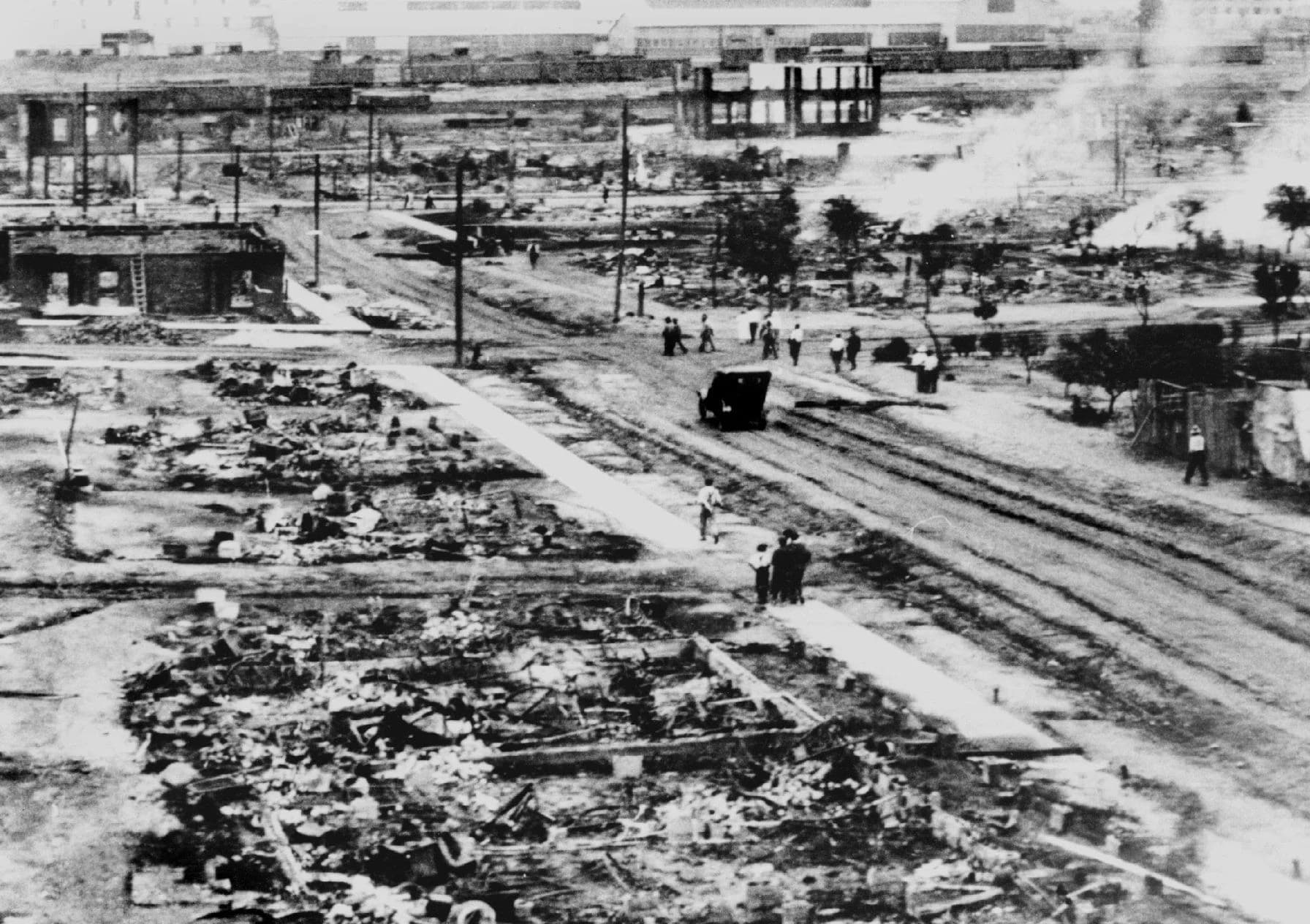
On the morning of 1 June 1921, thousands of white men entered Greenwood, the Black district of Tulsa, Oklahoma, and began to burn it. They looted houses and shops first, then set them on fire. By the time National Guard troops arrived at about quarter past nine, most of the district was already in flames.
Greenwood had been known as Black Wall Street, a name that described a real place rather than a slogan. About ten thousand Black residents lived there in a city of more than one hundred thousand people. The district had two newspapers, several churches, a library branch, and scores of Black-owned businesses. Within a day, much of that was gone.
The destruction did not come from nowhere. It followed an incident in a lift, a newspaper report, a gathering at a courthouse, and a night of gunfire. Each step is documented, and each step shows how quickly a local accusation could become a city-wide attack. The massacre lasted about eighteen hours, and its effects lasted for generations.
A Prosperous District in a Divided City
Tulsa in 1921 was a modern oil city, and Greenwood was its Black commercial centre. Segregation confined Black residents to the district, but inside it they built banks, hotels, theatres, restaurants, and professional practices. The wealth was real, and so was the resentment it drew from some white neighbours. Greenwood was not a slum that outsiders pitied, and that fact matters to the story.
The wider setting was a period of acute racial tension across the United States. The second Ku Klux Klan was growing rapidly, and attacks on Black communities were frequent. Black veterans returning from the First World War were determined to resist lynching and to defend their neighbourhoods. Tulsa was not an exception to that national pattern, and Greenwood was not an isolated target.
Booker Taliaferro Washington had visited the area in 1905, and Greenwood took its name from a district he had established in Tuskegee, Alabama. The district grew with the oil boom, and by 1921 it was the second largest Black community in Oklahoma. Its churches anchored its social life, and its newspapers reported its own news. That independence was part of its strength, and part of what made it a target.
An Accusation in the Drexel Building
On 30 May 1921, Dick Rowland, a nineteen-year-old Black shoeshiner, entered a lift in the Drexel Building in downtown Tulsa. Sarah Page, a twenty-one-year-old white elevator operator, was working there. What happened inside the lift is still uncertain, and the most common explanation is that Rowland stepped on Page's foot as he entered, causing her to scream. No reliable evidence supports a claim of assault, and the charge against Rowland was later dropped.
The Tulsa Tribune reported the incident on 31 May in terms that presented Rowland as a threat, and the report helped to draw a crowd. By half past seven that evening, hundreds of white men had gathered outside the Tulsa County Courthouse, where Rowland was held, demanding that the sheriff hand him over. The sheriff refused, and the crowd remained. The scene was a familiar one in that period, and everyone present understood what a lynching would mean.
Word of the gathering reached Greenwood, and at about nine in the evening a group of about twenty-five armed Black men, many of them veterans of the First World War, went to the courthouse and offered to help guard Rowland. They were turned away, and they returned to Greenwood. A second group, perhaps seventy-five men, went back at about ten in the evening after a false rumour reached Greenwood that white men were storming the courthouse.
Gunfire at the Courthouse
The second group found about fifteen hundred white men at the courthouse, some of them armed. A shot was fired, and the two sides exchanged gunfire until midnight. The Black men, greatly outnumbered, retreated to Greenwood.
Twelve people were dead by the end of that exchange, ten white and two Black. The confrontation that had begun as a defence of one young man had become a battle in the streets.
That night, white rioters began to invade Greenwood, killing men and burning and looting stores and homes. Some of the attackers had been deputised and given weapons by city officials, a fact established by the state commission. The violence was not only the work of an uncontrolled crowd, and the role of officials in arming it remains one of the most serious findings in the record. Martial law was declared, and thousands of Black residents were held under armed guard.
Among those killed was Jackson, a respected Black surgeon, who was shot after he surrendered to a group of white men. His death became one of the best documented murders of the massacre, because witnesses described it in detail. It showed that the attack was not limited to people carrying weapons, and that surrender offered no protection. The killing of a prominent professional also showed that status inside Greenwood counted for nothing outside it.
The Burning of Greenwood
Shortly before dawn on 1 June, thousands of armed white men gathered along the edges of Greenwood. When daybreak came, they poured into the district, looting homes and businesses and setting them on fire. Mount Zion Baptist Church, which had held its first service in a new building on 4 April 1921, was among the buildings destroyed. The church had cost ninety-two thousand dollars to build, and it was looted and reduced to rubble within two months of opening.
The Red Cross later estimated that 1,256 houses were burned and 215 others were looted but not torched. Other accounts put the total of homes and businesses destroyed at more than 1,400, across about thirty-five city blocks. About nine thousand to ten thousand people were left homeless, and more than eight hundred were admitted to hospitals. As many as six thousand Black residents were interned, many of them for several days, in camps and detention centres.
The official death toll recorded by the Oklahoma Bureau of Vital Statistics was 36 people, 26 Black and 10 white. The state commission confirmed 39 deaths from contemporary autopsy reports, death certificates, and other records, but reported estimates ranging from 39 to about 300. The Oklahoma Historical Society estimates approximately 75 to 100 deaths, possibly as many as 300. The true number is unknown, because bodies were buried in unmarked graves and records were lost or never made.
The Silence Afterward
For decades after 1921, the massacre was barely mentioned in local, state, or national histories. The Tulsa Tribune removed its 31 May front-page story from its bound volumes, and police and militia archives about the event went missing. There were no public ceremonies, no memorials for the dead, and no official effort to commemorate what had happened. Survivors rebuilt, but the city did not acknowledge what it had done.
Greenwood itself was rebuilt within about ten years by residents who chose to remain, despite opposition from many white officials and real estate interests. Mount Zion Baptist Church held services in its damaged basement for years, paid off its mortgage debt in 1942, and rebuilt on its original site in 1952. The rebuilding was a remarkable achievement, but many families never truly recovered, and segregation in the city increased. The new branch of the Ku Klux Klan in Oklahoma grew in strength in the years after the massacre.
No white Tulsan was ever arrested or tried for the attack on Greenwood, and no one was held legally responsible for the destruction. Insurance claims by Black property owners were largely rejected, and the city refused to pay compensation. The absence of accountability became part of the story, and it shaped how survivors and their descendants understood the event. The silence was not an accident of memory, and the commission later described it as a deliberate effort to cover the massacre up.
The Commission and the Reckoning
In 1997, the Oklahoma legislature authorised a bipartisan commission to investigate the massacre and formally document it. The Oklahoma Commission to Study the Tulsa Race Riot of 1921 published its final report on 28 February 2001. The report could not establish that the city had conspired with the mob, but it recommended a programme of reparations to survivors and their descendants. Its recommendations included direct payments, a scholarship fund, an economic development zone in Greenwood, and a memorial for the victims.
The commission's work also revived the search for the dead. Scholars used witness accounts and ground-penetrating radar to locate possible mass graves, including a site just outside Oaklawn Cemetery. Excavations in later years recovered remains that are still being examined, and the identification of victims remains unfinished work. The search matters because the official count of 36 was never credible to survivors, and because a grave is the one form of evidence that cannot be removed from a bound volume.
Public recognition followed slowly. John Hope Franklin Reconciliation Park opened in the Greenwood District in 2010, named for the historian whose father had survived the massacre. Greenwood Rising, a history centre honouring Black Wall Street and memorialising the victims, was established in 2021 by the centennial commission.
Oklahoma schools have been required to teach students about the massacre since 2002, and in 2020 it officially became part of the state school curriculum. These steps did not settle the question of reparations, which remains contested.
The Tulsa Race Massacre is now recognised as one of the worst incidents of racial violence in American history, and the reason it was forgotten is part of that history. A city burned a neighbourhood, lost the records, and taught its children nothing about it for eighty years. The commission, the park, the history centre, and the continuing search for graves have restored the facts, but they have not restored what was lost. Greenwood was rebuilt once by the people who lived there, and its story is now told because they refused to let it disappear.