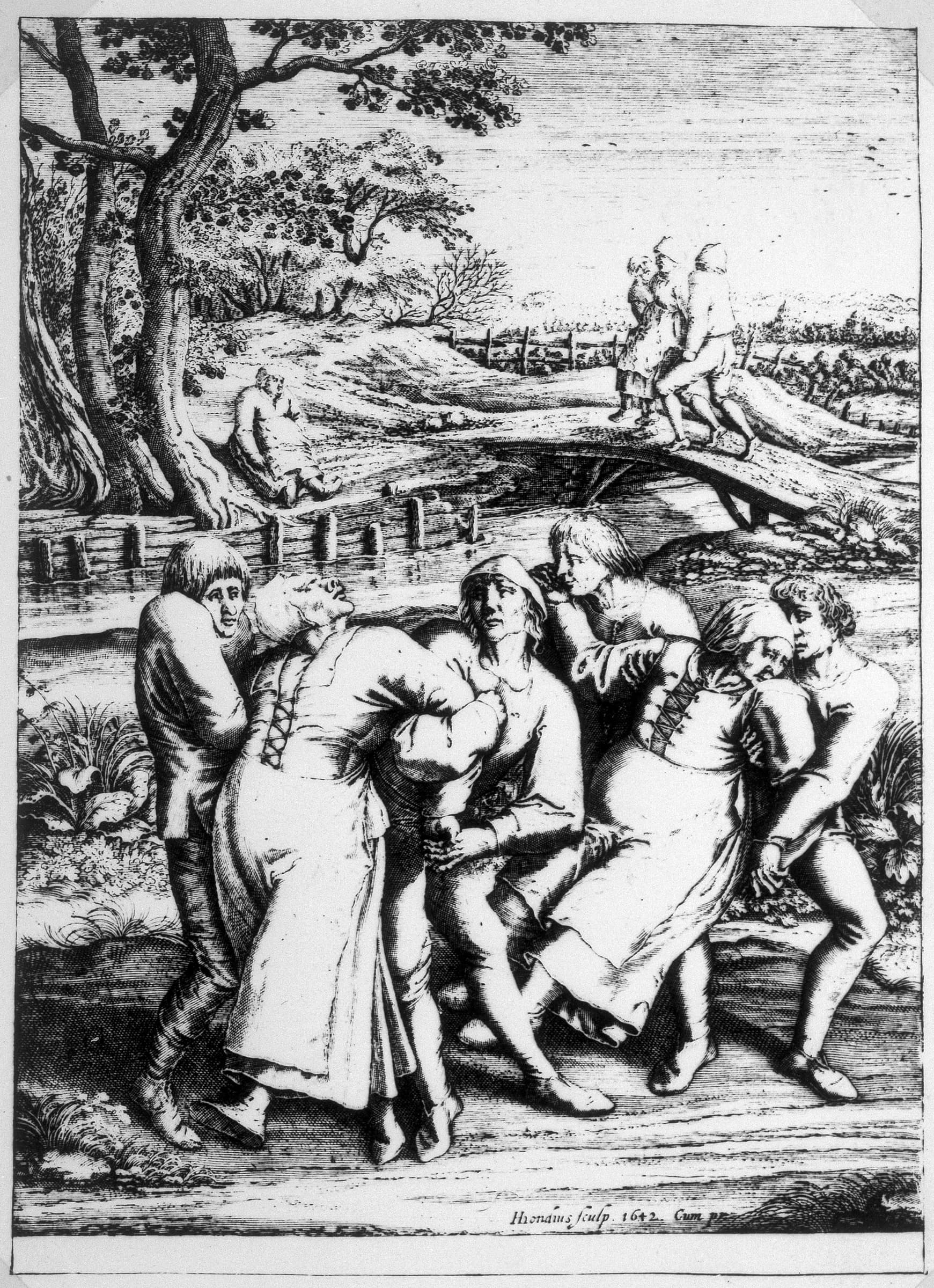
In July 1518, a woman stepped into a street in Strasbourg and began to dance. She had no musician with her, and there was no festival in progress. She danced through the day and into the night, rested, and started again. Within a week, dozens of her neighbours had joined her, and by the end of August the city council was writing letters about the dance, the physicians had issued a diagnosis, and public dancing had been banned.
Strasbourg was then a Free Imperial City of the Holy Roman Empire, a walled trading town on the Rhine in what is now north-eastern France. About twenty thousand people lived there, and the cathedral spire could be seen for miles. The city was rich, and it was frightened. The years before 1518 had brought famine, disease, and a disastrous harvest, and the people who began to dance were living in a city that already expected disaster.
The dancing lasted about two months, from July to September 1518. It ended as mysteriously as it began, when the remaining dancers were taken to a shrine to pray for absolution.
A Rich City in a Hard Decade
Strasbourg in 1518 was a busy trading city, and its fairs were visited by merchants from across Europe. One of its senior officials was Sebastian Brant, the humanist whose satire The Ship of Fools had been a bestseller across Europe since 1494. As city secretary, Brant kept the annals and signed the council's orders, and his pen is one of the main reasons anything reliable is known about the summer of 1518. The council minutes he kept are the closest thing to a contemporary record of the event.
The years before the outbreak had been brutal for ordinary people in Alsace. The historian John Waller lists serious famines around Strasbourg in 1492, 1502, and 1511, a scorching summer in 1516, and then a disastrous harvest in 1517. In August 1517, the city held a procession to pray against pestilence. By the summer of 1518, many of the poor were hungry, in debt, and frightened, and diseases including smallpox and syphilis were present in the city.
The dancing plague was not the first such outbreak in Europe, and it was probably the last of the major ones. More than ten outbreaks of dancing mania had occurred along the Rhine and Moselle rivers since 1374, and the 1518 event was the most thoroughly documented of them.
The First Dancer
The woman who started the dancing is usually called Frau Troffea, and the name comes from the physician Paracelsus, who wrote about the outbreak years later after he first came to Strasbourg in 1526. The Strasbourg historian Elisabeth Clementz, who transcribed and translated the surviving sources for the city's 2018 anniversary exhibition, points out that Troffea is almost certainly an invented name. The council records from the summer itself do not name the first dancer at all.
What the records do say is simpler. Around the feast of Saint Margaret in mid-July, Brant noted in his annals that a terrible illness, Saint Vitus dance, had spread so that about fifty people danced day and night. A chronicle written about thirty years later says the first dancer kept going for four days, that thirty-four people were dancing within a few days more, and that by the fourth week there were more than two hundred.
Later chronicles put the total at 400, and that figure is the one most often repeated today. The difference between fifty and 400 is the difference between a contemporary record and a story told decades later.
The dancers' movements were described as spasmodic, with many convulsions, and their bodies were left drenched in sweat. The first dancer was sent in a wagon about thirty miles away to Saverne, where she might be cured at the shrine of Vitus, the saint who it was believed had cursed her. Some of those who had witnessed her performance had already begun to mimic her, and within days more than thirty people were in motion.
The Physicians and the Cure That Made It Worse
The city did not treat the dancers as witches or heretics, and that fact is important. A special commission consulted both the church and the city's physicians, and the doctors gave a confident answer: this was a natural disease caused by hot blood.
The response of the authorities was not to bleed the dancers or to give them cooling diets, as humoral theory might have suggested. Instead, they prescribed more dancing. They cleared two guildhalls and the outdoor grain market, and they had a wooden stage constructed opposite the horse fair.
To those places the dancers were taken so they could dance freely and without interruption. The victims would only recover their minds, the authorities said, if they persisted both day and night with their frantic movements.
To help the supposed cure, the authorities paid for musicians and professional dancers to keep the afflicted moving. Every time the sick flagged, fainted, stumbled, or slowed, the musicians raised the tempo of their playing, and hired dancers held them firm and quickened their pace. It was a hot summer, and the dancers were in the full glare of the sun.
How Many Died
The question of how many people died is the most disputed part of the story, and it is the part where the popular version is least reliable. Some sources claim that for a period the plague killed around fifteen people per day, but the sources of the city of Strasbourg at the time of the events did not mention the number of deaths, or even if there were fatalities. The main source for the claim of fifteen deaths per day is John Waller, who cites later accounts of the events, not the council records of 1518.
A seventeenth-century chronicle by the Strasbourg jurist Johann Schilter quotes a now lost manuscript poem that describes hundreds dancing day and night, and says that many of them ate nothing until at last the sickness left them. Another chronicle from 1636 relates a less happy ending, and says that men in their madness began to dance day and night until finally they fell down unconscious and succumbed to death. Daniel Specklin, a Strasbourg architect who compiled records of the outbreak in his Collectanea, wrote that many danced to death.
The honest position is that people did die, and that the number is unknown. The council records show that the authorities changed course after deaths began, and that change is itself evidence that the dancing was killing people. The figure of fifteen per day may be exaggerated, and the figure of 400 dancers may also be exaggerated, but the core of the story is not in doubt: hundreds of people danced involuntarily for days and weeks, and some of them died. The article does not present either figure as an established fact.
Prayer, Penance, and the End
Only after those with weak hearts or prone to strokes began to die did the governors rethink their strategy. They decided that the dance had nothing to do with overheated blood, and they now saw it as a curse sent down by Saint Vitus. They banned dancing, except for some people in the privacy of their own homes, and they instituted a programme of penance and prayer. No one was permitted to dance in the city or its surrounding area until Saint Michael's Day, the end of September, on pain of a fine of thirty shillings.
The council had a High Mass celebrated in the Chapel of Our Lady, and the dancers were sent from the hospital to the shrine of Saint Vitus at Saverne, about thirty miles away in the hills. There, at a cave chapel, they prayed for absolution. Contemporary accounts say they wore red shoes that had been sprinkled with holy water, and had painted crosses on the tops and soles.
The mania began to abate in early September, and by the end of the month it was over. The dancing plague ultimately ceased in September, when the remaining dancers were led to the mountaintop chapel to pray.
The ending is as revealing as the beginning. The city had tried a medical cure, and it had made things worse. It then tried a religious cure, and the dancing stopped.
That does not prove that prayer cured the dancers, and the article does not claim that it did. It proves that the city changed its explanation, and that the change coincided with the end of the outbreak.
What Caused the Dancing
Modern explanations for the dancing plague fall into three groups, and none of them is settled. The first is ergot poisoning, the theory that the dancers had eaten bread made from rye flour contaminated with the fungal disease ergot, which is known to produce convulsions.
The second is the theory of the American sociologist Robert Bartholomew, who suggested that the dancers were adherents of heretical sects, dancing to attract divine favour. The third, and the most widely accepted, is the theory of John Waller, who argues in several papers and in his book A Time to Dance, a Time to Die that the dancing was a form of mass psychogenic disorder. Such outbreaks take place under circumstances of extreme stress, and they generally take form based on local fears. In Strasbourg, Waller cites the famines, the diseases, and the local belief that those who failed to propitiate Saint Vitus would be cursed by being forced to dance.
Waller's theory fits the evidence better than the others, because it explains why the dancing spread, why it took the form it did, and why it happened in a hungry summer in a city that feared Saint Vitus. The article presents his theory as the most widely accepted explanation, not as a proven fact, and it presents ergot poisoning and the sect theory as alternatives that have been proposed. The cause of the dancing plague remains a matter of debate, and the debate is part of the story.
The dancing plague of 1518 is remembered because it is strange, but its strangeness is not the whole story. The records from the summer itself are thin, and the later chronicles filled the gaps with numbers that cannot be verified.
What survives is enough to show that hundreds of people danced, that some of them died, and that a frightened city did its best with the knowledge it had. That is a smaller story than the legend, and it is a more honest one.