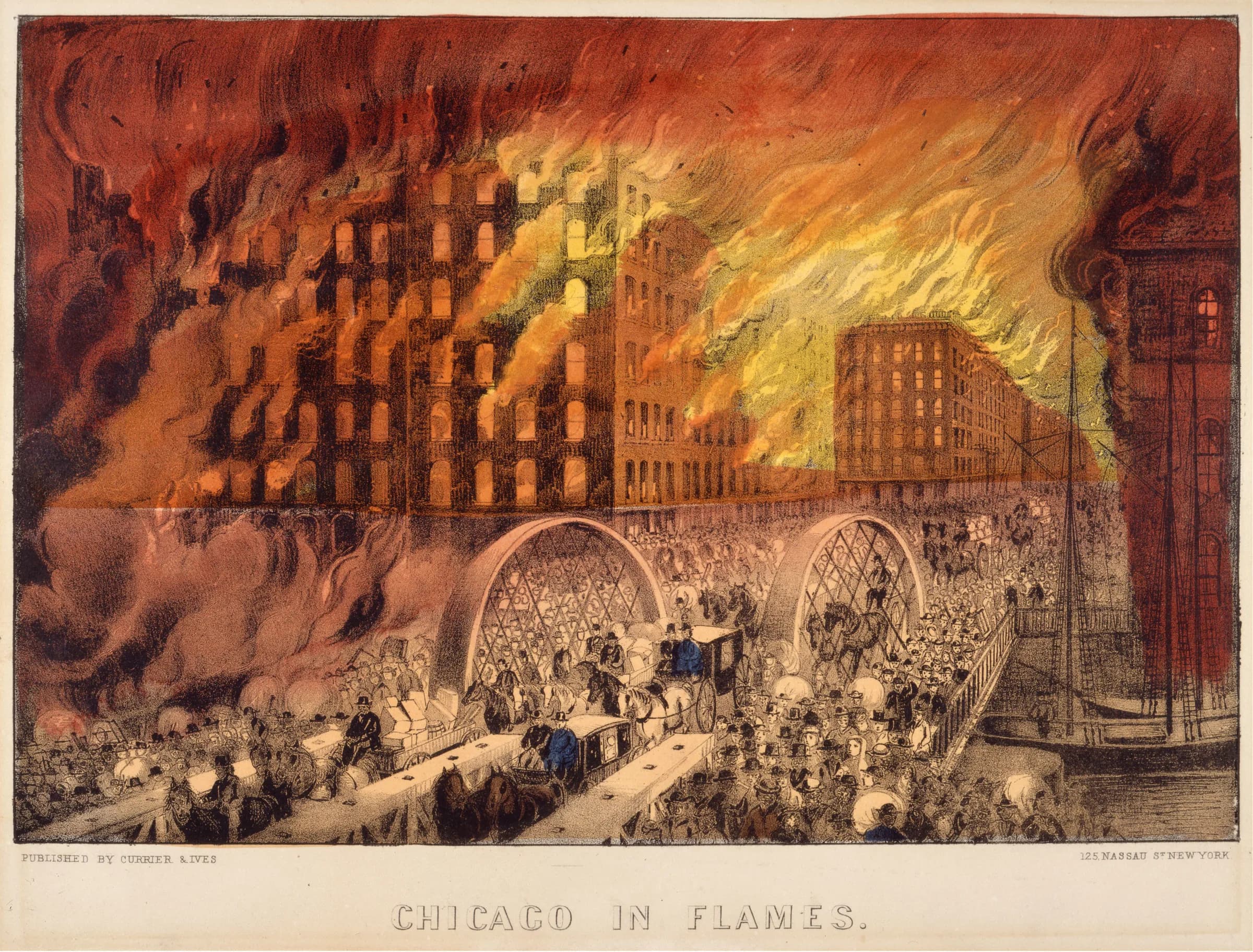
On the evening of Sunday 8 October 1871, a fire began in or near a small barn behind a cottage at 137 DeKoven Street, on the West Side of Chicago. The barn belonged to Patrick and Catherine O'Leary, Irish immigrants. Within minutes, the fire was out of control. A strong wind from the south-west carried the flames and burning debris from block to block, and by the next morning the centre of the city was burning.
The fire burned for about thirty hours, until rain helped to end it in the early hours of Tuesday 10 October. About 300 people were killed, more than 100,000 residents were left homeless, and about 17,000 buildings were destroyed across roughly 3.3 square miles. The damage was estimated at about 200 million dollars, about a third of the city's property value. Chicago was one of the fastest growing cities in the world, and in a day and a half it lost its business district, its government buildings, its newspapers, and its hotels.
The most famous detail of the fire is also the most false. The story that Catherine O'Leary's cow kicked over a lantern and started the blaze was invented by a journalist, and the city council formally cleared O'Leary of blame in 1997. The real causes were a dry summer, a city built almost entirely of wood, weak building codes, and a fire department that was already exhausted. The cow was a story, and the wood was the cause.
A City Built to Burn
Chicago in 1871 was a boomtown of more than 300,000 people, and it was built almost entirely of wood. Not only were buildings made of wood, but there were wooden streets, raised wooden sidewalks, and wooden fences everywhere, including in the O'Learys' neighbourhood. Lumber was plentiful and cheap in the American Midwest, and Chicago had grown so fast that it had built itself from the nearest material.
The summer and autumn of 1871 were two of the driest and hottest seasons in Chicago's history. From early July to the outbreak of the fire in October, less than three inches of rain fell on the city, and most of that came in brief showers. In the first week of October alone, Chicago firefighters put out nearly thirty fires, including a fire on the night of 7 October that burned a planing mill and four blocks of buildings.
The city had building rules on paper, but they were minimal, inconsistent, and loosely enforced. Fire limits existed, but they were drawn small and policed loosely, because growth was the priority and regulation slowed growth down. There were minimal building codes, no fire safety regulations, and no city officials to enforce them. One historian has written that it was as if Chicagoans had purposely intended to construct a city they wished to burn down, and then voted for aldermen and mayors who did little to stop that from happening.
The Night the Fire Began
The fire began at about half past eight or about nine in the evening on 8 October, and the exact time is one of several details on which the sources differ. What the sources agree on is the place: the barn behind the O'Leary cottage on DeKoven Street, near Halsted Street and what is now Roosevelt Road. The O'Learys swore under oath that they were asleep when the fire began, and Catherine told officials that she had last visited the barn hours earlier and had not carried a lamp. City officials never determined the cause of the blaze.
Several theories have been offered over the years. One account, from Daniel Sullivan, known as Peg-Leg Sullivan, said that he had accidentally knocked over a lantern while looking for beer for a party. Another said that a group of men gambling inside the barn had knocked over a lantern.
Still others suggested spontaneous combustion, or a connection with other fires in the Midwest that day, including the Peshtigo Fire in Wisconsin, which killed more than 1,200 people on the same night. The nine-day Police and Fire Department inquiry into the cause was inconclusive, and no theory has ever been proved.
What is certain is that the fire spread with extraordinary speed. Fanned by south-westerly winds, it grew through the neighbourhood, consuming cottages and barns filled with hay and grain saved for the coming winter. Burning embers landed on furniture factories and grain storage elevators, and soon the blaze was consuming everything in its path.
The City Without Water
The fire companies tried their best to contain the blaze, but they were already exhausted. On the night of 7 October, a fire in a planing mill had engaged nearly half of the city's 185 firemen, and the Great Fire began the next night before they had recovered. The city's new telegraph-based fire alarm system was in place, but miscommunication delayed the arrival of firefighters and equipment. By the time the fire was beyond the O'Leary neighbourhood, it was too large for any fire department of that period to stop.
One of the first casualties in the south division was the gasworks, where a massive fuel tank exploded and the city's gas lights went out. Then the city's waterworks were destroyed, and the battle was over. Without water, firefighters could only watch the fire advance.
The fire crossed the Chicago River, destroyed the business district, and swept northward through neighbourhoods of the wealthy and the poor alike. Theatres, churches, hotels, department stores, newspapers, and government offices all burned, along with thousands of homes.
The fire finally died out when rain began on Monday evening, extinguishing the last flames in the early hours of Tuesday. The wall of flame had levelled a corridor about four miles long and more than a mile wide, covering more than two thousand acres and twenty-eight miles of streets. The Chicago Tribune, in its edition of 11 October, described a fire in a barn on the West Side as the insignificant cause of a conflagration that had swept out of existence hundreds of millions of property, reduced thousands to poverty, and covered the prairies with homeless people. Martial law was declared on 11 October, and it lasted for several weeks.
The Cow That Never Did It
Even before the flames were completely extinguished, newspaper accounts had fixed the blame on the O'Leary family. On 9 October 1871, as the fire was still burning, the Chicago Evening Journal reported, without proof, that the blaze began with a cow kicking over a lamp in a stable in which a woman was milking. The story spread quickly, and it stuck.
Catherine O'Leary was caricatured in the press as a callous hag, and she became a recluse after the fire. She died in 1895, still blamed for a disaster she did not cause.
The cow story was invented. In 1893, Chicago journalist Michael Ahern admitted that he had invented the cow-and-lantern tale to make his copy more colourful. The official inquiry of 1871 had never established the cause, and no solid evidence has ever linked Catherine O'Leary or her cow to the fire.
The O'Learys were Irish immigrants, and reporters, politicians, and officials seized the opportunity to make scapegoats of them rather than place the blame on the city's substandard housing codes or on an overworked and understaffed fire department. The blame was easier to assign to one family than to a whole city.
In 1997, the Chicago City Council formally exonerated Catherine O'Leary of any responsibility for the fire, following research by historian Richard Bales. The resolution came 126 years after the fire, and it corrected a record that had been wrong from the first day. Bales's book, The Great Chicago Fire and the Myth of Mrs O'Leary's Cow, showed that the legend had no basis in the evidence. The exoneration did not undo the damage to O'Leary's reputation in her lifetime, but it put the historical record straight, and it is now the accepted position of the city itself.
Rebuilding a Different City
Chicago rebuilt so quickly that within four years there were no traces of the fire to be seen. The business community began rebuilding immediately, and between 1872 and 1879 more than ten thousand building permits were issued. The city retained its infrastructure, including the South Side stockyards, the wharves, lumberyards, and mills along the Chicago River, two out of three grain elevators, and the railroad tracks that linked it with both coasts. Above all, it retained its position as a trading and financial centre, and that position drove the rebuilding.
The rebuilding was not the same city built again. After 1871, Chicago dramatically expanded its fire limits, banning new wood-frame construction across a far larger district. New buildings in the burned zone went up in brick and stone, and when a second major fire in 1874 tore through what the first one had missed, Chicago hardened its rules again, requiring genuinely fire-resistant construction rather than stone shells with wooden frames.
The new rules were unaffordable to many immigrant families, most of whom had lived in wooden buildings, and they were forced to relocate away from the city centre. Irish residents moved closer to the stockyards, and Swedish residents moved to Andersonville, which was still farmland.
The new building codes also changed architecture. Because insurance companies and city governments mandated fire-resistant construction, architects began experimenting with steel, and by 1885 the Home Insurance Building, the world's first modern skyscraper, was completed. By 1890, Chicago's population had tripled to one million, and the city was selected by the United States House of Representatives to host the 1893 World's Columbian Exposition.
The fire had destroyed a city, and the rebuilding had made a different and larger one. The disaster also shaped building codes across the United States, and in 1905 the National Board of Fire Underwriters published its Recommended National Building Code, the first model building code in the country.
The Great Chicago Fire is remembered for a cow that never kicked a lantern, and for a city that rose from its ashes. The first part of that memory is false, and the second part is true but incomplete. Chicago rose again because it had railroads, stockyards, and a trading position that the fire could not destroy, and because it rebuilt with new rules that made the next fire less likely.
It also rose again on the backs of the immigrant families who were pushed out of the centre by those same rules, and on the reputation of a woman who was blamed for a fire she did not start. The fire is a story about wood and wind and drought, and it is also a story about who a city chooses to blame.