At about half past twelve on 15 January 1919, a steel tank on Commercial Street in the North End of Boston burst open. Inside it were about 2.3 million gallons of molasses, weighing about 13,000 short tons. The liquid came out as a wave, and witnesses described a roar, a rumbling sound, and then a crash like gunfire as the rivets failed. Within seconds, the streets around the tank were under a moving wall of syrup.
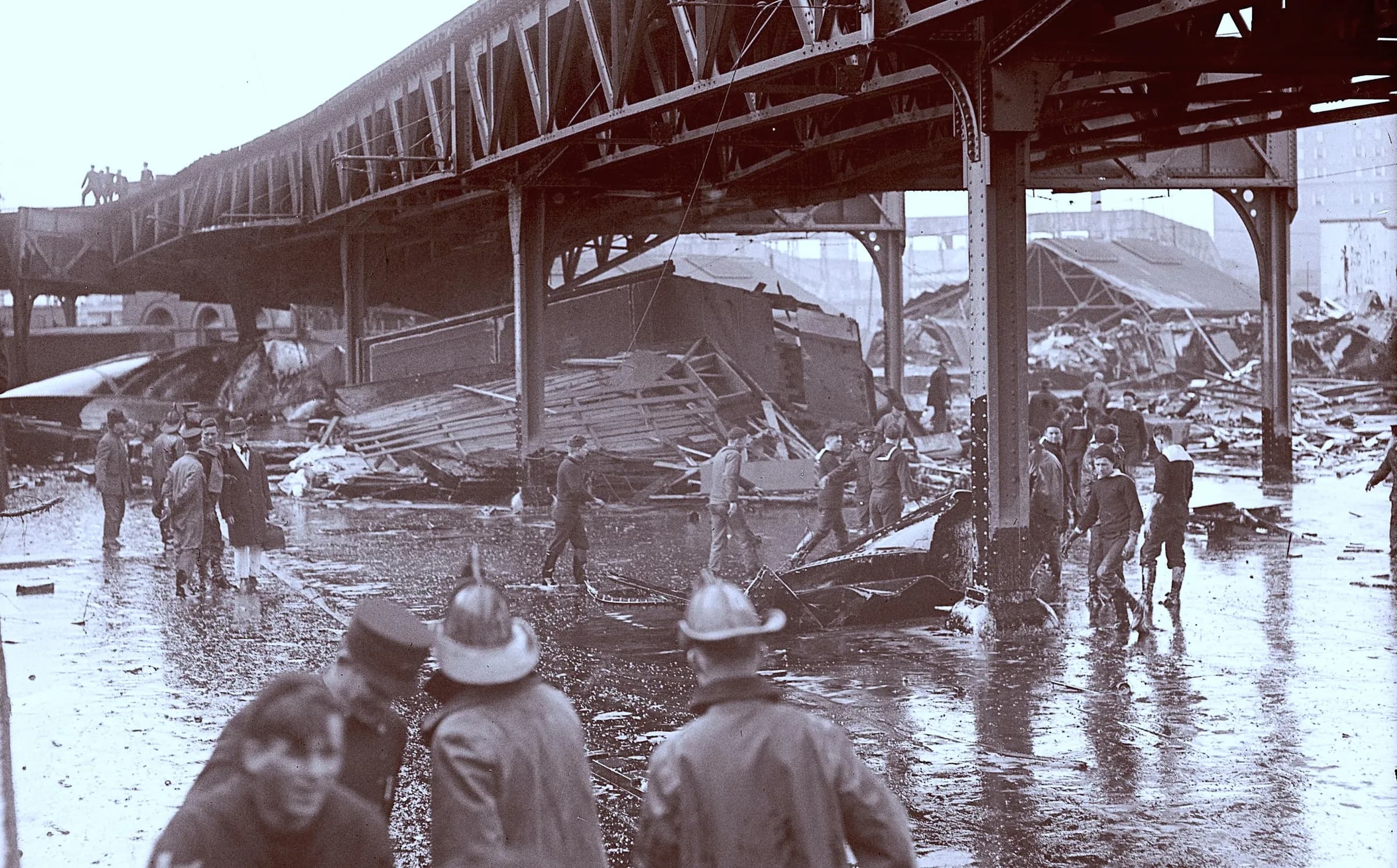
The wave moved at an estimated 35 miles per hour, faster than a person could run. It flattened buildings, tore the girders from an elevated railway, and lifted a streetcar from its track. Twenty-one people were killed and about 150 were injured.
Some were crushed, and some were suffocated by the molasses itself. The disaster lasted minutes, and the cleaning took weeks.
The flood sounds like a freak accident, and for years it was told that way. The record tells a different story. The tank had leaked from the day it was first filled, it had never been properly tested, and the company that owned it had painted it brown so the leaks would be harder to see. The flood was not a mystery, and it was not an act of sabotage.
Why Boston Had a Tank Full of Molasses
Molasses in 1919 was not only a food ingredient, and that fact explains why so much of it was stored in one place. It could be fermented to produce ethanol, the active ingredient in alcoholic drinks and a key component in munitions. During the First World War, demand for industrial alcohol was high, and the Purity Distilling Company built its tank to supply that trade. The company was bought by the United States Industrial Alcohol Company in 1917, and the tank continued in use.
The tank stood at 529 Commercial Street, beside Boston Harbor in the North End, where ships could unload molasses directly. It was 50 feet tall and 90 feet across, and it could hold up to 2.5 million gallons. Molasses arrived by ship from the Caribbean, including a shipment from Puerto Rico that had filled the tank almost to capacity a few days before the disaster. From the tank, molasses was sent by pipeline to the Purity ethanol plant in Cambridge, Massachusetts.
The North End around the tank was one of the most crowded neighbourhoods in Boston. Tall brick tenements housed many Italian immigrant families, and the streets were narrow. A firehouse, a paving department yard, a police station, and the offices of the Purity company stood within a short distance of the tank. The people who lived and worked there had no reason to think that the largest structure in their street could fail, and no warning when it did.
A Tank Built in a Hurry
The tank was built in 1915, in a hurry, because of the war. The project was overseen by Arthur Jell, an assistant treasurer of the company who had no engineering background. By his own later admission, he could not read a blueprint. No architect or engineer inspected the design, and the only test before the tank was put into service was filling it with about six inches of water, rather than running a full structural pressure test.
The tank leaked from the start. Brownish-red stains ran down its riveted seams, in sharp contrast to the original blue paint, and neighbourhood children came with pails to catch the drips. The company's answer was not a repair.
It painted the tank brown, so the leaks would be harder to see. The tank was never emptied, never rebuilt, and never properly inspected in the four years before it failed.
Later analysis found that the steel was about half as thick as it should have been for a tank of that size, and that it contained too little manganese, which left it brittle in cold weather. A 2014 structural engineering analysis by Ronald Mayville reached that conclusion, and the American Physical Society reported it in its account of the disaster. The failure appears to have begun at a manhole cover near the base of the tank, where a fatigue crack grew at a rivet hole until it reached a critical size. Fermentation inside the tank may also have raised the pressure, but the central finding is simpler: the tank was not strong enough for its load.
The Flood
The day of the disaster was cold, and the molasses in the tank was warm, because a fresh load had been pumped in two days earlier and had not yet cooled. Warm molasses flows quickly, and cold molasses thickens. That difference shaped what happened next, and it shaped who survived. The wave that left the tank was fast, and as it cooled in the January air it became heavier and harder to escape.
Reports of the height of the wave differ widely, from about 8 feet to 40 feet, and the most commonly cited figures are 15 to 25 feet. Other sources give lower figures. The disagreement reflects the chaos of the moment and the difficulty of measuring a moving wall of liquid. What the sources agree on is the speed, about 35 miles per hour, and the force, enough to rip buildings from their foundations.
People caught in the flow struggled waist-deep in molasses, and contemporary newspaper accounts described people being picked up and hurled several feet, crushed, and drowned in the syrup. Horses died in the streets, trapped in the molasses where they fell. Firefighters who reached the scene found that they could not simply wash the molasses away, because fresh water from their hoses did not dissolve it quickly. Rescue was slow, and the cold made the molasses thicker as the afternoon went on.
The cleanup took more than two weeks, and local residents reported for decades afterwards that the area still smelled of molasses on hot summer days. It took over 87,000 hours of work to remove the molasses from the cobblestone streets, theatres, businesses, automobiles, and homes.
The Company Blamed Saboteurs
The United States Industrial Alcohol Company moved quickly to explain the disaster, and its explanation pointed away from its own tank. The company claimed that anarchists had blown the tank up, because some of the alcohol it produced was used in making munitions. It pointed to a background of bombings blamed on Italian anarchist groups, and to a telephoned threat received in 1918. The claim was convenient, because it blamed strangers, and it pointed at the very neighbourhood that had just been hit.
Residents did not accept the explanation, and 119 of them brought a combined legal action, one of the first class actions in Massachusetts. The court appointed an auditor, Hugh Ogden, to hear the evidence. The hearings ran for years, and experts were called in numbers rarely seen in a courtroom at that time, to explain steel, rivets, and pressure.
One account counts about 1,000 witnesses, and another counts about 3,000. Closing arguments alone took eleven weeks, and the case drew more than 1,500 exhibits.
In April 1925, Ogden rejected the sabotage claim and found the company liable. The tank, he found, had simply not been strong enough for its load, and the company had been negligent in building and maintaining it. The company paid about 600,000 dollars in out-of-court settlements, and families of the dead received about 7,000 dollars each.
No one was criminally convicted. The case became one of the longest and most expensive civil actions in Massachusetts history, and it set a precedent for the use of expert evidence in industrial accident cases.
What the Cold Revealed
The legal case answered the question of responsibility, but it did not fully explain why so many people died. A wave of liquid, even a fast one, does not usually kill twenty-one people in a city street. The answer came almost a century later, from a study at Harvard University. In 2016, researchers Nicole Sharp, Jordan Kennedy, and Shmuel Rubinstein presented work at the American Physical Society Division of Fluid Dynamics meeting that tested the flood with a scale model.
The Harvard team ran cold corn syrup through a scale model of the North End in a refrigerated room, to mimic January 1919 conditions. They found that cooling molasses from 10 degrees Celsius to zero triples its thickness, and that the molasses thickened as it cooled mid-surge into a heavy, cement-like mass. Victims who might have survived the first impact were pinned in place, and rescuers could not pull them out. About half of the dead suffocated, and the researchers concluded that in spring or summer the same failure might have killed almost nobody.
The finding does not change the cause of the disaster, and it does not excuse the company. It explains the mechanism of death, and it explains why the cold mattered as much as the wave. The tank failed because it was badly built, and the victims died because the molasses cooled as it spread. Both facts belong in the same account, and neither one replaces the other.
A Case That Changed the Rules
The molasses flood is remembered in Boston, and a plaque near the site records the names of the twenty-one people who died. The case helped to lead to new rules requiring engineers to sign off on their plans, and those rules spread from Massachusetts to other states. The principle is now ordinary: a structure that can kill people must be designed, tested, and inspected by someone qualified to judge it. In 1919, that principle was not yet law, and the tank on Commercial Street was the price of learning it.
The story also matters because of how it was told. The company blamed anarchists, and the blame fell on the immigrant neighbourhood that had suffered most. The court case took six years, and the settlement was modest.
The victims were working people, many of them Italian immigrants, and their deaths were treated as a curiosity long after the legal case was closed. Boston still marks the anniversary, and the names of the dead are read aloud at commemorations. The lesson of the disaster is not that molasses is dangerous, and it is not that accidents happen.
It is that a company can see a warning for years, hide it with paint, and call the result an act of God or an act of sabotage. The court found otherwise, and the record has kept that finding ever since.