On 24 June 1948, the Soviet Union cut off all road, rail, and canal access to West Berlin. The city lay about one hundred miles inside the Soviet occupation zone of Germany, and its two million residents suddenly had no way to receive food, coal, or fuel by land. The Western Allies had three choices: abandon the city, force their way through by land and risk war, or supply it by air. They chose the air, and no one knew whether it would work.
Two days later, on 26 June 1948, the first American C-47 transport aircraft flew into Berlin with 80 tons of cargo, mainly powdered milk, flour, and medicine. The Americans called the operation Operation Vittles, and the British called it Operation Plainfare. Over the next fifteen months, the Allies delivered more than 2.3 million tons of supplies on 278,228 flights, and the city did not fall.
The airlift is remembered as a triumph of logistics, and it was, but it was also a gamble that nearly failed. The city needed about 3,475 tons of supplies a day, and in the first weeks the airlift delivered far less. It succeeded because a commander imposed a rigid system, because larger aircraft arrived, and because Berliners endured a winter with less coal and less food than they needed. The planes kept flying, and the blockade was lifted on 12 May 1949.
A City Cut Off
Berlin after the Second World War was divided into four occupation zones, even though the city lay deep inside the Soviet zone. The United States, the United Kingdom, and France controlled the western parts of the city, while Soviet troops controlled the eastern sector. The arrangement had been agreed in 1945, and it included three twenty-mile-wide air corridors connecting Berlin to West Germany. Those corridors, agreed by the Allied Control Council on 30 November 1945, became the lifeline of the city in 1948.
The immediate cause of the blockade was a dispute over currency. In June 1948, the Western Allies introduced a new currency in their zones of Germany, and the Soviet Union responded by cutting off surface access to West Berlin. The Soviet aim was to force the Western Allies out of the city, and to bring the whole of Berlin under Soviet control. The blockade was one of the first major international crises of the Cold War, and it tested whether the Western Allies would defend a city they could not reach by land.
West Berlin had only about thirty-five days of food and forty-five days of coal remaining when the blockade began. The city needed at least 2,000 tons of supplies a day for the most basic subsistence, and military planners calculated that 1,534 tons of food and 3,475 tons of coal and fuel would be required daily. The United States Air Force in Europe had only about one hundred Douglas C-47 aircraft, each with a cargo capacity of about three tons, and two of the larger C-54 aircraft.
The First Weeks
The first flights were small and improvised. On 26 June 1948, 32 C-47 aircraft flew into Berlin with 80 tons of cargo. The first British aircraft involved in the operation launched on 28 June.
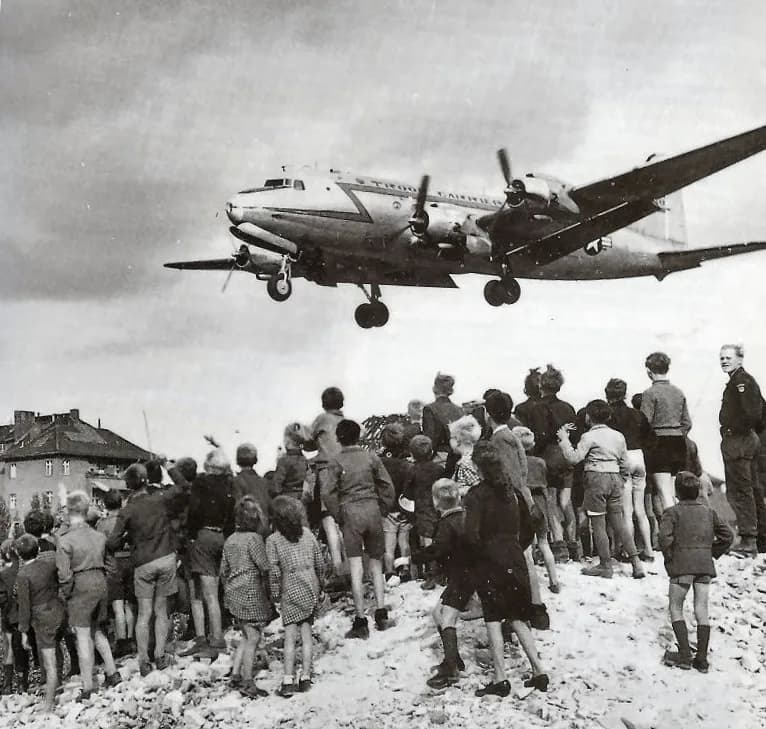
The C-47, a militarised version of the DC-3, was rated for a combat load of less than four tons, and it could not carry enough to feed two million people. The change came with the Douglas C-54 Skymaster, a four-engine aircraft capable of carrying ten tons with ease. The first Skymasters arrived at Rhein-Main Air Base in Germany on 28 June, and as soon as they landed they were loaded and sent to Berlin. By the end of the next week, 300 C-54 aircraft had arrived from the Panama Canal Zone, Alabama, Hawaii, and Texas.
The daily tonnage rose dramatically, but the Skymaster, designed for long-distance missions, suffered under the brutal regimen of short hops at maximum weight. In August 1948, Major General William Tunner took command of the Combined Airlift Task Force. Tunner was a veteran of the aerial supply line over the Himalayas during the Second World War, and he brought the same discipline to Berlin.
He imposed a rigid system: aircraft flew at three-minute intervals, at fixed altitudes and on fixed routes, with no stacking and no deviation. Air traffic controllers guided each aircraft on a straight approach, and planes were flown at fifteen-minute intervals at each five-hundred-foot level between five thousand and seven thousand feet.
A Plane Every Three Minutes
At the height of the airlift, one plane reached West Berlin every thirty seconds, according to one account, and one aircraft landed every three minutes at each airfield under Tunner's system. The difference reflects different ways of counting: the thirty-second figure counts arrivals across all three Berlin airfields, while the three-minute figure counts the interval at a single airfield. A sophisticated radio, radar, and ground-controlled approach system enabled flights to continue through fog, cloud, rain, and ice.
Tempelhof was the principal Berlin airfield used by the operation. Built in 1923 as a grass field on a former parade ground in the heart of the city, it had three modern concrete runways by November 1948, built to withstand the constant pounding of the transport planes. Royal Air Force aircraft landed at Gatow in the British sector, and Tegel Airport was constructed in the French sector in just sixty days, by Berliners working alongside French engineers.
The three airfields together handled the whole of the airlift, and their turnaround times were remarkably low. The cargo the city needed was not only food. Nearly two-thirds of the total tonnage was coal, which Berlin needed to heat homes and to power its electricity plants through the winter. The cargo also included medical supplies, soap, newsprint, and even steamrollers and power plant machinery.
The airlift delivered more than food, and the coal was the hardest part of the operation, because it was heavy, bulky, and dirty, and it cut deeply into the space inside the aircraft. The winter of 1948 to 1949 was the hardest test, and the city endured it on rations that were lower than peacetime levels.
The Candy Bomber
The most famous part of the airlift was also the smallest. At Tempelhof Airport, pilot Gail Halvorsen, a twenty-seven-year-old transport pilot, met some Berlin children who stood at the fences to watch the planes. He gave them the chocolate and chewing gum he had in his pockets, and he promised to drop more on his next flight.
He began dropping handkerchief parachutes containing chocolate and chewing gum from his aircraft, and the drops became known as Operation Little Vittles. The aircraft were called raisin bombers by the children, and Halvorsen became known as the Candy Bomber.
Operation Little Vittles ultimately dropped more than three tons of candy in more than 250,000 miniature parachutes, according to the Congressional Record, and 23 tons of treats according to another account. The difference reflects different counting methods, and the article gives both figures here rather than in the body. The candy was a tiny fraction of the total tonnage, but it had an effect far beyond its weight.
It convinced Berliners that the Allies would sustain the city, and it convinced the world that the airlift was a humanitarian operation, not only a military one. Tunner, who had first summoned Halvorsen for a reprimand, understood that, and he encouraged him to expand the drops.
The candy drops were not the only sign of goodwill, and they were not the reason the airlift succeeded. The planes carried coal, and the coal kept Berlin warm.
Easter Sunday and the End
On Easter Sunday, 17 April 1949, Tunner ordered a maximum effort to prove that the airlift could meet the city's needs. Flying around the clock with every aircraft available, the airlift delivered 12,941 tons of cargo in 1,398 flights, setting a record for a single day. The figure is given as 13,000 tons in rounded accounts, and the article uses the precise figure of 12,941 tons.
The Easter Parade, as it was called, delivered the equivalent of 600 railroad cars of coal, and it showed the Soviet Union that the airlift would not fail. The operation had reached a tempo that no blockade could outlast.
On 12 May 1949, the Soviet Union lifted the blockade, due in part to economic issues in East Berlin and in part to the success of the airlift. The airlift did not end on that day. The Americans and British continued to supply the city by air for several months, because they were worried that the Soviets would resume the blockade.
The airlift officially ended on 30 September 1949, after fifteen months. In total, the United States Air Force had delivered 1,783,573 tons and the Royal Air Force 541,937 tons, for a total of 2,334,374 tons on 278,228 flights. American C-47 and C-54 aircraft together flew over 92 million miles in the process, almost the distance from Earth to the Sun.
The airlift had a cost. Seventeen American and eight British aircraft crashed during the operation, according to one count, and seventeen American and seven British according to another. A total of 101 fatalities were recorded as a result of the operation, including forty Britons and thirty-one Americans, according to one source.
Other sources give 65 pilots, crew members, and civilian workers, and 74 pilots, crew, and ground personnel. The article gives the range in the verification notes, and does not present any single figure as certain. The dead included aircrew, ground personnel, and German civilians, and their deaths are part of the cost of the operation.
The Berlin Airlift marked the first use of air power to provide humanitarian assistance and to win a strategic victory without direct combat, and it began to repair the relationship between the Western Allies and the German people. It also advanced the art of air traffic control by ten years, according to Robert Garrett, an air safety investigator who observed the operation, and it laid the foundations for modern air cargo operations. The aircraft specifically designed for air cargo that followed, including the Lockheed C-130 Hercules, the C-141 Starlifter, the C-5 Galaxy, and the Boeing C-17 Globemaster, were designed based on the lessons of Operation Vittles. Berlin remained under Western control, and the Cold War had its first crisis, and its first Western victory, without a shot being fired.