The Photographs That Changed Everything
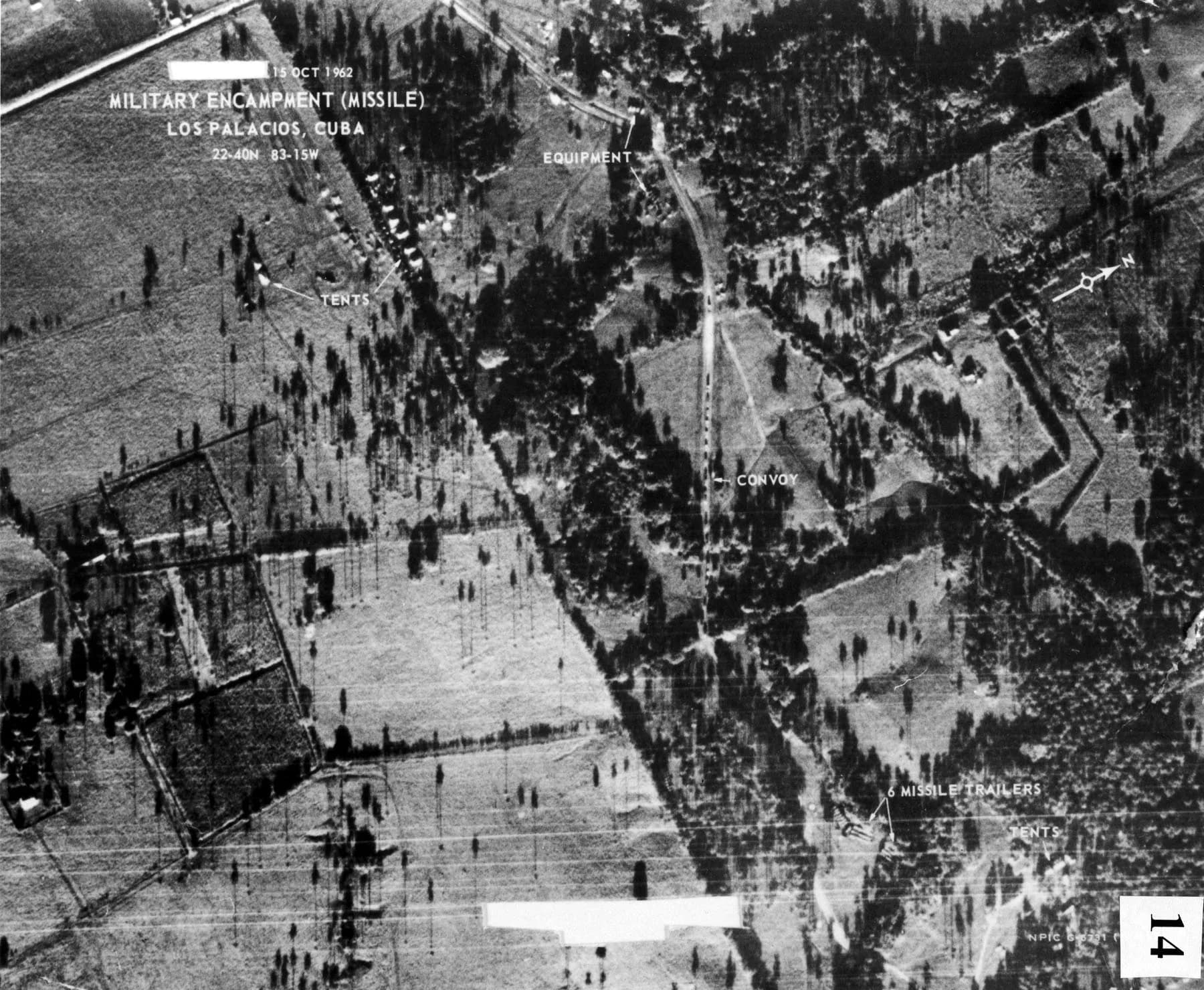
On the morning of Sunday 14 October 1962, an American U-2 spy plane flew over Cuba in clear weather and photographed something the United States had suspected for months but could not prove. The photographs showed Soviet medium-range nuclear missiles being installed on the island, ninety miles from the coast of Florida. The missiles could reach major American cities, and some could be ready to fire within days.
Two days later, on the morning of 16 October, National Security Adviser McGeorge Bundy showed the photographs to President John F. Kennedy in the Oval Office. Kennedy called his most trusted advisers together at once, a group that became known as the Executive Committee of the National Security Council, or ExComm. The crisis that followed lasted thirteen days, from 16 to 28 October, and it is widely considered the closest the Cold War came to becoming a nuclear war.
Kennedy decided that the missiles would have to be removed, but not how. The advisers considered doing nothing, taking the matter to the United Nations, offering to remove American missiles from Turkey, sending secret envoys, blockading Cuba, striking the missile sites from the air, or invading the island.
How the Missiles Got to Cuba
The missiles did not arrive in Cuba by accident. In April 1961, the United States had backed a failed invasion of Cuba at the Bay of Pigs, an attempt to overthrow the government of Fidel Castro. Kennedy continued to make Castro's removal a primary goal, and in November 1961 he authorised Operation Mongoose, a covert plan to encourage dissent against Castro. Castro, who had the Soviet Union's political and military backing, began receiving regular shipments of Soviet arms, described at the time as defensive.
In July 1962 the Soviet and Cuban governments agreed to place nuclear missiles on Cuba. The Soviet leader, Nikita Khrushchev, had several reasons: to deter another American invasion of Cuba, to give the Soviet Union a weapon that could reach the United States, and to match the American nuclear missiles already stationed in Britain, Italy, and Turkey.
The missiles were medium-range weapons, mostly SS-4s, known in the West as R-12s, with a range of about 1,100 nautical miles. They were shipped to Cuba in secret through the summer of 1962, and the sites were built under cover. American intelligence had suspected a build-up, but only the photographs proved that strategic weapons were involved.
The timing mattered. The ExComm received estimates that the Soviet missiles could be at full operation within fourteen days, with individual missiles readied within eighteen hours under a crash programme. That left Kennedy with very little time. Every day of delay brought the missiles closer to being usable, and every option he considered had to be weighed against a clock that was running.
The Men in the Room
Kennedy was forty-five years old, in the second year of his presidency, and the crisis was the hardest test he would face. He met in secret with his advisers for several days before telling the public anything, because he did not want the Soviet Union and Cuba to know that he had discovered the missiles. His brother, Attorney General Robert Kennedy, and his Secretary of Defense, Robert McNamara, were among the advisers in the room.
Khrushchev, the Soviet leader, had approved the deployment and believed, or said he believed, that the missiles were a defensive measure to protect Cuba. He was dealing with his own pressures: the Soviet Union's rivalry with China, the weakness of its missile force compared with America's, and the need to show that Moscow would stand by its allies. His letters to Kennedy during the crisis swung between threat and conciliation, and the deal that ended the crisis depended on reading them correctly.
Castro was the third leader in the crisis, and the one with the least room to move. He had welcomed the Soviet missiles as protection against another American invasion, and he was furious when Khrushchev agreed to remove them without consulting him. The settlement was made between Washington and Moscow, and Cuba's interests were discussed by the two superpowers rather than decided by Havana. That fact shaped Cuban politics for decades afterwards.
A World Already Armed to the Teeth
The crisis took place in a world that had been preparing for nuclear war for more than a decade. The United States had deployed nuclear missiles in Britain, Italy, and Turkey, within range of Soviet cities, and the Soviet Union had built its own arsenal in response. Both sides had weapons that could destroy the other's cities. The missiles in Cuba changed the balance not because they were new weapons, but because they were ninety miles from the United States and could strike with almost no warning.
The Cold War had already produced two crises over Berlin and a failed invasion of Cuba, and trust between Washington and Moscow was close to zero. The Soviet Union had insisted that the arms it sent to Cuba were defensive, and the United States had warned publicly, on 4 and 13 September, that offensive weapons in Cuba would not be tolerated. When the photographs proved that offensive missiles were being installed, Kennedy treated it as a deliberate deception, and that shaped his response.
Communication itself was part of the danger. There was no direct telephone line between the White House and the Kremlin, and messages travelled by letter, by telegram, and through intermediaries, taking hours to arrive. A misunderstanding, a delayed message, or a commander acting on his own could have started a war that neither leader wanted. That risk became real at sea, where a Soviet submarine carrying a nuclear torpedo was forced to the surface during the blockade, and in the air, where an American U-2 was shot down over Cuba on 27 October, killing its pilot.
The Deal That Ended the Crisis
On 22 October, at seven in the evening, Kennedy addressed the American public in a seventeen-minute speech. He announced the discovery of the missiles, demanded their removal, and ordered a strict quarantine on all offensive military equipment under shipment to Cuba. Ships bound for Cuba would be turned back if found to contain offensive weapons. He also warned that any nuclear missile launched from Cuba against any nation in the Western Hemisphere would be regarded as an attack by the Soviet Union on the United States.
The tensest day was Saturday 27 October, when the U-2 was shot down and the Joint Chiefs pressed again for an air strike. Kennedy held back, and behind the scenes both sides worked on the terms of a settlement. The next day, 28 October, Khrushchev announced that the Soviet Union would dismantle the weapon sites in Cuba.
The public deal was straightforward: the Soviet Union would remove its missiles from Cuba, and the United States would pledge not to invade Cuba. A separate deal, which remained secret for more than twenty-five years, was that the United States would also remove its nuclear missiles from Turkey. The blockade ended on 20 November, and the missiles were dismantled.
What the Crisis Left Behind
The crisis changed the Cold War. Both leaders had seen how close they had come to a war neither wanted, and both moved to reduce the risk of another. A direct teletype link — the "hotline" — was established between Moscow and Washington so that the two leaders could communicate in a crisis. In 1963 the two countries signed the Limited Nuclear Test Ban Treaty, and Kennedy, in a speech at American University that June, called for a strategy of peace and urged Americans to re-examine Cold War stereotypes.
The Cuban Missile Crisis is remembered as the moment the world came closest to nuclear war, and that memory has lasted because it is accurate. It is also remembered, less often, as a moment when two leaders chose to negotiate rather than to strike, and when the institutions they built afterwards — the hotline, the test ban — made the next crisis less likely. The thirteen days did not end the Cold War. They taught both sides what it could cost.