The Night the Wall Opened
At 6:53 p.m. on 9 November 1989, Günter Schabowski, the spokesman for East Germany's ruling party, sat down before television cameras in East Berlin to read out a set of new travel rules. The rules were meant to take effect the following day, after citizens had applied for exit visas in the normal way. Schabowski, who had not attended the meeting that drafted them, had been handed the text only shortly before the broadcast.
When the Italian journalist Riccardo Ehrman asked when the new rules would take effect, Schabowski searched through his papers and answered, as far as he knew, immediately, without delay. West German television carried the remark within minutes, and East Berliners who had been watching understood it as an announcement that the border was open. Thousands of them made their way to the Wall's crossing points that evening.
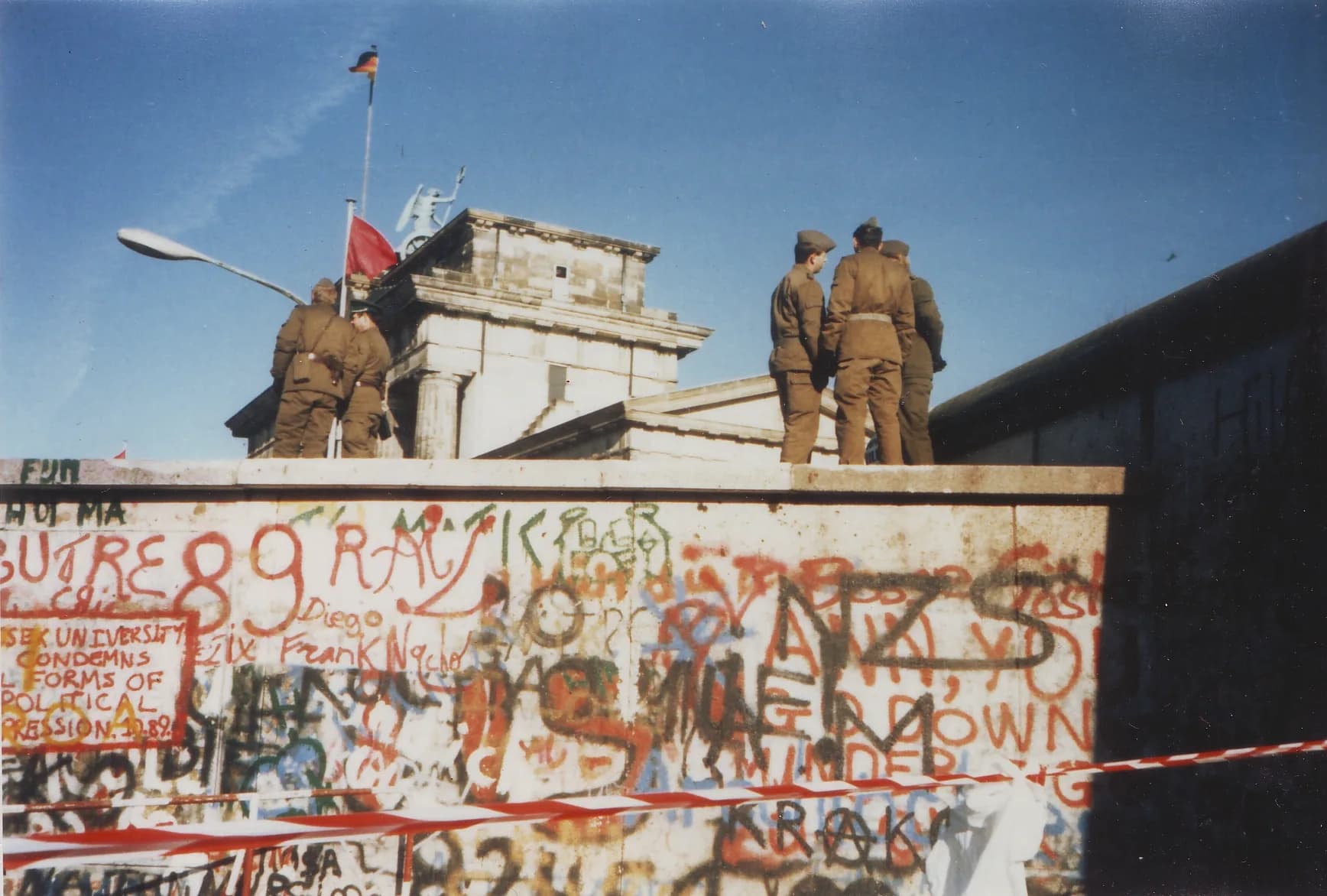
The border guards had received no orders to open the gates. At the Bornholmer Strasse crossing, the first to open, the officers on duty faced a crowd that kept growing and could not reach their superiors for instructions. Late that evening they lifted the barriers, and East Berliners walked through into West Berlin, where strangers embraced them and crowds gathered on top of the Wall.
By midnight, tens of thousands of people had crossed in both directions. The Wall itself still stood, a concrete barrier running through the city, but its authority had collapsed in a single evening. What had been the most guarded border in Europe was now, in practice, open.
The Months That Weakened the Wall
The Wall had been in effect breached months earlier, in the summer of 1989, when Hungary began allowing East Germans to escape to the West through its newly opened border with Austria. Thousands of East Germans travelled to Hungary on holiday and crossed into Austria instead of returning home. Others crowded into the West German embassy in Prague, and in late September the West German foreign minister told them from the embassy balcony that they would be allowed to leave.
At home, East Germans took to the streets. Monday demonstrations in Leipzig grew week by week through the autumn, and on 4 November about half a million people gathered at Alexanderplatz in East Berlin to demand reform. The pressure forced the long-serving party leader, Erich Honecker, from office in October, and his successor, Egon Krenz, promised change without delivering it.
The government tried to calm the protests with a new travel law, published on 6 November, but it was widely mocked as cosmetic. The following day the prime minister and two-thirds of the Politburo resigned. On 9 November the leadership agreed on new rules allowing citizens to apply for foreign travel without the old conditions, and to leave permanently through any crossing. The rules were intended to take effect the next day, once visa offices had been told what to do.
Behind all of this stood a deeper failure. East Germany's economy had stagnated through the 1980s, leaving shortages that drove its own citizens to leave, and the state depended on loans it could not repay. The Soviet Union, which had once sent tanks to crush reform in Eastern Europe, would no longer do so. Its leader, Mikhail Gorbachev, had made clear that each country must find its own way.
The People at the Centre
Schabowski himself was not a reformer acting on a plan. He was a party functionary handed a note he had not read properly, and his hesitation in front of the cameras turned a bureaucratic adjustment into a public announcement. His words mattered because millions of East Germans were watching West German television that evening, and they heard what they had waited years to hear.
The guards at the crossings carried the decision in practice. They had been trained to treat the border as a matter of life and death, and they had no instructions for a crowd that believed the Wall was open. The officers who lifted the barriers did so without orders from above, choosing to avoid a confrontation they could not control. Their decision, made under pressure in a few hours, is what turned an announcement into an opening.
The crowds themselves were the third force. They were not organised by any party or movement that night, but by families and neighbours who had lived for decades a few streets from relatives they could not visit. They arrived carrying identity cards and shopping bags, expecting to be turned back, and instead found themselves walking through. Their presence, and their numbers, made it impossible for the guards to hold the line.
A Division That Began in 1961
The Wall had been built in 1961 by the East German government to stop its own people from leaving. Berlin, deep inside East German territory, had remained divided between the victorious powers of the Second World War, and the sector boundary in the city was the last easy way out. After the border with West Germany was closed in 1952, hundreds of thousands of East Germans left through Berlin, and the Wall was built to close that route.
For twenty-eight years the Wall was the sharpest symbol of the Cold War. It was a guarded concrete barrier encircling West Berlin, separating it from East Berlin and the surrounding East German state. Hundreds of people were killed trying to cross it, and families on either side lived within sight of each other but under different political systems. The division of the city was the division of Europe in miniature.
The Wall endured because the Soviet Union guaranteed it. The Brezhnev Doctrine, named after the Soviet leader Leonid Brezhnev, committed Moscow to military intervention to preserve Communist governments in Eastern Europe. When Gorbachev withdrew it, the Wall's foundations were removed, even though the concrete remained standing.
From Opening to Reunification
The opening proved fatal for East Germany. In the weeks that followed, ever-larger demonstrations demanded free elections, and in mid-November Krenz was replaced by Hans Modrow, who promised multiparty elections. The Brandenburg Gate, the symbolic centre of the divided city, reopened on 22 December 1989. East Germany held its first free elections on 18 March 1990, and the new government chose reunification.
Reunification came faster than almost anyone had expected. A monetary union took effect on 1 July 1990, a unification treaty was signed on 31 August, and on 3 October 1990 East Germany dissolved itself and its five states joined the Federal Republic of Germany. The process, which began on 9 November 1989, was completed in 339 days. The demolition of the Wall itself began in June 1990 and was completed in 1994.
The consequences reached far beyond Germany. Within two years the Soviet Union itself had collapsed, and the Cold War, which had shaped international politics since the late 1940s, came to an end. The countries of Eastern Europe held free elections and chose their own governments.
Why the Night Still Matters
The fall of the Wall is often told as a story of triumph, but the record is more complicated. It was not the result of a single speech, a single protest, or a single decision. It was the product of an economy that could no longer provide for its people, a Soviet policy that had changed, months of emigration and protest, and a mistake made live on television. Any one of those factors alone would not have opened the border that night.
Pieces of the Wall now stand in museums and public squares around the world, and the line where it ran through Berlin is marked in the pavement. The city that was divided for a generation is a single city again, and 3 October is celebrated each year as German Unity Day. The lesson of 9 November is not that walls fall on their own. It is that they fall when the people behind them, and the powers that built them, stop believing they must stand.