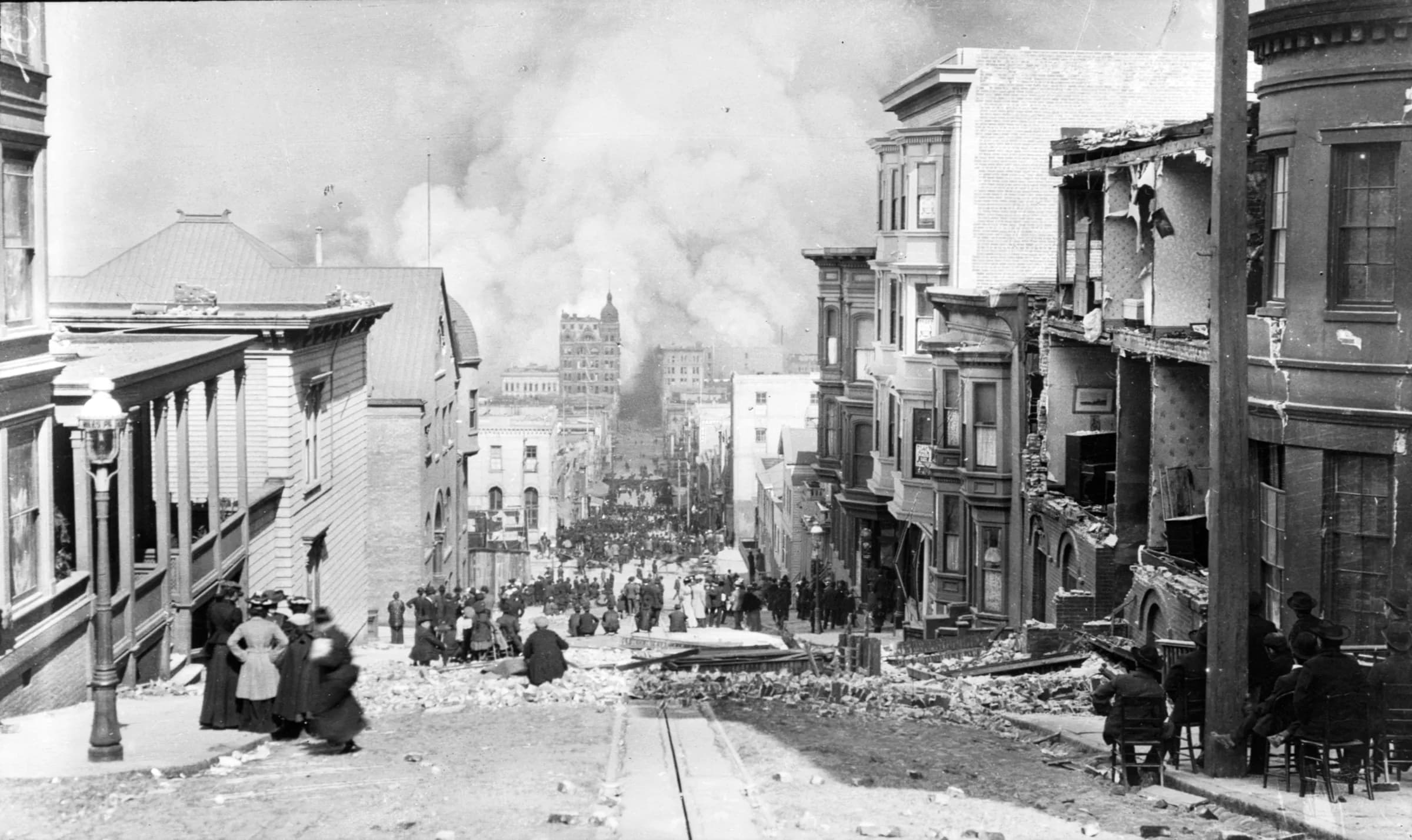
At 5:12 in the morning on Wednesday 18 April 1906, most of San Francisco was asleep. The ground under the city began to shake, and it shook violently for more than forty seconds. Buildings fell, streets buckled, and gas and water mains tore apart underground. The earthquake itself lasted less than a minute, but it set in motion a fire that would burn for three days and destroy more than eighty percent of the city.
The earthquake was one of the largest in the recorded history of the continental United States, with an estimated magnitude of 7.9 on the modern moment magnitude scale. The rupture ran for about 296 miles along the San Andreas Fault, from San Juan Bautista in the south to Cape Mendocino in the north. The shaking was felt from Oregon to Los Angeles, and as far inland as central Nevada. In San Francisco, the largest city on the American Pacific coast, the damage was immediate and total.
The official death toll at the time was about 700, and that figure was wrong. Modern research puts the toll at more than 3,000, and the difference is not an accident of record keeping. The city deliberately minimised the toll, because it wanted to present the disaster as a fire rather than an earthquake, and to protect its reputation with investors. The earthquake is a story about geology, and it is also a story about what a city chooses to count.
The Fault Beneath the City
The San Andreas Fault is a continental transform fault that forms part of the tectonic boundary between the Pacific Plate and the North American Plate. The western plate moves northward relative to the eastern plate, and the fault is characterised by mainly lateral motion. Stress builds along the fault over decades, and when it releases, the ground on either side slides past the other.
The rupture propagated both northward and southward for a total of 296 miles, and the maximum observed surface displacement was about 20 feet. Geodetic measurements showed displacements of up to 28 feet in places. Fences, roads, and rows of trees that crossed the fault line were cut and offset where the two sides slid past each other.
The earthquake preceded the development of the Richter scale by three decades, so its magnitude has been estimated from seismograms and field observations. The most widely accepted estimate on the modern moment magnitude scale is 7.9, with proposed values from 7.7 to as high as 8.3. Some Geological Survey summaries give 7.8, and the difference reflects different methods of estimation rather than a dispute about the event.
Forty-Five Seconds
The shaking began at 5:12 in the morning, when most of the city's 400,000 residents were still asleep in their beds. There was no time to evacuate buildings before the shaking began, and the pre-dawn timing meant that ruptured gas lines and overturned lamps and stoves immediately sparked fires across the city. The earthquake destroyed the water distribution system that firefighters would desperately need to combat those flames, and the two failures together made the disaster far worse than either one alone.
The most catastrophic structural failure was at the Valencia Street Hotel in the Mission District, a four-storey wooden building constructed on filled marshland. Buildings on filled land shook far more violently than buildings on rock, and the hotel collapsed with many of its residents inside. Across the city, brick buildings fell, chimneys toppled, and streets cracked open.
The shaking went on for more than forty seconds, and some accounts give forty-five to sixty seconds. In less than a minute, a city of 400,000 people had lost its water, its gas, and many of its buildings.
San Francisco's fire chief, Dennis Sullivan, was the one man who had spent years planning for exactly this scenario, and he was mortally wounded when a falling chimney crashed through the roof of the fire station where he slept. He died three days later without regaining consciousness.
Three Days of Fire
Within minutes of the shaking, fires began breaking out across the city, and by six in the morning more than fifty separate fires were burning. Ruptured gas lines ignited in dozens of locations, and the fires were fed by the gas and fanned by shifting winds. The water mains were broken, and the pipeline that carried water into the city had been cut. Firefighters had no water, and the fires burned out of control for three days.
The army was called in, and soldiers demolished whole blocks of houses along Van Ness Avenue in an attempt to create a firebreak. The fires kept going through 19 and 20 April, and on 19 April, with their own plants destroyed or without power, several newspapers printed a combined edition on the presses of the Oakland Tribune, across the bay.
The destruction was staggering. About 28,000 buildings were destroyed, and the burned area covered about 4.7 square miles, more than eighty percent of the city's built environment. The fires consumed about 490 city blocks, and the total property loss was estimated at 400 million dollars in 1906, which made it the costliest disaster the United States had ever experienced at that time.
About 225,000 people were left homeless, more than half of the city's population, and refugees gathered in the open spaces of the city. Major camps went up in the Presidio and in Golden Gate Park, with other camps run by the army elsewhere in town.
Counting the Dead
The first official count of the dead was about 700, and that figure was quoted for decades. It is now believed to underestimate the total loss of life by a factor of three or four. Modern research by Gladys Hansen, San Francisco's city archivist, documented at least 3,000 deaths through painstaking analysis of death certificates, coroner's records, and other primary sources.
The Geological Survey now states that at least 3,000 people were killed, and that 225,000 were left homeless. The range in the sources is 700 to more than 3,000, and the article gives both figures with attribution.
Hundreds of fatalities in Chinatown went ignored and unrecorded, and that omission is part of the reason the official count was so low. The total number of deaths is still uncertain, but various reports present a range of 700 to more than 3,000. In 2005, the city's Board of Supervisors voted unanimously in support of a resolution recognising the higher toll, and the modern figure of more than 3,000 is now the accepted estimate. The discrepancy reflects both the chaos of the disaster, which made accurate record keeping impossible, and a deliberate attempt by civic boosters and business interests to minimise the reported casualties.
The reason for the minimisation was commercial. San Francisco wanted to present the disaster as a fire, which could be rebuilt from, rather than an earthquake, which might deter investors and residents. The city emphasised the fire in its official accounts, and it downplayed the earthquake.
The strategy worked in the short term, because the city rebuilt quickly, but it distorted the historical record for a century. The earthquake was the cause, and the fire was the consequence, and the official count hid the scale of both.
The Science the Earthquake Created
The investigation that followed the earthquake changed earthquake science. The Lawson Report of 1908, edited by Andrew Lawson and published by the Carnegie Institution of Washington, remains the authoritative work on the earthquake, and it is arguably the most important study of a single earthquake ever published. It documented the fault rupture, the shaking, and the damage in detail, and it established methods for studying earthquakes that are still used today. The report was based on geological observations of the fault rupture and on the damage the earthquake caused, and it remains a basic reference more than a century later.
In 1910, Harry Fielding Reid proposed the elastic rebound theory, based on his study of the 1906 earthquake. The theory holds that stress builds along a fault, the ground deforms, and then the fault slips and the ground rebounds, releasing the stored energy as an earthquake. It is still the principal model of the earthquake cycle, and it came directly from the observations of 1906. The earthquake gave seismology its founding theory, and the theory came from a disaster that the city had tried to minimise.
The Geological Survey's own response to the earthquake is also part of the record. At the time, the only permanent Geological Survey office in California was the Pacific Division topographic mapping office in Sacramento, established three years earlier. Their photographs and measurements, including the photographs of the dynamite squads at work, are now among the most important records of the disaster.
Rebuilding and the Lessons That Remained
Rebuilding began almost immediately. On 22 April, four days after the earthquake, rebuilding efforts were widely announced, and the city rebuilt fast. Within a decade, it had a new City Hall, which opened in 1915, and a world's fair, the Panama-Pacific International Exposition, to celebrate the recovery.
The rebuilding was a remarkable achievement, and it was also a choice: the city rebuilt on the same ground, on the same fault, with the same risks. The decision was commercial, and it was human, and it has shaped San Francisco ever since.
The earthquake's legacy extends beyond the rebuilding. The scientific investigations that followed fundamentally changed how humans understand earthquakes, and the political response shaped San Francisco's relationship with seismic risk for generations. The use of military forces for evacuation, security, and relief distribution, and the establishment of refugee camps housing more than 200,000 displaced people, set precedents for disaster management that are still used today. The coordination between the army, the city, and relief organisations became a model, even as the counting of the dead remained a failure.
San Francisco in 1906 was a city that shook for less than a minute, burned for three days, and rebuilt in a decade. The earthquake is remembered as the deadliest earthquake in the history of the United States, and the fire is remembered as the disaster that destroyed the city. Both memories are true, and both are incomplete without the other.
The shaking caused the fire, the fire caused most of the destruction, and the city counted only a fraction of the dead. The record has been corrected, but the correction took a century, and the people who were not counted are still being found in the archives.