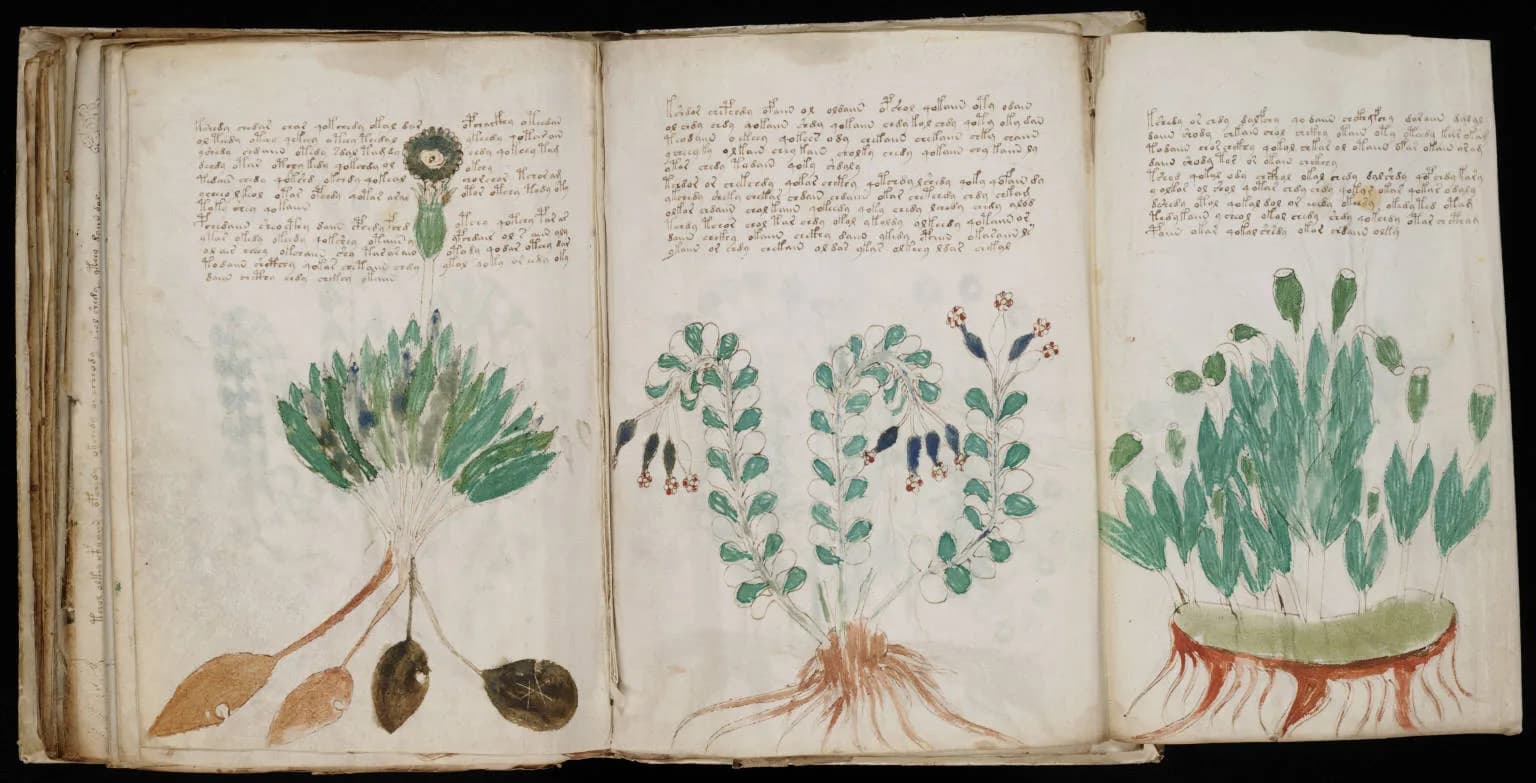
In the reading room of Yale University's Beinecke Rare Book and Manuscript Library, under the shelfmark MS 408, sits a small book that has defeated every reader for more than a century. It is written on vellum, the prepared skin of calves, in a flowing script that belongs to no known alphabet. Its pages are filled with drawings of plants that match no known species, diagrams of stars and zodiac signs, and small figures bathing in pools connected by tubes.
The book is about the size of a modern hardcover, measuring roughly 23.5 by 16.2 centimetres. It has around 240 surviving pages, gathered into quires of uneven size, and there is evidence that some pages are missing. It has been photographed page by page in high resolution, and anyone with an internet connection can examine it. No one has yet produced a translation that other scholars accept.
The Mystery
The manuscript is named after Wilfrid Voynich, a Polish-born bookseller who bought it in 1912 from a Jesuit collection near Rome. Voynich was a revolutionary turned antiquarian dealer, and he spent the rest of his life trying to find someone who could read his purchase. He failed, and so has everyone since, including professional codebreakers from the First and Second World Wars.
The text itself is the problem. It is written in an alphabet of about twenty to thirty distinct characters, in words that repeat with a regularity suggesting a real language rather than random marks. Statistical studies have found patterns in the writing that resemble the structure of natural language, with some words appearing often and others rarely, as in any ordinary book. Yet no one has matched the script to a known language, and no one has found a key.
The drawings divide the book into sections that scholars describe by their illustrations: botanical pages with unidentifiable plants, astronomical and astrological diagrams, biological pages with bathing figures, cosmological foldouts, pharmaceutical pages, and continuous text that reads like recipes. The sections look as though they belong to a practical handbook of some kind, perhaps medical or herbal, but the pictures do not match any known medieval text.
What Is Known
The physical facts about the manuscript are well established, and they are more solid than any theory about its meaning. In 2009, with the library's permission, a team led by Greg Hodgins of the University of Arizona took four small samples of parchment from different parts of the book and dated them by accelerator mass spectrometry. All four fell within the early fifteenth century, and the combined range was 1404 to 1438, at 95 per cent probability.
The dating matters because it settles several old claims at once. It rules out Roger Bacon, the thirteenth-century English friar long said to have written the book, since he died in 1292, more than a century before the parchment was made. It also makes a modern forgery very unlikely, since the inks and pigments are consistent with European materials of the period. Radiocarbon dating measures the death of the animal whose skin became the parchment, not the act of writing, but the handwriting and illustration style point to a book made in the first half or middle of the fifteenth century.
The manuscript's later history is documented, though its early history is not. The first confirmed owner was Georg Baresch, a seventeenth-century alchemist from Prague. The earliest firm evidence of its existence is a letter written in 1665 or 1666 by Johannes Marcus Marci, a physician and rector of the university in Prague, to the Jesuit scholar Athanasius Kircher in Rome. The letter was found inside the covers of the manuscript, and it reports, at second hand, that the book once belonged to Emperor Rudolf II.
The Timeline
The parchment was made between 1404 and 1438, probably in the area of modern southern Germany, Switzerland or northern Italy, then all part of the Holy Roman Empire. Nothing is known about who wrote the book, who commissioned it, or where it was kept for the next two centuries. No scribe, artist, author or patron is named anywhere in the manuscript, and none has ever been identified by any external document.
The documented record begins in Prague in the seventeenth century. Baresch owned the book, Marci sent it to Kircher in Rome in 1665 or 1666, and it probably remained in the library of the Collegio Romano for two hundred years. When the troops of Victor Emmanuel II captured Rome in 1870 and annexed the Papal States, the Jesuit library's books were hidden from confiscation, most likely at Villa Torlonia in Castel Gandolfo.
In 1912, Wilfrid Voynich bought the manuscript, along with other books, from the Jesuits at the Villa Mondragone near Frascati, Italy. After his death in 1930 it passed to his widow, Ethel Lilian Voynich. In 1961 the dealer Hans P. Kraus bought it for $24,500, offered it for sale at $160,000 without finding a buyer, and donated it to Yale in 1969. It has been held at the Beinecke Library ever since, leaving the building only once, for a loan exhibition at the Folger Shakespeare Library in 2014 and 2015.
Available Evidence
The manuscript itself is the evidence, and Yale has made it available to everyone. The whole book is digitised in high resolution, in 213 images that cover every page, foldout and cover, and the images can be zoomed and downloaded without charge. The catalogue record describes the book as a scientific or magical text in an unidentified language, in cipher, apparently based on Roman minuscule characters.
Recent scholarship has added detail without adding a translation. In 2020, the palaeographer Lisa Fagin Davis published a study suggesting that the text was written by five different scribes, a finding that implies a collaborative effort rather than the work of a lone eccentric. The handwriting differs between sections in ways that are consistent with several hands working from a common model.
The physical construction has also been studied closely. The manuscript measures 23.5 by 16.2 by 5 centimetres, and its pages are collected into quires of uneven size. A study published in 2026 proposed that the book was originally bound not in quires at all, but as a series of singulions, four-page units made from a single folded bifolio. The finding changes how scholars think the book was assembled, but it does not bring them closer to reading it.
Investigations and Explanations
A century of claimed decipherments has been examined and rejected by specialists, one after another. In 1921, William Newbold announced that the text was written in microscopic shorthand and contained the work of Roger Bacon; his reading depended on details that other scholars could not see in the photographs. In 2019, Gerard Cheshire claimed the language was proto-Romance, an ancestor of the Romance languages; linguists found his method unsound and his translations unconvincing.
Three broad explanations remain on the table, and named scholars hold each one. The first is that the text encodes a real language, written in an invented alphabet, perhaps a natural language of the fifteenth century that has not yet been recognised. The second is that it is a working cipher, a code that has not yet been broken, possibly enciphering Latin or an early Italian dialect. The third is that it encodes nothing at all, and is a deliberate construction of meaningless text designed to look like a book, perhaps to impress or deceive a buyer.
The statistical evidence cuts both ways. The word patterns look like language, which argues against pure gibberish, but no proposed reading has produced a text that behaves like a real document, with grammar, names and numbers in the places where a reader would expect them. The drawings, meanwhile, resemble real medieval herbals and astronomical diagrams without matching any of them, which keeps the question open rather than settling it.
What Remains Unresolved
The manuscript has never been demonstrably deciphered, and none of the proposed hypotheses has been independently verified. Its author, its place of production, its language and its purpose are all unknown. The book is a genuine early fifteenth-century object, made of period materials by several hands, with a documented history from the seventeenth century onward, and it has so far refused to say what it is.
That refusal is the reason the manuscript endures in public imagination, appearing in novels, video games and online forums as a symbol of the unknowable. The scholarly position is narrower and more patient. Yale published a full-colour facsimile in 2016, edited by Raymond Clemens, with essays by specialists, and the library's high-resolution images allow anyone to study the book page by page.
What is known is the object: its size, its materials, its date, and the chain of owners who carried it from Prague to Rome to London to New Haven. What is not known is the only thing that matters to a reader, which is what the book says. Until someone produces a reading that other scholars can test and confirm, the Voynich manuscript will remain exactly what it has been for six centuries: a book that can be held, measured, photographed and owned, but not read.