On the afternoon of 4 December 1872, the Canadian brigantine Dei Gratia was sailing in the Atlantic, about halfway between the Azores and the coast of Portugal. Her helmsman reported a vessel approaching unsteadily from about six miles away, under partial sail and answering no signal. Captain David Morehouse sent two men across in a small boat to investigate, and they climbed aboard a ship that was deserted.
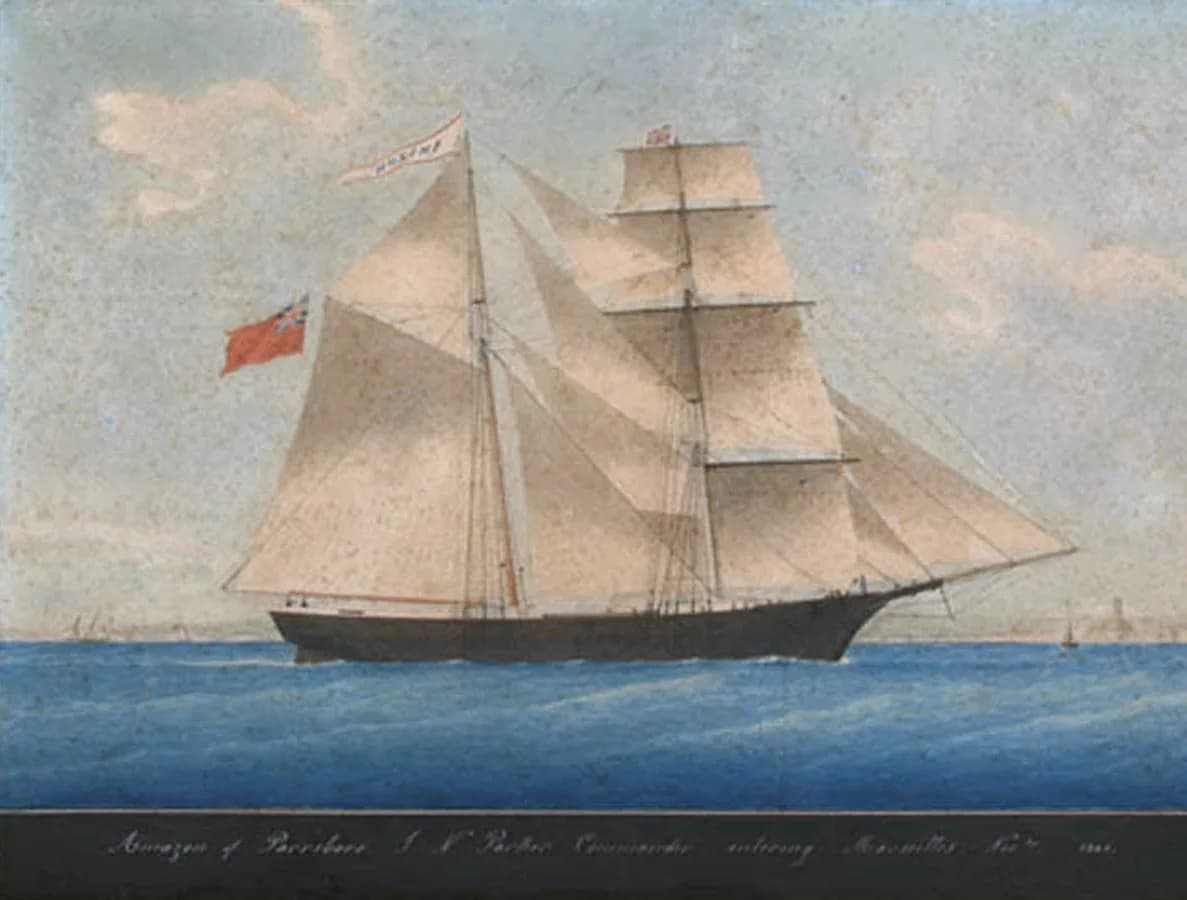
The vessel was the Mary Celeste, an American brigantine bound from New York to Genoa. She was seaworthy, her cargo was largely intact, and food and water remained aboard. Her only lifeboat was missing, and so were the ten people who had sailed in her: Captain Benjamin Briggs, his wife Sarah, their two-year-old daughter Sophia, and seven crewmen.
The Mystery
The Mary Celeste had left New York on 7 November 1872, carrying more than 1,700 barrels of industrial alcohol bound for Genoa, Italy. Briggs was an experienced captain, and this was his first voyage in command of the ship after a refit in New York. He had decided to bring his wife and young daughter with him, a choice that suggests he expected a routine crossing rather than a dangerous one.
For the first two weeks the crossing appears to have been ordinary. The ship's log was kept daily, and its entries record bad weather but nothing that suggests alarm. Then the entries stop. The final entry, dated 25 November, places the Mary Celeste near Santa Maria Island in the Azores, about 400 nautical miles from the position where the Dei Gratia would find her nine days later.
Nothing in the log explains what happened next. The ship had drifted eastward, roughly along her intended course toward Genoa, with no one at the wheel. When the Dei Gratia's men boarded her, they found the sails partly set and in poor condition, the fore and lazarette hatches open, and the binnacle that housed the compass shifted from its place with its glass cover broken.
What Is Known
The boarding party found the ship in a dishevelled but seaworthy condition. The cargo was well stowed and in good order, except for one barrel that had been opened. The cabins were wet from water that had entered through the open hatches, but the crew's personal belongings were largely undisturbed, and there was no sign of fire or violence aboard.
Two details stood out to the men from the Dei Gratia. The ship's single lifeboat, a small yawl that had been stowed across the main hatch, was gone. A sounding rod, used to measure the water in the hold, had been left on deck, and one of the ship's two pumps had been taken apart. More than three feet of water stood in the hold, an amount that would not normally endanger a ship of her size.
The Dei Gratia's crew divided, and a party sailed the Mary Celeste to Gibraltar, arriving on 13 December, a day after the Dei Gratia herself. The ship was impounded at once, and a formal salvage inquiry opened in the Vice Admiralty Court under Chief Justice Sir James Cochrane. The inquiry would last for months, and it would examine the ship, her cargo and her crew's testimony in detail.
The Timeline
The Mary Celeste was built in Nova Scotia in 1861 and launched under British registration as the Amazon. She was transferred to American ownership in 1868, renamed the Mary Celeste, and sailed uneventfully until the voyage of 1872. In October of that year she was refitted in New York, at considerable expense, before loading her cargo of alcohol.
On 5 November 1872, Briggs arrived in New York from his home in Marion, Massachusetts, to take command. The ship anchored at Staten Island while the captain waited for better weather, and she finally sailed on 7 November. The Dei Gratia, also bound from New York, had sailed eight days earlier, on a similar route toward the Mediterranean.
The last log entry was written at eight in the morning on 25 November, when the ship was about six nautical miles from Santa Maria Island. Nine days later, on 4 December, the Dei Gratia sighted her at 38°20′N 17°15′W. The Mary Celeste reached Gibraltar on 13 December, and the inquiry opened there on 17 December. It closed in February 1873 with a salvage award to the Dei Gratia's crew, reduced from the usual rate.
Available Evidence
The strongest evidence in the case is the physical condition of the ship as the inquiry recorded it. A survey carried out on 23 December 1872, by a shipping surveyor and a diver, found no damage below the waterline, no sign of collision, and no trace of heavy weather damage. The hull, masts and yards were in good condition, and the pitch in the waterways had not started, which suggested the ship had not met seriously heavy seas.
The cargo told a similar story. Of the 1,701 barrels of alcohol, all were in good order except one that had been opened, and nine barrels were later found empty when the cargo was discharged at Genoa. The inquiry found no blood, no weapon, and no sign of a struggle anywhere aboard. The chronometer, sextant and the ship's papers were missing, which suggests that whoever left the ship took the instruments needed for navigation.
The sounding rod and the dismantled pump point toward the most concrete clue in the case. The captain appears to have been measuring the water in the hold and trying to work a pump, which suggests he believed the ship was taking on water. With one pump out of action and the hold full of cargo, he could not see how much water was actually there, and he may have believed the ship was sinking.
Investigations and Explanations
The inquiry's prosecutor, Attorney General Frederick Solly-Flood, was convinced that a crime had been committed. He pursued theories of mutiny, murder by the crew, piracy by the Dei Gratia's men, and a conspiracy to commit insurance or salvage fraud. Months of testimony produced no evidence for any of them, and no charge was ever brought against anyone.
The explanation most widely accepted by maritime historians is a precautionary abandonment that went wrong. On this reading, Briggs feared that the alcohol cargo was leaking vapour and might explode, or that the ship was sinking, and ordered everyone into the lifeboat as a precaution. He may have intended to keep the boat attached to the ship by a line, and to reboard once the danger had passed.
If the line parted, or the small boat was swamped in open water, all ten people would have been lost, while the ship herself sailed on. This account explains the missing lifeboat, the missing navigation instruments, and the orderly state of the ship, but it remains a reconstruction rather than a proven fact. Other explanations, including a waterspout, an earthquake at sea, and a sudden panic, have been proposed, and none has evidence behind it.
What Remains Unresolved
No trace of Briggs, his family, or his crew was ever found, and no wreckage of the lifeboat was ever reported. The inquiry's verdict settled the question of foul play, but it offered no alternative explanation for the abandonment. The salvage award was reduced, a decision widely read as reflecting lingering suspicion rather than proof of any crime.
The Mary Celeste sailed on for another thirteen years, under new owners, before she was deliberately wrecked off Haiti in 1885 as part of an attempted insurance fraud. Her name, however, had already entered the language as a byword for unexplained desertion. That reputation owes much to Arthur Conan Doyle, whose 1884 story about a fictional survivor of a ghost ship called the Marie Celeste fixed the wrong name and several invented details in the public mind.
What the record actually shows is narrower and stranger than the legend. A sound ship was abandoned in open ocean, in calm conditions, by people who took the trouble to carry off their navigation instruments and left almost everything else behind. The reason they left, and what happened to them in the small boat, is still unknown after more than a century and a half.