On 27 February 1988, the BBC television programme "That's Life" did something its audience had not expected. The host, Esther Rantzen, produced a scrapbook that listed the names of hundreds of mostly Jewish children brought to Britain from Czechoslovakia in 1939. One of the names was Vera Diamant, a ten-year-old girl whose parents had arranged for her and her older sister to start a new life in Britain.
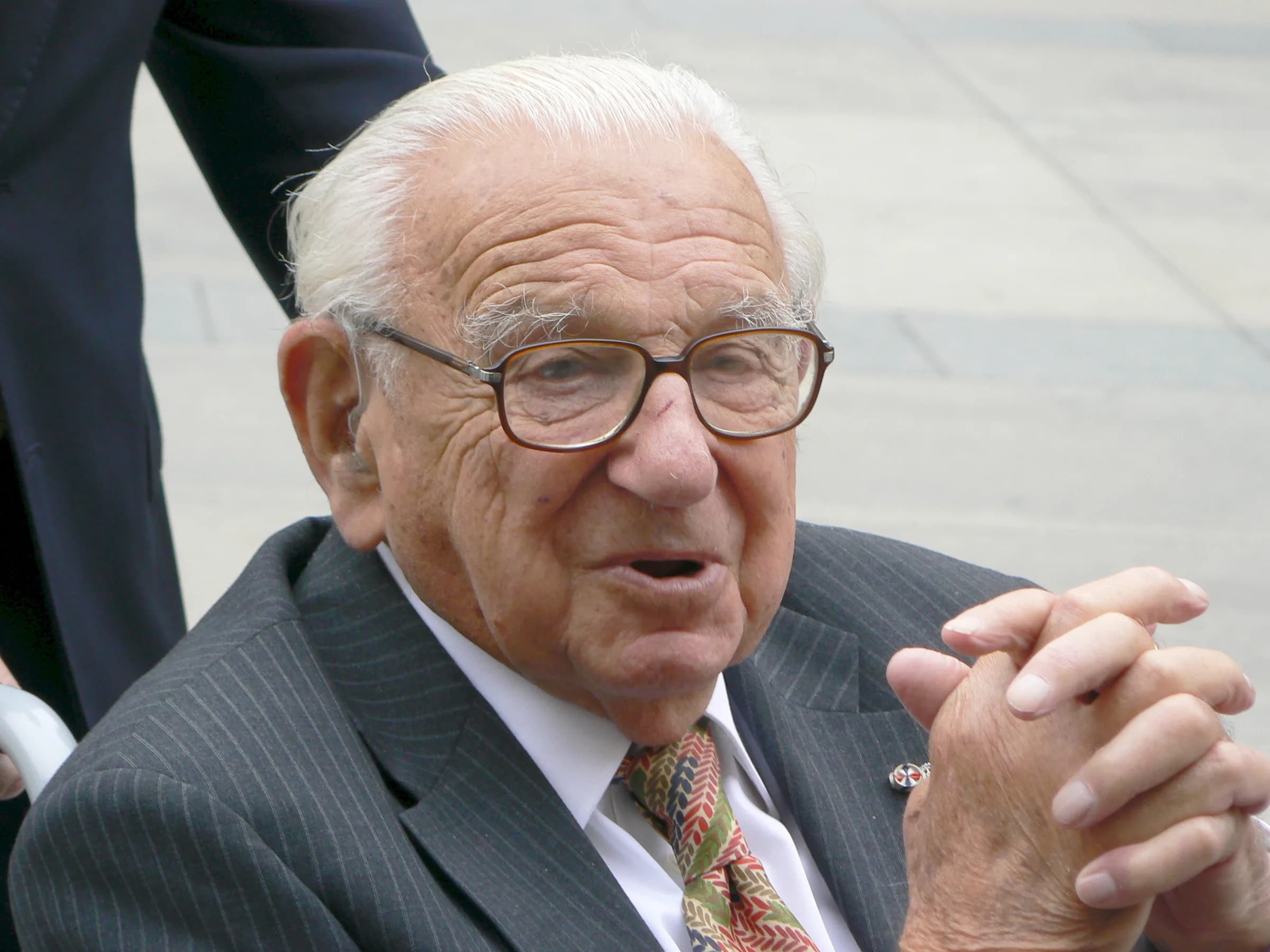
Vera was sitting in the studio audience, next to an old man she did not know. Rantzen announced that the old man was Nicholas Winton, and that forty-nine years earlier he had been instrumental in saving Vera's life. The two embraced, and Vera whispered her thanks. In the following week's episode, Rantzen asked whether anyone in the audience owed their life to Winton, and more than two dozen people around him stood up and applauded.
Winton was seventy-eight years old. He had kept quiet about the rescue for nearly half a century, and he would have kept quiet longer if his wife had not found the scrapbook in their attic. He always said he was not heroic, and he meant it. The story of the children is the story of what he did, not of what he claimed about himself.
A Skiing Holiday Cancelled
Nicholas Winton was born Nicholas Wertheim on 19 May 1909 in Hampstead, north London, to German Jewish parents. He was privately educated and became a successful stockbroker by the late 1930s. His family had been raised Christian, and in 1938 they changed their name from Wertheim to Winton, to underline where their loyalties lay as war approached.
In December 1938, Winton was preparing for a skiing holiday in Switzerland over the New Year. Shortly before he was due to leave, he received an urgent message from his friend Martin Blake, who was in Prague. Blake was working with refugees, and he asked Winton to come and see the situation for himself. Winton cancelled the holiday and went to Prague instead, arriving on New Year's Eve.
What he found was a city full of refugees. In October 1938, Germany had occupied the Sudetenland, the border region of Czechoslovakia, and tens of thousands of Jewish families had fled into the parts of the country that were still free. They were living in freezing camps, and children were separated from their parents or wandering the streets. It was clear that Germany would soon invade the rest of the country.
In Prague, Winton was introduced to Doreen Warriner, a thirty-four-year-old English academic who had come to help political refugees. She had offered her services to the British Committee for Refugees from Czechoslovakia, the main voluntary organisation working with the refugees. Winton offered his services too, and Warriner asked him to be secretary of a children's committee, which he suggested should be formed.
Lists in a Hotel Room
Winton had three weeks in Prague before he had to return to London for work, and he used them to understand what moving children to Britain would require. He wrote to his mother in early January 1939 that Miss Warriner had asked him to be secretary of a Children's Committee for Czechoslovakia. He set to work at once, and the work was mostly paperwork.
Each morning, queues of families formed outside his hotel room from six o'clock, and Winton met each family in turn to record the details of their children. He registered more than 900 children in those three weeks, according to the local authority record of his life. He also had to solve three practical problems: how the children would travel, what papers they would need, and which families in Britain would take them in.
The British government required a £50 guarantee for each child, to cover the cost of the child's eventual return, and a foster family willing to take the child. Winton raised money to pay the guarantees for the children of poorer families, and he worked with the British Committee for Refugees from Czechoslovakia and the Czechoslovak travel agency Čedok to arrange the transport. He asked the United States for help, and he was refused, as were other countries he approached, until Sweden and Britain agreed to take children.
Winton was not working alone, and the record is clear on this point. Doreen Warriner, Martin Blake, Trevor Chadwick, and many others in Prague and London did work that was as essential as his own. The rescue was part of a much larger voluntary effort to help refugees fleeing fascism, and recent scholarship has stressed that it was not led by Winton alone. He was the organiser who made the children's transports happen, and he was one of a group.
Eight Trains
Winton flew back to Britain on 21 January 1939, carrying the files of the children he wanted to help. He spent February working with the Home Office on the requirements for bringing each child to Britain, and his mother worked with him to place the children in homes and later in hostels. The first train left Prague on 14 March 1939, carrying twenty children. The next day, Germany invaded the rest of Czechoslovakia.
A small group of fifteen children was also flown out via Sweden on 14 March. In Prague, Winton's role was taken over by Trevor Chadwick, a teacher from Swanage in Dorset, who stayed on to keep the transports moving. The trains kept leaving through the spring and summer, and the last of them left on 2 August 1939. In total, 669 children reached Britain on eight trains, most of them Jewish, and almost none of them ever saw their parents again.
The ninth train was the largest. It was due to leave Prague on 3 September 1939, the day Britain entered the war, carrying 250 children. It never left the station.
Within hours of the announcement, the train disappeared, and none of the 250 children on board was ever seen again. More than 15,000 Czech children were killed in the years that followed, and the parents of most of the 669 who escaped perished at Auschwitz.
Winton returned to his career and his family. In 1940, he joined the Royal Air Force, rising from sergeant to flying officer. He married Grete, a Danish secretary, in 1948, and they had three children.
In 1983 he was appointed MBE for his work in establishing Abbeyfield homes for the elderly in Britain. He said nothing about the children from Prague, to his colleagues or to his own family.
The Scrapbook in the Attic
The scrapbook that changed everything was not Winton's own diary. It had been presented to him at the end of the rescue operation by a volunteer named Loewinsohn, and it contained correspondence, photographs, and information gathered during the work in Prague. At the back was a list of the rescued children and the names and addresses of the families who had agreed to foster them.
Grete found the scrapbook in a trunk in the attic of their home in Maidenhead in 1988. She showed it to the historian Elisabeth Maxwell, who passed the details to Esther Rantzen at the BBC.
Rantzen invited Winton to be a member of the audience on "That's Life", without telling him that the people sitting around him were adults he had saved as children. The reunion was broadcast on 27 February 1988.
The programme made Winton known around the world. He received the Freedom of the City of Prague, and on 28 October 1998 President Václav Havel awarded him the Order of Tomáš Garrigue Masaryk. He was the subject of two films by the Czech filmmaker Matej Mináč, and of the biography "Nicholas Winton and the Rescued Generation". He accepted the honours quietly, and he continued to say that he had not been heroic.
He died peacefully in his sleep on 1 July 2015, at the age of 106, with his daughter and grandchildren nearby. By then, the children he had helped save had children and grandchildren of their own, and many of them had kept in touch with each other as "Winton's children". They had also kept the scrapbook's lesson, which was that the rescue had been the work of many hands, not one.
Winton's own summary of the work was simple, and it is the one the record supports. He saw children who needed to leave, and he organised the means for them to leave. He did it with other people, in a few weeks, before a war closed the border.
He then went back to his life and said nothing about it for fifty years. The scrapbook in the attic did the talking in the end.