In 1959, in the village of Gehlaur in the Gaya district of Bihar, a woman named Falguni Devi set out across a mountain ridge to bring lunch to her husband. She slipped on the rocky path and fell, badly injured. The nearest town with a doctor was 70 kilometres away, around the mountain, and she died before help could reach her in time.
Her husband was Dashrath Manjhi, a landless agricultural labourer. He was born on 14 January 1934 in Gehlaur, into the Musahar community, one of the most marginalised communities in India's caste order. He had run away from home as a young man and worked in the coal mines at Dhanbad before returning to the village and marrying Falguni Devi.
Gehlaur lay in a plain, but a steep ridge of quartzite rock rose along its southern edge, part of the Rajgir hills. The ridge stood between the village and Wazirganj, the town where the nearest school, market, and doctor could be found. To reach Wazirganj, villagers had to walk around the mountain on a journey of many hours.
Manjhi believed his wife's death could have been prevented if there had been a direct road through the ridge. He decided to cut one himself. He had no money, no machinery, and no support from any authority. He had a hammer, a chisel, and a crowbar, and he had the next twenty-two years of his life.
A Vow Made in Grief
Manjhi began work in 1960, the year after his wife's death. He sold the family's goats to buy his tools, and he climbed to the ridge and started chipping at the rock. People in the village thought he had lost his mind with grief. He worked anyway, day after day, in heat and rain, and the mountain gave way very slowly.
He later described what drove him in words that reporters recorded: "That mountain had shattered so many pots; claimed lives. I could not bear that it hurt my wife. If it took all my life now, I would carve us a road through the mountain."
The words are plain, and they match the work that followed. He did not speak of changing the world. He spoke of a road.
The ridge was not soft earth but hard quartzite, a rock that resists a hammer. Manjhi developed his own method for breaking it. He built fires of wood on the rock face, heated the stone until it was hot, and then threw water on it so that it cracked. He broke the cracked stone apart and carried the rubble away, a little at a time.
He worked as a labourer to support himself while he worked on the mountain. He had no wages for the road and no one paying him to build it. The work was done in the hours he could spare, and the mountain did not hurry for him. For years, the cut he made was too small to look like a road at all.
Ten Years to a Cleft
After about ten years, the cut in the ridge had become a cleft that people could see. Some villagers who had mocked him began to help, carrying stone away or working alongside him for a time. Most of the work, however, remained his. The road would bear his name in the end because he was the one who stayed with it.
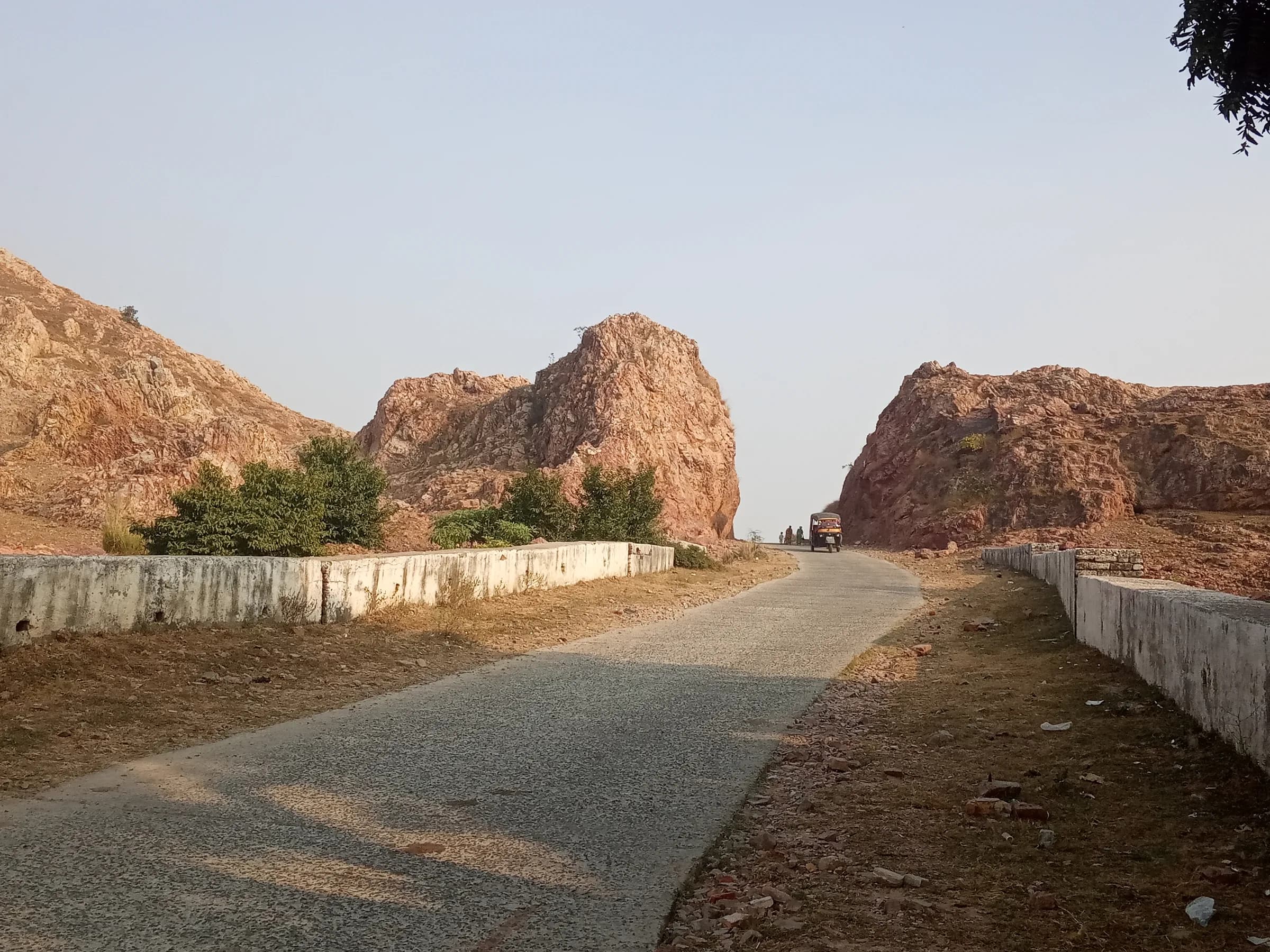
The dimensions of what he made are recorded in the sources that describe the site. The path he cut is about 110 metres long, 9.1 metres wide, and 7.7 metres deep in places — in the measurements most often quoted, 360 feet long, 30 feet wide, and 25 feet deep. It is a road cut through solid rock, wide enough for bicycles and motorcycles to pass.
Manjhi worked through the 1960s and the 1970s, and the mountain shrank by inches and feet. He was not a young man when he finished. He had begun at twenty-six, and he would be forty-eight when the work was done. The village watched a man grow old against a rock, and the rock lose.
In 1982, after twenty-two years, he broke through. The thin wall of rock at the far end gave way, and he walked out into open ground on the other side. The road was complete. Wazirganj, with its doctors, school, and market, was now a short journey from Gehlaur instead of a long one around the mountain.
What the Road Changed
The road changed the arithmetic of daily life in Gehlaur. The distance between the Atri and Wazirganj blocks of Gaya district fell from 55 kilometres to 15 kilometres, according to the figures most often cited for the route. Villagers who had walked for hours around the mountain could now cross it directly. Children could reach school, and the sick could reach a doctor, in a fraction of the time.
Some accounts describe the change in starker terms, saying the journey to medical help fell from 70 kilometres to one kilometre. The two sets of figures measure different things — the distance between administrative blocks on one hand, and the distance to the nearest doctor on the other — and the record does not settle them into a single number. Both are reported in the sources, and both are recorded in the verification notes to this article.
What is not in dispute is that the road was used. People from Gehlaur and the surrounding villages used it every day, and it remains in use. It was not a monument. It was a working road, and it was used as one from the day it opened.
Manjhi did not stop when the road was finished. He spent the years that followed asking the authorities to tar the road and connect it properly to the main road network. He travelled to New Delhi to seek recognition for the work, and he knocked on official doors for years. The proper road over his path was built only after his death.
Recognition, Late and Incomplete
In July 2006, Manjhi went to the public audience of Nitish Kumar, the Chief Minister of Bihar, to press his case for the road. The state government proposed his name for the Padma Shri, India's civilian honour, in the social service category that same year. The award did not come to him in his lifetime.
He was diagnosed with gallbladder cancer and admitted to the All India Institute of Medical Sciences in New Delhi on 23 July 2007. He died there on 17 August 2007, at the age of seventy-three. The Government of Bihar gave him a state funeral, an honour rarely given to a landless labourer.
His story spread after his death, in documentaries, in plays, and in the Hindi biographical film "Manjhi: The Mountain Man" (2015), directed by Ketan Mehta and starring Nawazuddin Siddiqui. On 26 December 2016, India Post issued a commemorative postage stamp featuring Manjhi, as part of its Personality Series on Bihar. The stamp carried his face across the country he had never left for long.
Manjhi's road is still there, in the ridge south of Gehlaur, and a memorial and statue stand in his home village. The road he cut is now surfaced and maintained, and it carries the traffic he imagined when he began. He did not live to see it tarred, and he did not receive the national honour proposed for him.
He had said he would carve a road if it took all his life. It took twenty-two years, and he kept his word. The mountain is still there, and so is the gap he cut through it. Anyone who walks it can measure what one person did, in metres of rock, without needing anyone to explain it.