On the afternoon of 26 April 2003, Aron Ralston was canyoneering alone through Bluejohn Canyon in southeastern Utah. He was twenty-seven years old, an experienced mountaineer and a mechanical engineer, and he had planned a long day of mountain biking and canyoneering through the desert canyons near Canyonlands National Park. He had told nobody where he was going, and he had no way to call for help.
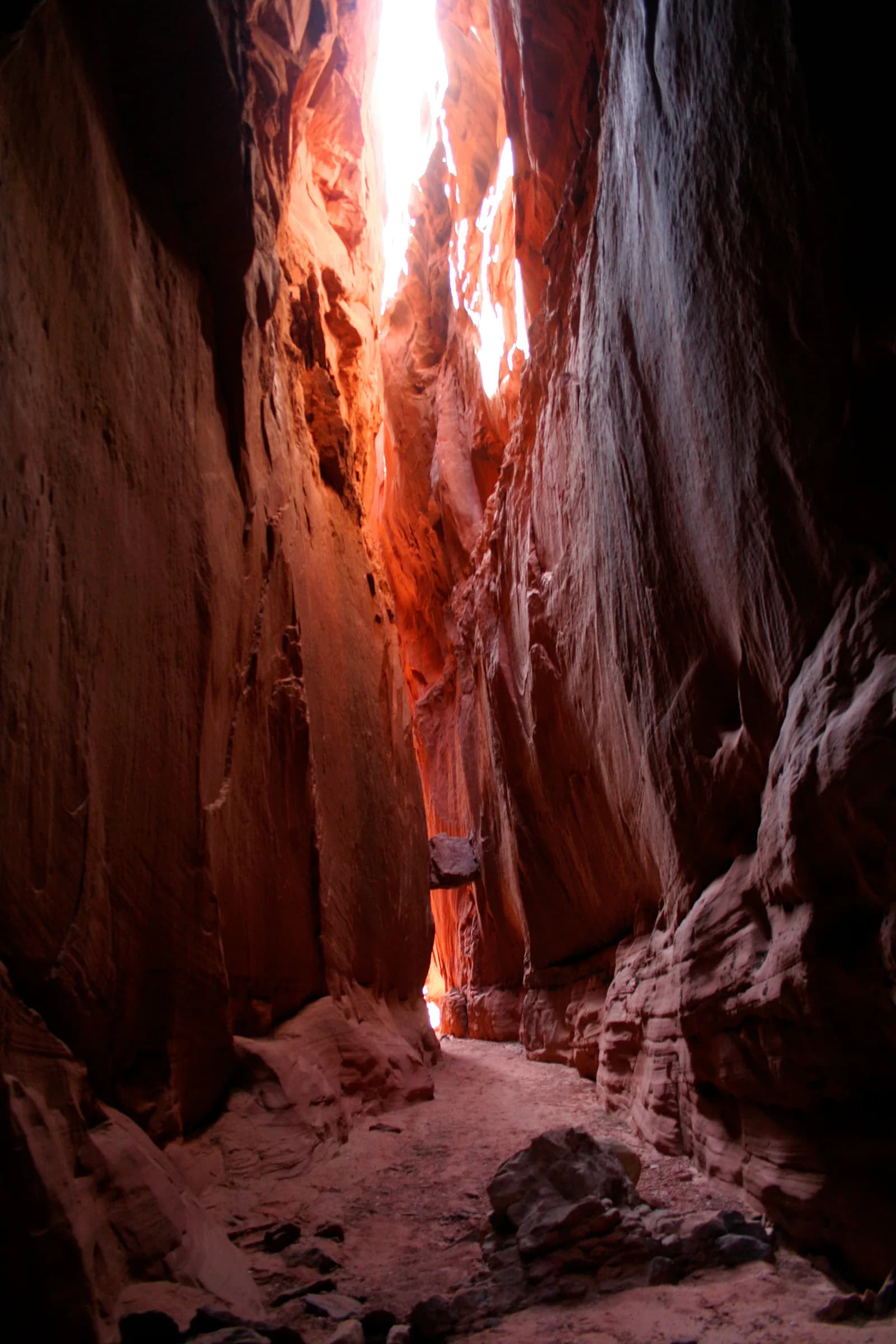
He was descending into the lower stretches of a narrow slot canyon when a suspended boulder came loose above him. The rock, later estimated to weigh about 800 pounds, first struck his left hand and then crushed his right hand and wrist against the canyon wall. It pinned his right arm so tightly that he could not move it, and it would not move when he pushed against it.
Ralston was alone in a canyon where a person can walk for hours without seeing another hiker. He had about 350 millilitres of water left, two burritos, a small multitool, a headlamp, a camera, and a camcorder. He had a climbing rope and a first-aid kit.
He did not have a mobile phone, and he had not left his plans with anyone. He understood at once that nobody would be coming to look for him.
He was born on 27 October 1975 in Marion, Ohio, and he grew up in Colorado, where he attended Cherry Creek High School in Greenwood Village. He had climbed all of Colorado's fourteen-thousand-foot peaks, many of them alone and in winter, and he had built a life around the mountains. He was not a beginner who had wandered into danger. He was an experienced outdoorsman who had made a single mistake, and the mistake had cost him his arm.
The Boulder
The boulder had been wedged between the walls of the slot canyon, and Ralston had climbed over it believing it was stable. When he shifted his weight, it moved, and his arm was caught between the rock and the wall. The pressure cut off the circulation to his hand, and the hand began to lose feeling.
The injury was not only a trap. It was also damaging the muscles, nerves, and tissues of his arm with every hour that passed.
He spent the first hours trying everything he could think of. He pulled, pushed, and changed position, but the boulder did not move. He tried to chip away at the rock with the small blade of his multitool, but the blade was dull and the stone was too hard. He rigged a pulley with his climbing rope and tried to lift the boulder, but the system could not move it either.
He shouted for help, and the canyon returned only echoes. He had met two young hikers earlier in the day and given them directions, but they had gone on their way, and no one else came. He settled in to wait, rationing his water a sip at a time and eating his burritos slowly. He assumed that he would die in the canyon, and he began to record video messages for his family on his camcorder.
On the third day, he began to prepare for the possibility of cutting off his arm. He experimented with tourniquets and made shallow exploratory cuts on his forearm, to learn what the blade could do. The blade could cut skin, but it could not cut bone, and he knew that cutting through the bone was the only way to free himself. He put the idea aside and kept trying to move the rock.
Five Days
By the fourth day, Ralston was dehydrated and delirious, and he understood that his tools were not enough. He could not cut the bones in his forearm with the small knife, and he could not break the boulder. The arm itself was beginning to deteriorate, the damaged tissue softening as the days passed. He had not yet found a way to use that change, and he was running out of time.
On the fifth day, his food and water were gone. He drank his own urine, and he carved his name, his date of birth, and his presumed date of death into the sandstone wall of the canyon. He recorded his last goodbyes to his family on the camcorder, and he did not expect to survive the night. He tried to stay warm as the temperature fell, and he began to hallucinate.
He later said that he had a vision of himself playing with a future child, while missing part of his right arm. He credited that vision with giving him the belief that he would live, and he held on to it through the night. Whether the vision was a hallucination brought on by dehydration or something else, it is part of his own account of the ordeal, and it is reported here as his account, not as an independent fact.
He woke on the morning of the sixth day, Thursday 1 May 2003, and found that he was still alive. He also found that the arm had changed. The damaged tissue had softened enough that he could bend the arm, and he realised that he could break the bones in his forearm by using the boulder itself as a lever. He had spent five days looking for a way to cut the bone, and the answer was to break it.
The Decision
Ralston threw his weight against his trapped arm, using the boulder as the lever, and snapped the first bone in his forearm. Then he snapped the second. He tied a tourniquet from the insulation of his water pack, took the small knife, and cut through his arm, leaving the arteries for last. The amputation took about an hour, and when it was done, he was free.
He took one photograph of the boulder, rigged his rope one-handed, and rappelled down a 65-foot sheer wall to the floor of the canyon. He still had to get back to his car, and he was eight miles from his vehicle, with no phone and no water. He began to hike out of the canyon in the hot midday sun, weak, dehydrated, and bleeding from the wound he had just made.
After several miles, he met a family on holiday from the Netherlands, Eric and Monique Meijer and their young son Andy, who gave him water and food and hurried to alert the authorities. Ralston had feared he would bleed to death before help arrived, and he had already lost about 40 pounds, including a quarter of his blood volume. By coincidence, rescuers were already searching for him, alerted by his family and friends, and a helicopter picked him up about four hours after the amputation.
He was flown to Allen Memorial Hospital in Moab, and then to St Mary's Hospital in Grand Junction, Colorado. Days later, a team of rangers returned to the canyon with a hydraulic jack and a hoist, lifted the boulder, and recovered his severed arm. Ralston later scattered the arm's ashes in the canyon where it had stayed behind.
After the Canyon
Ralston wrote his account of the ordeal in the memoir "Between a Rock and a Hard Place", published by Atria Books in September 2004. The book reached number three on the New York Times hardcover non-fiction list, and it was adapted into the film "127 Hours" in 2010, directed by Danny Boyle and starring James Franco. The film was nominated for six Academy Awards, including Best Picture.
The title of the film refers to the total duration of the ordeal, from the moment the boulder fell on the afternoon of 26 April to the moment rescuers reached him on 1 May. Some accounts measure the time differently, and the figure should be read as the reported duration of the whole ordeal rather than as a stopwatch measurement of the entrapment alone. The discrepancy is recorded in the verification notes to this article.
Ralston continued to climb after the accident, and he became the first person to climb all of Colorado's fourteeners solo in winter. He became a public speaker, and he has spoken about the accident for two decades, always returning to the same point. He had not told anyone where he was going, and that decision, more than the boulder, is what nearly killed him.
He later said that if he had amputated his arm earlier, he would have bled to death before being found, and that if he had not done it, he would have been found dead in the slot canyon days later. The timing of the decision was as important as the decision itself, and it depended on the arm deteriorating enough to break. He had to wait for the moment when the choice became possible, and then he had to take it.
Ralston's story is often told as a story about willpower, but the record tells a narrower story. A man was trapped by a rock, and he tried everything else first. He waited five days, and when the arm could be broken, he broke it and cut himself free.
Then he walked out of the canyon and met the people who saved his life. That is what happened, and it is enough to tell it plainly.