In August 1923, Walt Disney left Kansas City for Hollywood with a few drawing materials, $40 in his pocket, and a completed animated and live-action film. His first studio, Laugh-O-Gram, had failed earlier that year, and he had little to show for his work except the film itself. His brother Roy was already in California, and together they started again.
That restart became the Walt Disney Company. It grew from short cartoons to feature films, from films to television, and from television to Disneyland, a theme park that opened in Anaheim, California, on 17 July 1955. Each step was a risk, and each was paid for by the one before it.
Disney's public image was warm and approachable, and he presented his work on television as a friendly showman. Behind that image was a producer who demanded long hours, controlled the details of his films, and kept pushing into new forms. The empire was built on imagination, and it was also built on persistence.
The Public Image
By the 1950s, Walt Disney was one of the most recognisable figures in American entertainment. He appeared on television to introduce the Disneyland series, which began on 27 October 1954, and he presented himself as the man behind the mouse, the films, and the park. Audiences associated his name with family entertainment, and the Disney name became a promise of a certain kind of film.
That image was carefully maintained. Disney received more than 950 honours and citations from around the world, including 48 Academy Awards and seven Emmy Awards in his lifetime, according to D23, and he was presented with the Presidential Medal of Freedom. He was, in the words of the D23 biography, "a modern Aesop" whose work had become "a genuine part of Americana".
The image also hid the scale of the business. By the end of the twentieth century, the company Disney founded had become one of the world's largest mass media and entertainment conglomerates, with theme parks in Florida, Tokyo, Paris, Hong Kong, and Shanghai. The showman had built a corporation that outlived him by decades.
Origins and Background
Walter Elias Disney was born on 5 December 1901 in Chicago, Illinois, the fourth of five children of Elias Disney, a carpenter and contractor, and Flora Call Disney. In 1906 the family moved to a farm near Marceline, Missouri, where Walt spent a few brief but formative years. He later idealised small-town life, and the main street of Disneyland echoed his memories of Marceline.
He took art classes as a boy and drew cartoons for his high school paper in Chicago. In 1918, too young for the army, he joined a Red Cross ambulance unit and was sent to France, where he spent a year driving an ambulance and chauffeuring Red Cross officials. After the war he returned to Kansas City, where he began his career as an advertising cartoonist.
In 1920 he created and marketed his first original animated cartoons, and he later perfected a new method for combining live-action and animation. His first studio, Laugh-O-Gram, produced short modernised fairy tales but went bankrupt in 1923. The failure was complete, and it left him with almost nothing except the decision to try again in California.
The Path to Fame
In October 1923, Walt and Roy Disney founded the Disney Brothers Cartoon Studio in Los Angeles. Roy, steady and careful with money, ran the business side for the rest of Walt's life, while Walt led the creative work. Their first series, the Alice Comedies, mixed a live girl with cartoon surroundings, and it gave the new studio a foothold.
In 1927 the studio created Oswald the Lucky Rabbit for Universal. The next year Disney discovered that the distributor owned the character and had hired away most of his animators. He responded by developing a new character with Ub Iwerks, who did most of the original drawing: Mickey Mouse. Disney supplied Mickey's voice for years, and the character became the studio's star.
The third Mickey cartoon, Steamboat Willie, opened at New York's Colony Theatre on 18 November 1928, and it was the first widely seen cartoon with fully synchronised sound. It made Mickey a national sensation, and it established Disney as a pioneer of sound in animation. The studio's Silly Symphonies series became a laboratory for colour, music, and new techniques.
The Reality Behind the Image
Disney's next risk was larger than any cartoon. In 1934 he began work on Snow White and the Seven Dwarfs, the studio's first feature-length animated film. Hollywood insiders doubted that audiences would sit through a cartoon feature, and the film took about three years and roughly $1.5 million to complete, far over budget. It premiered in Los Angeles on 21 December 1937 and succeeded commercially, helping to finance a larger studio in Burbank.
The features that followed — Pinocchio, Fantasia (both 1940), Dumbo (1941), and Bambi (1942) — furthered the development of animated film, but they did not all succeed at the box office at first. The studio also faced a strike in 1941, when staff raised grievances over pay, credit, and treatment. Disney's paternalistic management, which had worked in a small studio, collided with the demands of a larger workforce.
After the war, Disney diversified. Cinderella (1950) restored the studio's finances, and he moved into live-action films such as Treasure Island (1950) and the musical fantasy Mary Poppins (1964). He also moved into television, which gave him a regular audience and a way to finance his next project: a theme park.
Challenges, Decisions and Consequences
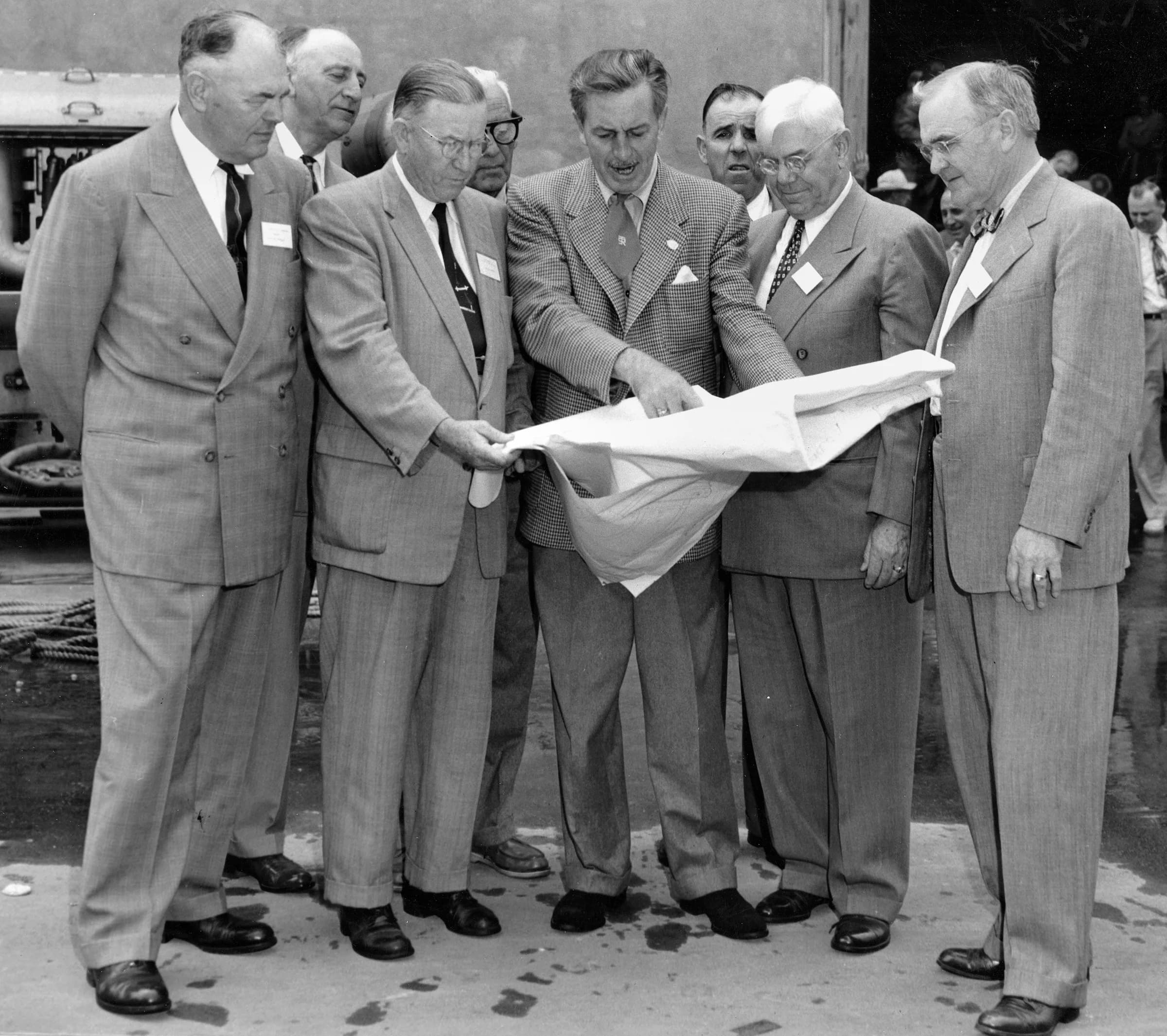
Disneyland, in Anaheim, California, opened on 17 July 1955, after more than two years of development. The Walt Disney Family Museum records that an estimated 90 million viewers watched the opening on television, more than half the population of the United States at the time. The park's opening day was marked by operational problems, but the park itself extended Disney's work beyond films and television into a physical place that visitors could enter.
Disney pursued the project despite scepticism, and he partly financed the effort himself. The park was the only Disney theme park created entirely under his supervision, and it became the model for the parks that followed. Walt Disney World, near Orlando, Florida, opened in 1971, five years after his death, and later parks opened near Tokyo in 1983, near Paris in 1992, in Hong Kong in 2005, and in Shanghai in 2016.
Disney was also involved in planning the 1964 New York World's Fair, and in 1965 he began development of the Florida project, the heart of which was to be a new type of city. He did not live to see it completed. He was diagnosed with lung cancer in 1966 and died on 15 December 1966 in Los Angeles, at the age of 65.
Present and Legacy
Disney holds the record for the most Academy Awards won by an individual, with 22 wins from 59 nominations, and he was presented with two Golden Globe Special Achievement Awards and an Emmy Award, among other honours. His film work continues to be shown and adapted, the Disney theme parks have grown in size and number around the world, and his company has grown to become one of the world's largest mass media and entertainment conglomerates.
His legacy is not only the films and the parks. Disney showed that animation could carry a feature-length story, that sound and colour could be used as part of the storytelling, and that a studio could move from one medium to another without losing its audience. He also showed the risks of that ambition: the studio's finances were strained by Snow White, by the war years, and by the cost of Disneyland, and each risk depended on the success of the last.
The company that bears his name is now far larger than anything he supervised, and its later acquisitions, including the ABC network and 20th Century Fox, belong to a history after his death. What remains from his lifetime is the sequence itself: a failed studio in Kansas City, a mouse drawn in 1928, a feature film in 1937, and a park in 1955. Each step was a bet, and each bet was made with the earnings of the one before it.