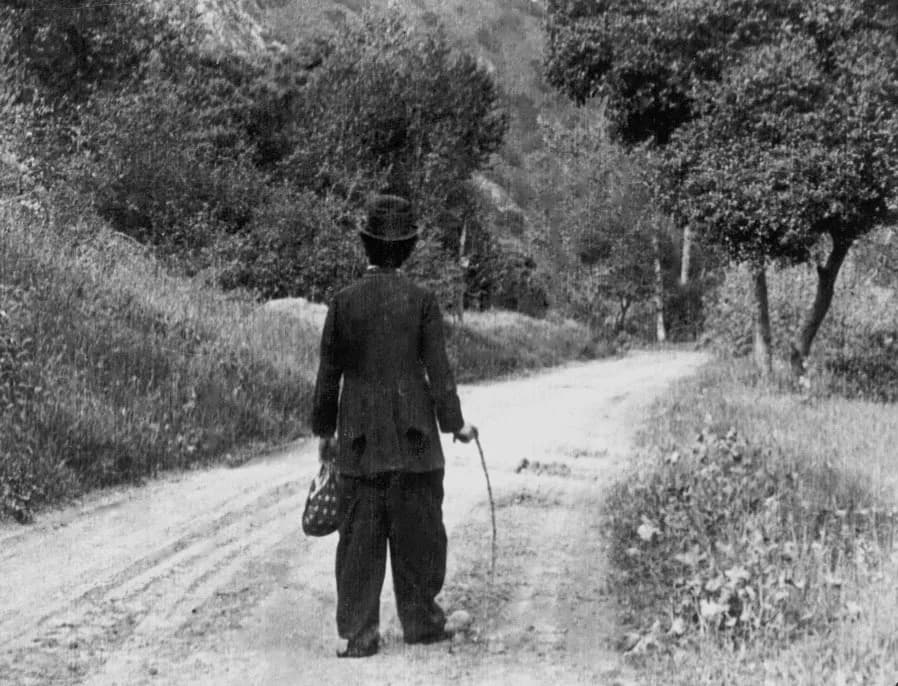
In 1914, a 24-year-old English comedian put together a costume from mismatched clothes: a tight coat, baggy trousers, oversized shoes, a bowler hat, and a cane. He walked in front of a camera at Keystone Studios in Los Angeles, and the Tramp was born. Within a few years, that figure was recognised from America to Japan, and Charlie Chaplin was the most famous performer in the world.
The costume looked like a joke, and it was also a portrait. Chaplin had grown up in poverty in south London, and the Tramp was a down-and-out gentleman who kept his dignity in a world that offered him little. The character made Chaplin rich, and it also gave him a way to talk about poverty, hunger, and humiliation without lecturing his audience.
Chaplin's fame was not an accident of one film. It was built on control: over his films, over his company, and over the terms on which he worked. That control later became the reason he could survive losing the American audience that had made him.
The Public Image
The Tramp was one of the first truly global images in cinema. His bowler hat, toothbrush moustache, tight coat, and distinctive walk needed no translation, and silent film needed none either. By 1918, Chaplin was one of the best-known and best-paid figures in the world, and his face was reproduced on posters, toys, and advertisements in many countries.
His films added depth to the image. The Kid (1921), The Gold Rush (1925), City Lights (1931), and Modern Times (1936) mixed slapstick with pathos, and they showed a poor man struggling against machines, hunger, and authority. Audiences laughed at the Tramp, and they also recognised the world he lived in.
Chaplin resisted sound film longer than almost any other major star. He made City Lights and Modern Times without dialogue, because he believed the Tramp's silence was part of his meaning. His first sound film was The Great Dictator (1940), a satire of Adolf Hitler, in which the Tramp's moustache became a deliberate echo of the dictator's.
Origins and Background
Charles Spencer Chaplin was born on 16 April 1889 in London, England, to Hannah Hill and Charles Chaplin Sr., both music hall entertainers. No official record of his birth has been found, although Chaplin believed he was born in Walworth, in south London. He grew up in the poor districts of Lambeth and Kennington, and his childhood was marked by poverty and hardship.
His parents separated when he was young. His father, a singer, died of alcohol-related illness in 1901, when Charlie was twelve. His mother lost her singing voice and later her health, and she was repeatedly committed to mental hospitals, including the Cane Hill asylum from 1903. Charlie and his older half-brother Sydney spent periods in the Lambeth workhouse and, from 1896, in the Hanwell school for destitute children.
Chaplin made his stage debut at the age of five, filling in for his mother during a performance when her voice failed. At about nine he toured with a troupe of clog dancers, the Eight Lancashire Lads, and in his early teens he played the page boy Billy in a touring production of Sherlock Holmes. Those early years gave him a performer's training, and they also gave him the material for his comedy: hunger, humiliation, and his mother's illness.
The Path to Fame
In 1908, Sydney persuaded the impresario Fred Karno to hire his brother, and Chaplin joined Karno's comedy company. He toured the United States with Karno in 1910 and again in 1912, and during the second tour he caught the attention of the film producer Mack Sennett. In late 1913, Chaplin signed with Keystone Film Company in Los Angeles at $150 a week.
His first film, Making a Living, was released in February 1914. By his second film for Keystone that year, he had developed the Tramp character, and he made about 35 films for the studio in 1914 alone. His popularity grew at an extraordinary pace, and he moved to Essanay in 1915, where he gained more creative control.
In 1916 he signed with Mutual for about $670,000 a year, a contract that made him one of the highest-paid people in the world. The twelve Mutual shorts, including The Immigrant and Easy Street, both from 1917, showed growing sophistication and sympathy for the poor and for newcomers to America. Chaplin later called this period the happiest of his career.
The Reality Behind the Image
In 1919, Chaplin joined Mary Pickford, Douglas Fairbanks, and D. W. Griffith in founding United Artists, a distribution company that gave him complete control over his films. It was a business decision as much as an artistic one: ownership meant he could spend years on a film, as he did on City Lights, without a studio telling him to hurry.
His first feature-length film was The Kid (1921), followed by A Woman of Paris (1923), The Gold Rush (1925), and The Circus (1928). He wrote, directed, produced, edited, starred in, and eventually composed the music for most of his films. His financial independence allowed him to work slowly and to demand perfection, and his films were made on his terms.
That independence also meant that Chaplin's films could carry social commentary. Modern Times (1936) showed a factory worker struggling with machines and unemployment during the Depression, and The Great Dictator (1940) mocked Hitler at a time when many in Hollywood were still cautious about doing so. The Tramp was funny, but the films around him were serious about the world they described.
Challenges, Decisions and Consequences
The 1940s brought controversy that damaged Chaplin's standing in the United States. He was accused of communist sympathies, and the Federal Bureau of Investigation opened an investigation into him. His involvement in a paternity suit and his marriages to much younger women were reported widely, and some members of the press and public turned against him.
In 1952, Chaplin left the United States to visit London, and his re-entry permit was cancelled while he was travelling. He did not return to live in America, and in 1953 he moved to Vevey, on Lake Geneva in Switzerland, where he settled with his fourth wife, Oona O'Neill, whom he had married in 1943. The couple had eight children, and Chaplin lived in Switzerland for the rest of his life.
His later films, including Monsieur Verdoux (1947), Limelight (1952), A King in New York (1957), and A Countess from Hong Kong (1967), were made outside the Hollywood system that had made him famous. They did not reach the audience of his earlier work, and his popularity in America declined. The exile cost him his American audience, but it did not cost him his independence.
Present and Legacy
Chaplin died on 25 December 1977 in Vevey, Switzerland, at the age of 88. His career had spanned more than 75 years, from childhood performances in Victorian music halls to films made in the year before his death. In 1972, the Academy of Motion Picture Arts and Sciences gave him an Honorary Award for his outstanding contribution to the film industry, and in 1975 he was knighted.
His films remain among the most admired in cinema history. The Gold Rush, City Lights, Modern Times, and The Great Dictator are regularly listed among the greatest films of all time, and the Tramp remains one of the most recognisable images in film. The character that began as a costume in 1914 outlived the silent era, the studio system, and Chaplin's own exile.
Chaplin's life also left a practical lesson for performers. He showed that a star could own the means of production — through United Artists and through his own studio — and could therefore decide what to make and how long to take. He also showed the limits of that freedom: ownership could not protect him from political pressure, and fame could not guarantee a welcome home. Both parts of that lesson are part of his legacy.