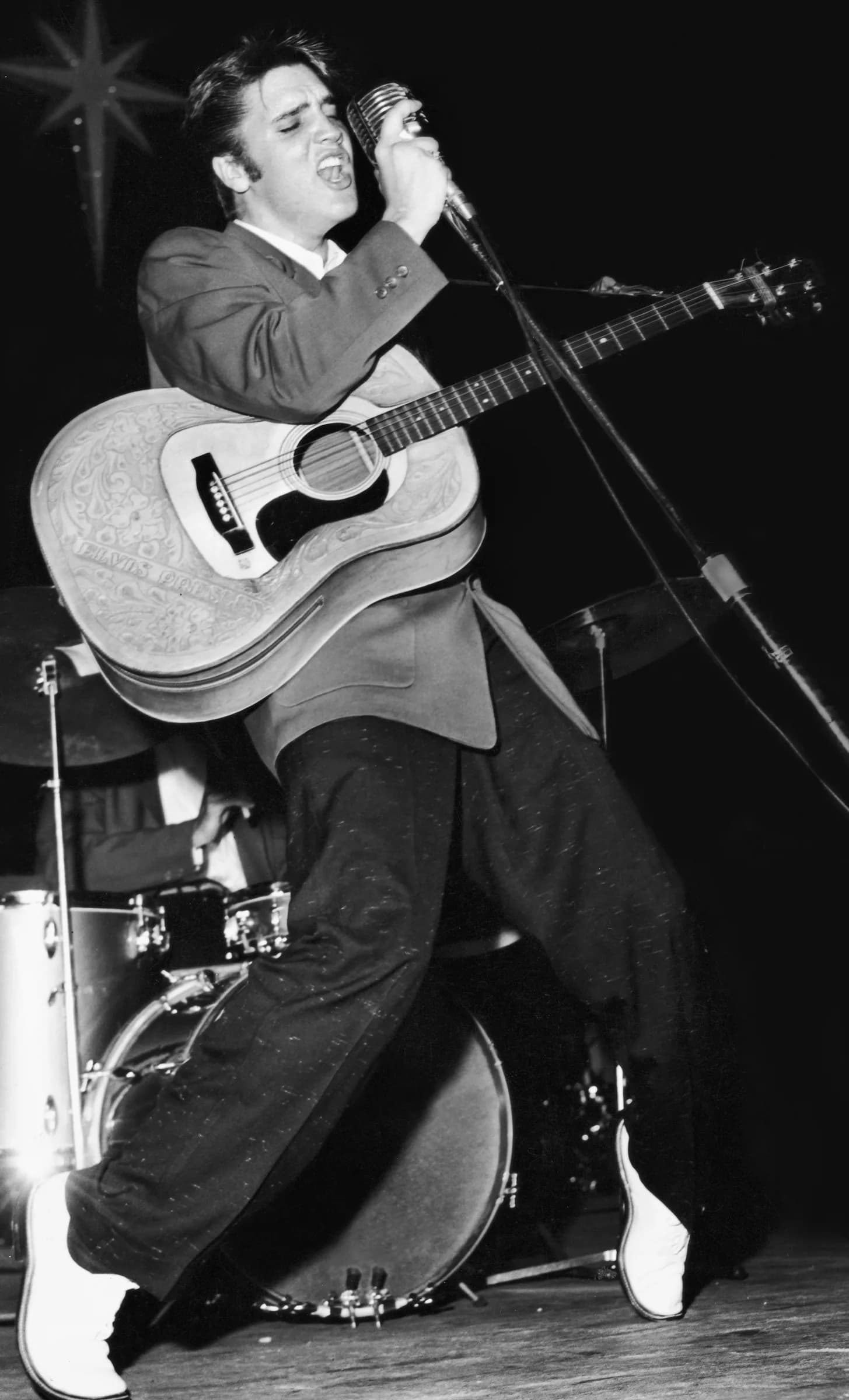
In 1956, Elvis Presley was 21 years old and already an international sensation. Two years earlier he had been a truck driver in Memphis, recording a song at a small local studio. By the end of 1956, "Heartbreak Hotel" had topped the charts, and his performances on television had reached audiences in the tens of millions.
The speed of that rise is hard to overstate. It was also the pattern of his life: sudden success, followed by years of work inside arrangements made by other people. Presley became the King of Rock and Roll, and the title described both his influence and his confinement.
His story is about what fame gave him and what it took away. The money and the audience were real, and so were the limits placed on his music, his films, and his time.
The Public Image
Presley's public image was built on sound and movement. His music mixed blues, country, gospel, and rhythm and blues, and his stage performances were more physical than anything American television audiences had seen from a popular singer. That energy made him a sensation, and it also made him a target of criticism from people who found his style too loud and too suggestive.
Graceland, his Memphis home, became part of the image as well. He bought the mansion in 1957, when he was 22, and lived there for the rest of his life. After his death it opened to the public in 1982 and became one of the most visited private homes in the United States.
The title "King of Rock and Roll" stuck because the scale of his success supported it. Graceland records that he sold over one billion records worldwide, starred in 31 feature films and two concert documentaries, and won three Grammy Awards, all for gospel recordings. He was inducted into the Rock & Roll Hall of Fame in 1986, in its first class of inductees.
Origins and Background
Elvis Aaron Presley was born on 8 January 1935 in a two-room house in Tupelo, Mississippi, to Vernon and Gladys Presley. His twin brother, Jessie Garon, was stillborn, and Elvis grew up as an only child. The family lived in near-poverty during his early years, and the house had no running water or electricity.
The family moved to Memphis, Tennessee, in 1948, when Elvis was thirteen. He attended Humes High School there and graduated in 1953. His musical influences were the pop and country music of the time, the gospel music he heard in church, and the rhythm and blues he absorbed on Beale Street as a teenager in Memphis.
After leaving school he worked as a truck driver for Crown Electric in Memphis. He also recorded at the small Sun Records studio, where the owner, Sam Phillips, was looking for a performer who could bring Black musical styles to a wider audience. That search, and Presley's voice, met in the summer of 1954.
The Path to Fame
On 5 July 1954, Presley recorded "That's All Right" at Sun Records. The song was not an immediate national hit, but it established him in the South, and his live performances built a following quickly. By the end of 1955 he was one of the biggest names in country music, and his manager, Colonel Tom Parker, arranged the sale of his recording contract to RCA Victor.
The RCA deal brought "Heartbreak Hotel", which topped the charts in early 1956 and sold in the millions. Television appearances followed, and his first film, Love Me Tender, was released in 1956. In March 1957 he bought Graceland for $102,500.
Parker took a 25 per cent share of Presley's income, a large proportion for a manager, and he controlled many of the decisions about Presley's career. That arrangement brought Presley money and exposure, and it also meant that his manager's judgement shaped where he performed, what he recorded, and which films he made.
The Reality Behind the Image
In March 1958, at the height of his fame, Presley was drafted into the United States Army. He served in Germany and was honourably discharged in March 1960. His mother, Gladys, died in 1958, not long after he was drafted, and the loss affected him deeply. The army years kept him in the public eye through press coverage, but they also removed him from recording and performing for two years.
When he returned, his career moved toward films. He starred in 31 feature films, many of them light musical comedies made quickly and to a formula. The films earned money, but they gave him little room to develop as a musician, and critics have long noted that the film years narrowed his artistic range. His recording work continued, but the films set the pace of his working life through much of the 1960s.
He married Priscilla Beaulieu in Las Vegas on 1 May 1967, and their daughter, Lisa Marie, was born on 1 February 1968. The marriage ended in divorce in 1973. In December 1968, his television special, widely known as the Comeback Special, returned him to live performance with new energy, and he resumed touring and performing in Las Vegas in the years that followed.
Challenges, Decisions and Consequences
The final years of Presley's life were marked by heavy touring, long residencies, and declining health. Years of prescription drug use and poor eating habits had damaged his health, and his weight and energy fluctuated. He continued to perform because the work, the contracts, and the expectations around him made stopping difficult.
His final concert took place in Indianapolis on 26 June 1977. He died at Graceland on 16 August 1977, at the age of 42, from cardiac arrest. Britannica records that he died of a heart attack brought on largely by drug abuse, and that his girlfriend found him unconscious in the bathroom adjoining his bedroom. He was pronounced dead at 3.30 pm at Baptist Memorial Hospital in Memphis.
After his death, his family sued Parker for fraud and mismanagement, a dispute that reflected long-standing questions about the manager's share of Presley's earnings and the terms of his contracts. The legal dispute did not change the music, but it changed how the business of his career was understood.
Present and Legacy
Graceland remains one of the most visited private residences in the United States, and Presley's records continue to sell decades after his death. He was inducted into five music halls of fame, for rock and roll, country, gospel, rockabilly, and rhythm and blues, and he received the Presidential Medal of Freedom posthumously in 2018. In 2002, the United States Library of Congress added his Sun recording sessions of 1954–55 to the National Recording Registry.
His influence on popular music is documented in the work of the performers who followed him. The Rock & Roll Hall of Fame quotes John Lennon of the Beatles: "Without Elvis, there would be no Beatles." That is a claim about influence, not a measure of sales, and it points to the part of Presley's legacy that is hardest to count: the way he changed what a popular singer could sound like and how a popular singer could perform.
The other part of his legacy is a warning that the industry has not fully absorbed. Presley's talent was real, his audience was enormous, and his earnings were large, yet the structure around him — a single manager, a heavy schedule, and a career built on constant output — left him with little room to rest or to change direction. Fame made him, and the arrangements that sustained that fame helped to wear him out.