On 2 November 1947, Howard Hughes piloted a wooden flying boat, the H-4 Hercules, on its first and only flight, above the water at Long Beach, California. The aircraft, nicknamed the Spruce Goose by critics, had been built to carry troops across the Atlantic during the Second World War. The war had ended two years earlier, and the flight lasted less than a minute.
Hughes had spent years and millions of dollars on the project, and he had defended it before a United States Senate committee earlier that year. The brief flight proved that the giant aircraft could leave the water, and it also proved how far Hughes's ambitions had outrun their original purpose. It was a public triumph and a private warning at the same time.
That pattern ran through his life. Hughes used great wealth to attempt things other people could not afford to attempt, and he kept attempting them long after the practical case for them had faded. The same wealth later allowed him to withdraw from the world almost entirely.
The Public Image
In the 1930s, Hughes was a public figure in the most glamorous sense. He was a film producer in Hollywood, a record-setting pilot, and a wealthy young man whose romances with actresses were reported in the press. His round-the-world flight in July 1938 made him a national hero, and he received a ticker-tape reception on his return.
His films added to that image. Hell's Angels (1930), a First World War aviation epic, was one of the most expensive films of its time, and Scarface (1932) was noted for its violence. Hughes directed and produced films that ran over budget and clashed with censors, and the press treated those clashes as part of his character.
By the late 1940s, the image had changed. Hughes bought a controlling interest in RKO Pictures in 1948, but the studio struggled under his control and stopped production in 1957. He had also become a major figure in aviation, controlling Trans World Airlines, yet he was seen in public less and less. The playboy pilot was becoming a figure people wrote about rather than saw.
Origins and Background
Howard Robard Hughes Jr. was born on 24 December 1905 in Houston, Texas, the only child of Howard R. Hughes Sr. and Allene Stone Gano Hughes. His father had invented a rotary drill bit for oil-well drilling in 1909, and the patent made the family extremely wealthy. The Hughes Tool Company, built on that invention, became the foundation of the family fortune. Hughes showed an early talent for engineering, and he studied at the Rice Institute in Houston and at the California Institute of Technology.
His mother died in 1922, when he was sixteen, and his father died in 1924, when he was eighteen. A Texas court declared him an emancipated minor on his nineteenth birthday, and he took control of the family business.
That inheritance shaped everything that followed. Hughes did not need to earn a living before he could take a risk, and he did not need anyone's permission to spend large sums on a film or an aircraft. The freedom was real, and it removed the ordinary limits that force most people to choose between projects.
The Path to Fame
Hughes moved to Hollywood in 1926 and began producing films. He produced Two Arabian Knights (1927), which won an Academy Award, and then Hell's Angels, on which he took over as director. The film made Jean Harlow a star, and its cost and scale made Hughes a serious figure in Hollywood.
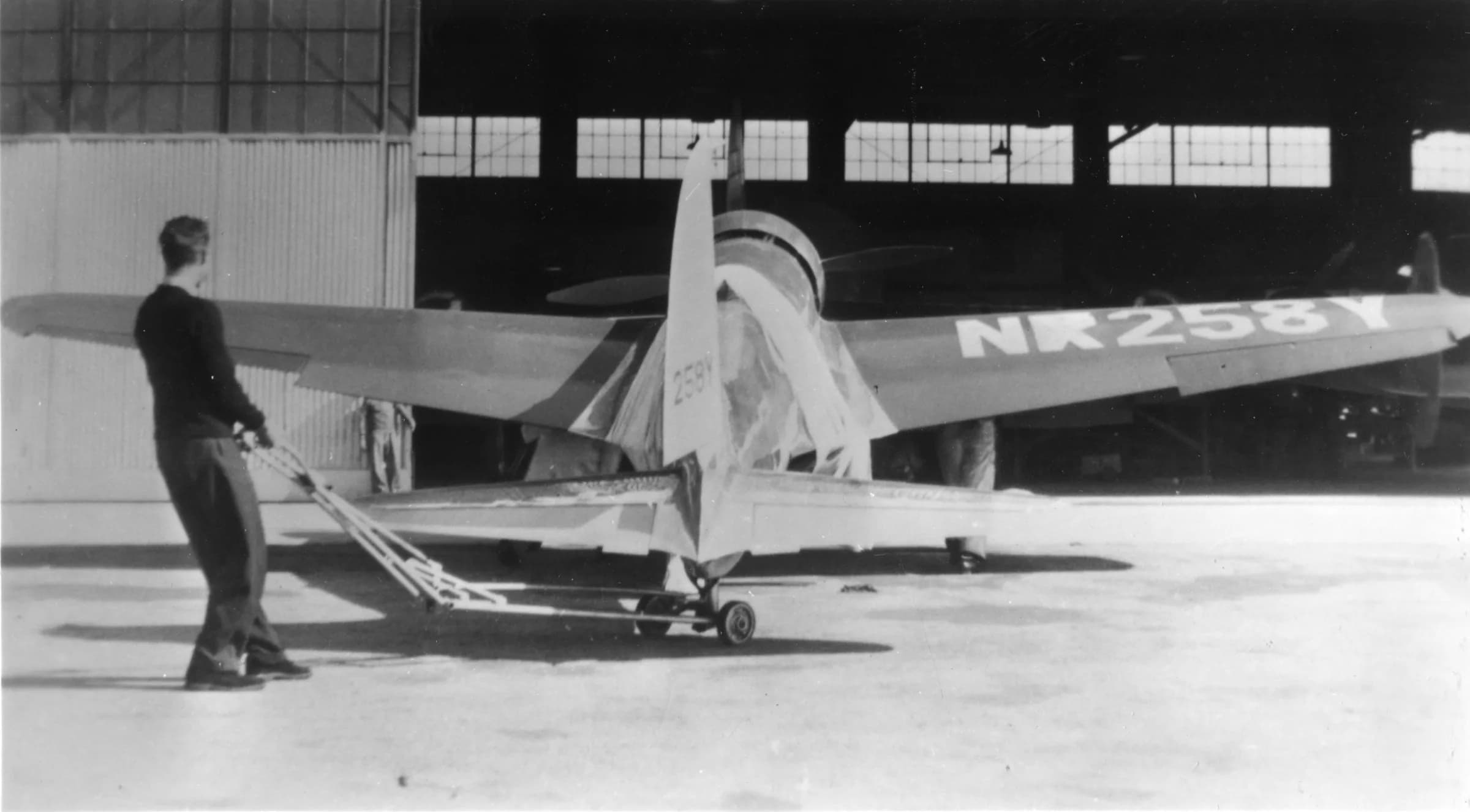
In 1932 he founded the Hughes Aircraft Company. Three years later, on 13 September 1935, he flew the H-1 Racer, an aircraft he had designed with Richard Palmer and built with Glenn Odekirk, to a world landplane speed record of 352 miles per hour at Santa Ana, California. The Smithsonian, which now holds the H-1, records the speed as 567 kilometres per hour.
On 19 January 1937, Hughes broke the transcontinental speed record, flying from Los Angeles to Newark, New Jersey, in 7 hours, 28 minutes, and 25 seconds. In July 1938 he flew around the world in 91 hours, a record that brought him the Harmon Trophy and the Collier Trophy, and the Congressional Gold Medal in 1939.
The Reality Behind the Image
The H-4 Hercules shows the difference between Hughes's ambition and its results. The project began in 1942, when the shipbuilder Henry J. Kaiser proposed a giant flying boat to carry cargo over the Atlantic, where German submarines were sinking Allied ships. Hughes joined the project, and the aircraft was built largely of wood, using a laminated process called Duramold, because wartime restrictions limited the use of aluminium.
Kaiser withdrew in 1944, and Hughes continued alone. The aircraft was not completed until after the war, and its single flight on 2 November 1947 lasted about 26 seconds and covered roughly a mile. The H-4, with a wingspan of about 320 feet, remained the largest flying boat ever built, and it held the record for the largest wingspan of any aircraft flown until 2019. It never flew again, and it is now preserved at the Evergreen Aviation & Space Museum in McMinnville, Oregon.
Hughes's business career followed a similar pattern of bold moves and difficult endings. He acquired and expanded Trans World Airlines, but he was forced to sell his controlling stock in 1966 after legal action. He invested in Las Vegas in the 1960s, buying hotels and casinos, and he founded the Howard Hughes Medical Institute, which continues as a major medical research organisation.
Challenges, Decisions and Consequences
In July 1946, Hughes was nearly killed while test-piloting the XF-11, a photo-reconnaissance aircraft. The crash left him with chronic pain, and sources describe worsening obsessive-compulsive disorder and increasing deafness in the years that followed. This article does not offer a diagnosis beyond what those sources report, and it does not present any single cause for his later behaviour.
From about 1950, Hughes went into seclusion. He lived in luxury hotels, often in a black-curtained room, and was rarely seen except by a small number of male aides. He worked for days without sleep, and his contact with his own companies narrowed to written messages passed through intermediaries. Britannica records that he sought absolute privacy and was rarely seen by anyone except a few aides.
The seclusion had practical consequences. Decisions about his businesses were delayed or made through layers of intermediaries, and his absence made it harder for his companies to respond to change. He married the actress Jean Peters in 1957, and the couple divorced in 1971. He left no will, and after his death his estate was tied up in litigation for years.
Present and Legacy
Hughes died on 5 April 1976, at the age of 70, of kidney failure, while being flown from Acapulco, Mexico, to a hospital in Houston. He had spent more than twenty years as a recluse, and his death closed a life that had moved from public celebration to almost complete invisibility. Most of the empire he had built dissolved after his death, and the money was distributed through years of legal proceedings.
What remains is more concrete than the legends around him. The H-1 Racer is on display at the Smithsonian's Steven F. Udvar-Hazy Center in Virginia, and the H-4 Hercules is preserved in Oregon. The Howard Hughes Medical Institute continues to fund medical research, and Hughes Aircraft, in its various forms, contributed to aviation and defence technology for decades.
Hughes's life also left a clearer lesson than his reputation suggests. Wealth gave him the freedom to build aircraft, make films, and buy an airline, and those achievements were real. The same wealth, combined with illness and isolation, allowed him to avoid the ordinary checks — colleagues, schedules, and public accountability — that might have limited the damage of his later years. His records in the air are documented, and his silence on earth is documented too, and both belong in the same story.