On 1 May 1888, the United States Patent Office issued seven patents to one applicant at once. The first of them, US Patent 381,968, described an electro-magnetic motor. It was a machine unlike any motor built before it. It had no commutator, no brushes, and no electrical connection to its moving part at all.
Instead, alternating currents in fixed coils created a magnetic field that rotated, and the rotor followed it. The inventor was Nikola Tesla, a thirty-one-year-old Serbian immigrant who had arrived in New York four years earlier. Within weeks, he would sell the patents to George Westinghouse, and the system they described would become the basis of the world's electricity grids.
Tesla did not invent alternating current. It came out of the first generators anyone built, and it had been known since Faraday's work in 1831. What Tesla invented was the thing that made alternating current useful: a motor that could run on it, and a system of generators, transformers, and lines that could carry it from a power station to a factory floor.
A Boy from Smiljan
Nikola Tesla was born on 10 July 1856 in Smiljan, a village in what is now Croatia, then part of the Austrian Empire. Some sources give the night of 9 to 10 July, and the date was 28 June in the Julian calendar then used by the Orthodox church. His family was Serbian.
His father, Milutin Tesla, was a priest of the Serbian Orthodox Church, and his mother, Đuka, had no schooling but built household tools and devices of her own design. Tesla later credited both parents for his abilities. He was the fourth of five children, and in 1863 his older brother Dane was killed in an accident, a loss that marked his childhood.
He went to secondary school in Karlovac from 1870, and in 1875 he enrolled at the Joanneum polytechnic in Graz, now the Graz University of Technology. There he saw a Gramme dynamo run as a motor, its commutator sparking badly, and he began to think about a motor that would need no commutator at all. He studied in Graz for three years and then stopped attending lectures. He worked as a draughtsman in Maribor from 1878, and he went to Prague in 1880 to attend the university there, but he never took a degree.
In 1881 he moved to Budapest, where he was hired to help install the city's telephone exchange. By his own account, it was in Budapest in 1882 that he visualised the principle of the rotating magnetic field: two alternating currents, a quarter of a cycle apart, could create a magnetic field that turned, and a rotor placed inside it would follow. The idea was the answer to the problem he had seen at Graz. In 1882 he went to Paris to work for the Continental Edison Company, installing incandescent lighting, and while on assignment in Strasbourg in 1883 he built his first induction motor, after work hours, in a workshop.
New York and Edison
Tesla sailed for America in 1884 and arrived in New York with a letter of introduction to Thomas Edison. He found employment with the Edison Machine Works as a dynamo designer, but the two inventors were far apart in background and methods, and their separation was inevitable. Tesla left Edison in 1885. He spent the next two years in difficult circumstances, including a period digging ditches for a living, before two investors backed him to create the Tesla Electric Company in 1887 and set up a laboratory in Manhattan.
On 12 October 1887 he filed his main patent application for the electro-magnetic motor. On 1 May 1888 the Patent Office issued him seven patents, numbers 381,968 to 381,970 and 382,279 to 382,282, covering the motor and the polyphase system of generators, transformers, and lines needed to feed it. On 16 May 1888 he presented the system to the American Institute of Electrical Engineers at Columbia College in a paper called "A New System of Alternate Current Motors and Transformers". The motor's principle was simple to state and hard to build: a rotating magnetic field, created by alternating currents, spun a rotor that needed no electrical connection to anything at all.
George Westinghouse, whose Pittsburgh company was already selling alternating-current lighting, had no practical motor for it. On 7 July 1888, Tesla's backers sold the patents to Westinghouse. The terms are reported differently in different sources, and the article does not state a figure, because the sources do not agree.
Tesla spent about a year in Pittsburgh helping Westinghouse's engineers adapt the motor, then returned to New York in 1889. The sale set off what the press called the war of the currents, a struggle between Edison's direct-current system and the Tesla-Westinghouse alternating-current approach. The alternating-current system eventually won, because a transformer could step its voltage up for transmission over long distances and down again for use, which direct current could not do.
Niagara and the World's Fair
The victory was demonstrated in public. In 1893, Westinghouse's alternating-current system lit the World's Columbian Exposition in Chicago, powering the fair's lights with Tesla's system. Then came Niagara Falls.
The Adams power station at Niagara used Westinghouse alternating-current generators built to Tesla's patents, and in 1896 power from Niagara began reaching Buffalo, about twenty miles away. The machines carried Tesla's name and patent numbers, and Niagara settled the argument over which kind of current would electrify cities.
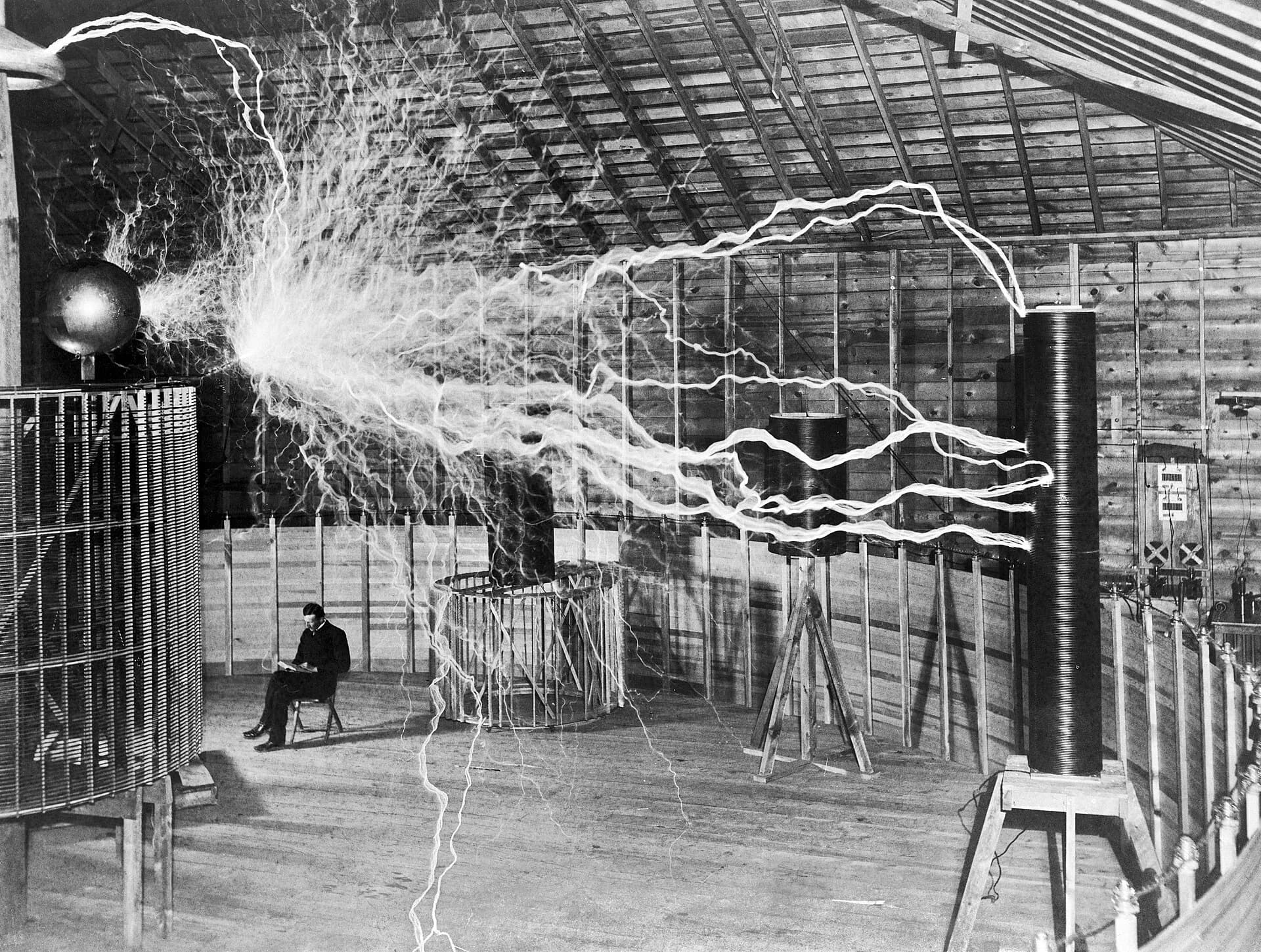
Tesla, meanwhile, had established his own laboratory in New York, where his inventive mind could be given free rein. In 1891 he invented the Tesla coil, a resonant transformer that became a standard part of early radio equipment. He gave exhibitions in which he lit lamps by allowing electricity to flow through his body, to allay public fears of alternating current. In 1898 he demonstrated the first wirelessly controlled boat, at an electrical exhibition in New York, steering a small vessel by radio signals while the audience watched.
He was, by the end of the 1890s, a widely photographed and widely quoted electrical engineer, and a wealthy one. He had registered patents in the United States and in Europe, and he had a laboratory, a reputation, and the attention of the press. He also had ambitions that went beyond the motor. He wanted to send power around the world without wires, and he spent the second half of his life trying to do it.
The Tower and the Long Decline
In May 1899, Tesla set up a laboratory in Colorado Springs and ran it for nine months, building giant high-voltage machines and testing his ideas about wireless transmission. In 1901 he began building the Wardenclyffe Tower on Long Island, a tall structure intended to transmit power and messages around the world without wires. The project was funded by the financier J. P. Morgan, but the money ran out, the tower was never completed, and it was demolished in 1917. Tesla never found another backer on that scale, and he never built the system he had imagined.
His later years were marked by projects that did not succeed and by a growing distance from the electrical industry he had helped to create. He received the Edison Medal in 1917, the highest honour of the American Institute of Electrical Engineers, a recognition from the profession that had once been divided by his work. He continued to work on ideas for wireless power, for turbines, and for aircraft, but few of them reached the market. He lived in hotels in New York, moving from one to another as his money ran out, and he fed the pigeons in Bryant Park.
Nikola Tesla died on 7 January 1943, alone in room 3327 of the Hotel New Yorker, at the age of eighty-six. After his death, the Office of Alien Property impounded his papers, his diplomas, and his letters, because he had been born in a country that was then at war. The papers were later returned, and most of them are now held by the Nikola Tesla Museum in Belgrade, which also keeps his ashes.
The Current That Remained
Tesla's reputation has grown since his death, and it has grown in ways he might not have recognised. The SI unit of magnetic flux density has carried his name since 1960. He was inducted into the National Inventors Hall of Fame in 1975 for his electro-magnetic motor. A museum in Belgrade keeps his papers, and monuments to him stand in many countries.
An electric car company bears his name. The growth of his reputation has also brought exaggeration, and many claims are now made for him that the record does not support. He did not invent alternating current, and he did not invent radio. What he did invent was the motor and the polyphase system that made alternating current the standard for powering homes and offices.
That is enough. Every time a light is switched on, a lift moves, or a factory machine turns, the current that does the work is the current Tesla's motor was built for. He imagined it in Budapest, built it in Strasbourg, patented it in New York, and sold it to Westinghouse, and the world has used it ever since. He died alone in a hotel room, but the system he built is in every wall in every city.