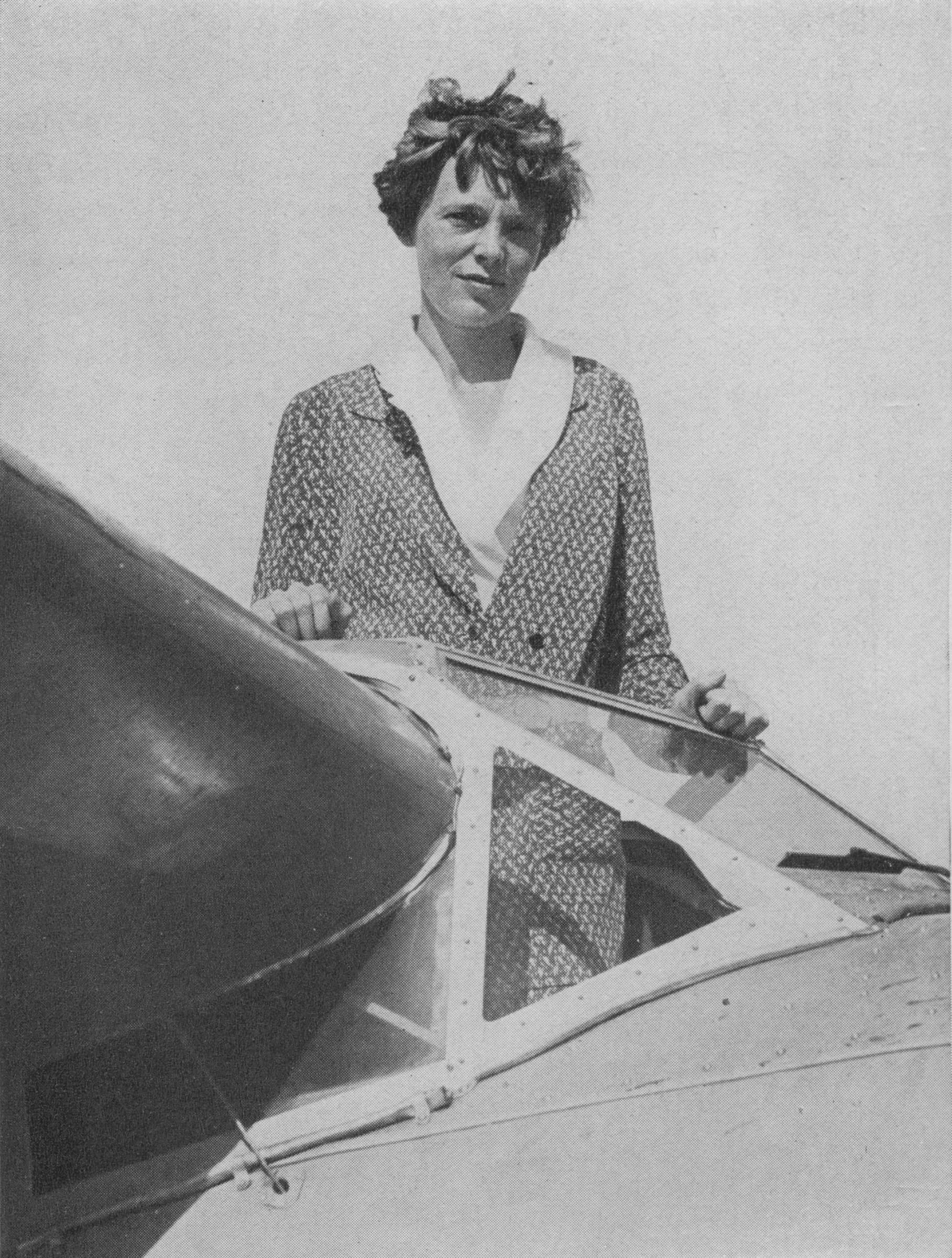
On the evening of 20 May 1932, Amelia Earhart took off from Harbor Grace, Newfoundland, in a red Lockheed Vega, alone. She was flying across the Atlantic Ocean, and no woman had done it solo before. The flight lasted about fifteen hours. Ice formed on the wings, the fuel tank leaked, and a cracked manifold sent flames out of the engine cowling.
At one point the aircraft dropped three thousand feet in a spin before she pulled it out. She landed in a farmer's field in Culmore, near Londonderry in Northern Ireland, 2,026 miles from where she had started. She was thirty-four, and she was, overnight, the most famous woman pilot in the world.
She had not set out to be famous. She had set out to prove that a woman could fly an aeroplane across an ocean alone, and that the feat was a matter of skill rather than luck. The flight proved it. What followed was five years of records, lectures, and books, and then a final flight that ended in silence.
A Girl from Atchison
Amelia Mary Earhart was born on 24 July 1897 in Atchison, Kansas. She was an independent child, keeping a scrapbook of accomplished women, taking an auto repair course, and playing games that were then considered boys' games. She attended college but never graduated. In 1918, while serving as a Red Cross nurse's aide in Toronto, Canada, she attended her first flying exhibition, and she began to think about flying herself.
She took her first flying lesson in 1921, with the instructor Neta Snook, and she soloed the same year. In 1922 she bought her first aeroplane, a Kinner Airster, and set a women's altitude record of 14,000 feet. She was not yet famous, and she was not yet rich. She worked as a nurse's aide and then as a social worker at a settlement house in Boston, and she flew when she could afford to.
In 1928, she was invited to fly across the Atlantic as a passenger, with the pilots Wilmer Stultz and Louis Gordon, in the Fokker Friendship. She was the first woman to cross the Atlantic by air, but she had not flown the aircraft, and the distinction mattered to her. She wanted to make the crossing alone, as pilot.
In 1929, she organised an all-women's air race from Los Angeles to Cleveland, which the humourist Will Rogers called the Powder Puff Derby. With a group of women pilots, she founded the Ninety-Nines, the first professional organisation for women pilots, and became its first president. She was building, deliberately, a place for women in aviation. She married the publisher George Putnam in 1931.
The Solo Atlantic Crossing
On 20 May 1932, exactly five years to the day after Charles Lindbergh had made the first solo Atlantic crossing, Earhart took off from Harbor Grace in her Lockheed Vega 5B. Lindbergh had been the first person to fly the Atlantic alone; Earhart became the second person, and the first woman. The flight was 2,026 miles, and it took about fifteen hours.
She fought fatigue, a leaking fuel tank, and a cracked manifold that spewed flames. Ice on the wings caused a descent of three thousand feet to just above the waves. Realising she was on a course far north of France, she landed in a field near Londonderry.
The crossing made her a worldwide sensation, and it proved she was a courageous and able pilot. She was awarded the Distinguished Flying Cross, the first woman to receive it, and she was awarded it by the United States Congress. Then, on 24 and 25 August 1932, she made the first solo, nonstop flight by a woman across the United States, from Los Angeles to Newark, New Jersey, in 19 hours and 5 minutes, covering 2,447 miles. In January 1935 she became the first person to fly solo from Hawaii to California, a flight of about eighteen hours over the Pacific.
She used her fame to argue that women should reject constrictive social norms and pursue opportunities in aviation and in other fields. She wrote books about her flights, she lectured, and she worked as a visiting faculty member and careers counsellor for women at Purdue University. In 1936, with funds from the Purdue Research Foundation, she bought a new Lockheed 10-E Electra, a twin-engine aircraft. Her intent was to fly it around the world.
The World Flight
Earhart wanted to be the first person of either sex to fly around the world at its widest, close to the equator. Her first attempt began on 17 March 1937 in Oakland, California, and ended abruptly in Honolulu, Hawaii, when a tyre blew and a shock absorber on the landing gear failed, damaging the aircraft on the runway. She had the Electra repaired and decided to try again, this time heading east.
The second attempt began on 21 May 1937, again from Oakland. She and her navigator, Fred Noonan, flew to Miami, Florida, where they made final adjustments to the engines and instruments. On 1 June they departed Miami, flying east around the world.
They reached Lae, New Guinea, on 29 June, having flown on 21 of the previous 30 days and covered 22,000 miles. They had about 7,000 miles left to go, and the hardest leg was next: a flight of about 2,500 miles to Howland Island, a speck of land in the Pacific Ocean, where the United States Coast Guard cutter Itasca waited to guide them in.
On 2 July, Earhart and Noonan left Lae for Howland Island. They never found it. Earhart radioed the Itasca that the aircraft was running out of fuel, and about an hour later she announced, "We are running north and south." That was the last transmission the Itasca received.
The two aircraft and the two people were never found. A massive sea and air search covered an area roughly the size of Texas, and Earhart and Noonan were declared lost at sea in mid-July 1937. Earhart was declared legally dead on 5 January 1939.
What Remains
Earhart's disappearance became one of the great mysteries of the twentieth century, and it has generated countless theories. Some say the aircraft ran out of fuel and went down in the sea about a hundred miles from Howland Island. Others have proposed landings on other islands, capture, or survival.
None of the theories has been proved, and no wreckage has ever been found. In October 2026, researchers reported that a blurry object seen in satellite images, which some had suggested was her aircraft, was in fact a collection of trees. The mystery remains a mystery, and this article does not endorse any theory.
What is not a mystery is what Earhart did. She was the first woman to fly solo across the Atlantic, the first woman to fly solo across the United States, and the first person to fly solo from Hawaii to California. She founded the first professional organisation for women pilots, and she used her fame to argue that women belonged in aviation. Her red Lockheed Vega, the aircraft in which she crossed the Atlantic, is held by the Smithsonian Institution, and it is still painted the colour it was on the morning she took off from Harbor Grace.
She disappeared at thirty-nine, on a flight she had chosen to make. The last message from her aircraft was a report of a search pattern, flown north and south, looking for an island that was too small to find. The search for her has continued, in one form or another, ever since.