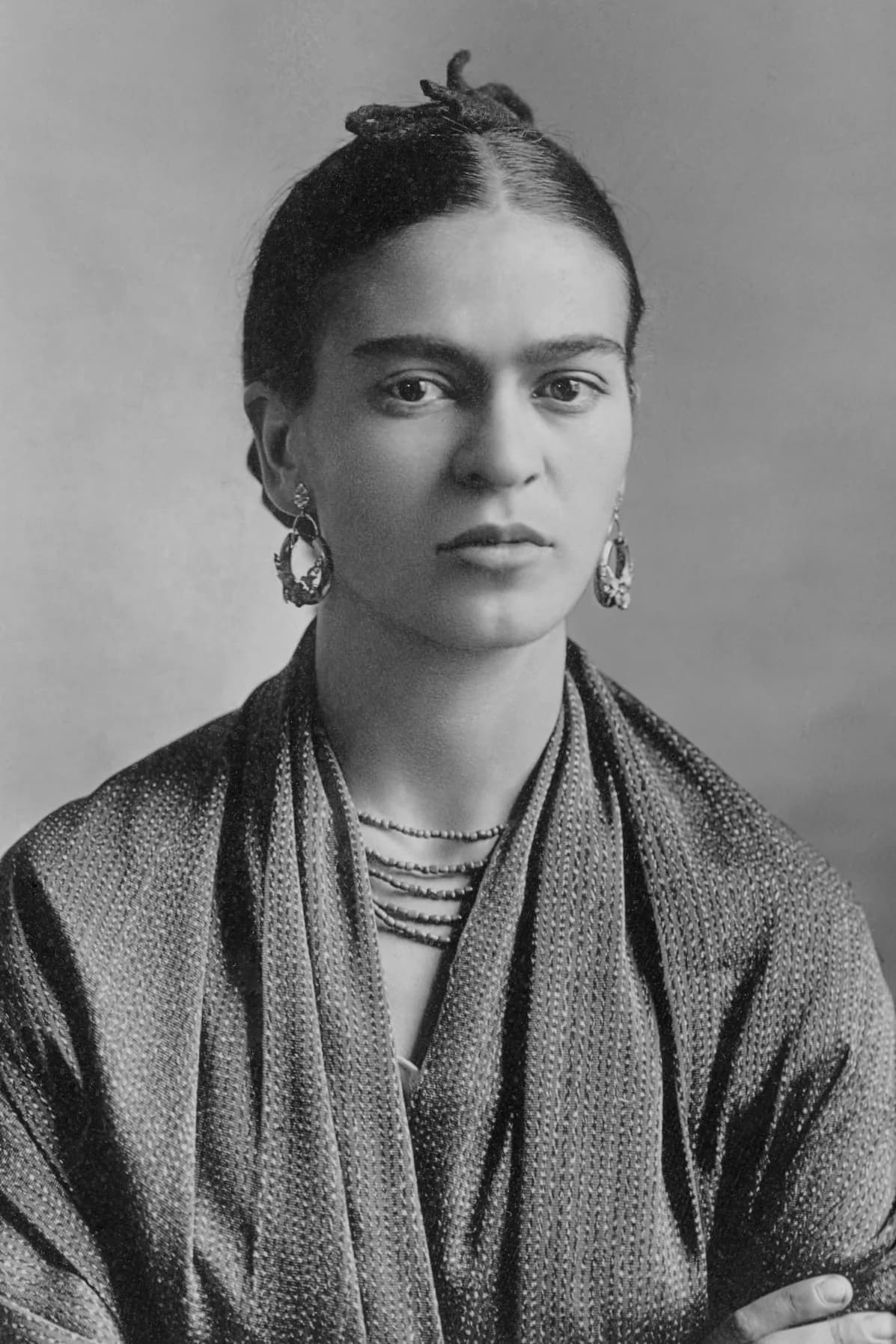
Frida Kahlo painted herself twice in 1939, sitting side by side on a bench against a stormy sky. In The Two Fridas, one Frida wears a white Victorian dress and the other a brightly coloured Tehuana costume. Their hearts are exposed on their chests, joined by a single artery.
One holds surgical forceps; the other holds a small portrait of Diego Rivera, her husband, from whom she had just been divorced. The painting is nearly two metres wide, and it is the most famous work of her life. It was painted in the year her marriage ended, and it shows a woman looking at herself as two people at once.
Kahlo painted herself more than any other subject, because her own body was the subject she knew best, and the one that had given her the most to paint about. She had been in pain since she was eighteen, and she would be in pain for the rest of her life.
A Childhood in Coyoacán
Magdalena Carmen Frida Kahlo y Calderón was born on 6 July 1907 in Coyoacán, then a town on the edge of Mexico City. Her father, Guillermo Kahlo, was a German photographer of Hungarian descent. Her mother, Matilde Calderón, was Mexican, of Spanish and Indigenous descent.
The family home, built by her parents and painted blue, is now the Frida Kahlo Museum, known as the Casa Azul. Kahlo spent most of her childhood and adult life there.
She contracted polio at six, which left her right leg thinner than her left and gave her a slight limp. She was a promising student, and she was headed for medical school. She was interested in science and in politics, and she had begun to fill notebooks with sketches.
She was eighteen, riding a bus home from school in 1925 with her boyfriend, Alejandro Gómez Arias, when the bus collided with a streetcar. The accident nearly killed her.
Her injuries were severe: multiple fractures of the spine, pelvis, collarbone, ribs, and right leg, a dislocated shoulder, a crushed right foot, and an iron handrail that pierced her abdomen and uterus. She was confined to bed for months, wearing plaster corsets, and she would undergo many operations over the rest of her life. She abandoned her plans for medicine.
Her mother had a special easel made for her bed, and a mirror fixed above it, so that she could paint lying down. She began to paint herself, because her own face was the subject in front of her. Her first known work, Self-Portrait Wearing a Velvet Dress, was painted in 1926, a year after the accident.
Rivera and the World
Kahlo joined the Mexican Communist Party in 1927, through which she met the muralist Diego Rivera, twenty years older than her and already the most famous artist in Mexico. They married in 1929. The marriage was stormy from the start, marked by infidelity on both sides, by Rivera's size and fame and Kahlo's illness, and by a devotion that survived two separations.
They divorced in 1939 and remarried in 1940. The relationship shaped her work more than any other, and it also overshadowed it: for most of her life, she was known first as Rivera's wife.
Her painting developed in the 1930s into something unmistakable. She painted small self-portraits that mixed realism with fantasy, drawing on Mexican folk culture, pre-Columbian art, and Catholic imagery. She painted her body as it was: in pain, in plaster corsets, with a spine shown as a shattered column, with a necklace of thorns, with her heart exposed.
She painted miscarriages she could not carry to term, and the operations she endured. The work was intensely personal, and it was also rooted in the Mexico around her, in its colours, its clothes, and its art.
The surrealist André Breton arranged her first solo exhibition in 1938, at the Julien Levy Gallery in New York. It was a success. The following year she travelled to Paris for an exhibition of Mexican art, and the French government acquired her painting The Frame, making her the first Mexican artist whose work entered the Louvre's collection.
The Paris exhibition itself was less successful, and Kahlo returned to Mexico. In 1939, the year of her divorce, she painted The Two Fridas, the double self-portrait that remains her most famous work.
Pain as a Subject
Kahlo never recovered from the accident, and her health declined through the 1940s. She painted less often, and when she did, the paintings were smaller and more painful. She painted The Broken Column in 1944, showing herself in a steel corset with her spine replaced by a cracked Ionic column.
She painted The Wounded Deer in 1946, showing herself as a deer pierced by arrows. She painted Self-Portrait with Thorn Necklace and Hummingbird in 1940, her face calm while thorns cut into her neck. The calm in the paintings is part of their force: she does not ask for pity, and she does not look away.
Her politics remained part of her life. She had joined the Communist Party in 1927, and she remained committed to its ideals. Her last paintings include political works, and her last public appearance, in a wheelchair, was at a demonstration on 2 July 1954 against the overthrow of Guatemala's elected government. She was forty-seven, and she had eleven days to live.
Her health had deteriorated so far by 1953 that part of her right leg was amputated because of gangrene. That same year she had her first solo exhibition in Mexico, at the gallery of the photographer Lola Álvarez Bravo. She was too ill to stand, so she arrived by ambulance and greeted her guests from a four-poster bed carried into the gallery. The exhibition was a triumph, and it was the only solo exhibition she ever had in her own country.
Death and Rediscovery
Frida Kahlo died on 13 July 1954 at the Casa Azul, a week after her forty-seventh birthday. The official cause of death was a pulmonary embolism, a blood clot in the lungs. No autopsy was performed, and some historians have questioned the official explanation. Her last paintings, from that spring, include the still life Viva La Vida, painted after a gap of a year, and the political works Marxism Will Give Health to the Sick and Frida and Stalin.
During her lifetime, her work was relatively little known outside Mexico, and she was overshadowed by Rivera. That changed from the late 1970s, when feminist art historians and Chicana artists rediscovered her work, and a widely read biography by Hayden Herrera brought her story to a wider audience. The 2002 film Frida, starring Salma Hayek, carried her story to a mass audience. By the early 1990s she had become not only a recognised figure in art history but a cultural icon, celebrated for her uncompromising depiction of the female body and for her Mexican identity.
Her work is now reproduced everywhere, on posters, clothing, and household objects, and the reproduction has sometimes reduced her to a symbol. The paintings themselves resist that. They are small, detailed, and specific, and they show a woman who painted what happened to her body and what she thought about it. She painted herself because she was the subject she could reach from a bed, and because no one else had painted a life like hers.