On 5 April 1887, a six-year-old girl stood at a water pump in the yard of her family's house in Tuscumbia, Alabama. Her teacher held one of the girl's hands under the spout while the cool water ran over it, and with her other hand spelled a word into the girl's palm: W-A-T-E-R. The girl had been spelling words for a month without knowing what a word was.
In that moment, she understood. Everything had a name, and the names could be learned.
The girl was Helen Keller. She had been deaf and blind since she was nineteen months old. She would go on to graduate from university, write twelve books, and travel the world as an advocate for blind and deaf-blind people. The moment at the pump is the one she returned to for the rest of her life, because it was the moment language began.
A Childhood Without Words
Helen Adams Keller was born on 27 June 1880 in Tuscumbia, a small town in northern Alabama. She opened her own autobiography with that fact, plainly: "I was born on June 27, 1880, in Tuscumbia, a little town of northern Alabama." Her father, Arthur Keller, was a former Confederate officer and the editor of the local newspaper.
Her mother, Kate, kept the house at Ivy Green, the family estate. Helen was a healthy baby, and by all accounts a lively one.
In February 1882, when Helen was nineteen months old, she fell seriously ill. The fever lasted for days, and when it passed, she could neither see nor hear. No doctor ever established what the illness was.
Scarlet fever and meningitis have both been suggested, and the American Foundation for the Blind notes that no definitive diagnosis was ever determined. What was certain was the result: a child who had begun to speak a few words was cut off from language before she had learned it.
Helen grew into a wilful, frustrated child. She could not be told what was happening, and she could not tell anyone what she wanted. Her family loved her and indulged her, and she learned to get her way with temper and force. She was bright, and her family knew it.
They also knew that without a teacher she would remain locked inside herself. In the summer of 1886, her mother heard about the Perkins School for the Blind in Boston from Alexander Graham Bell, the inventor of the telephone, who had worked with deaf children. Bell recommended that the Kellers write to Michael Anagnos, the director of Perkins.
The Teacher Arrives
Anagnos sent his star pupil. Anne Mansfield Sullivan was twenty years old, a graduate of Perkins, and only fourteen years older than Helen. Her own childhood had been harsh: the daughter of poor Irish immigrants, she had spent four years as a ward of the state at the Tewksbury Almshouse in Massachusetts before entering Perkins at fourteen.
Her own sight was badly damaged, and she had undergone several operations before it was partly restored. She understood, from the inside, what it meant to live with damaged vision.
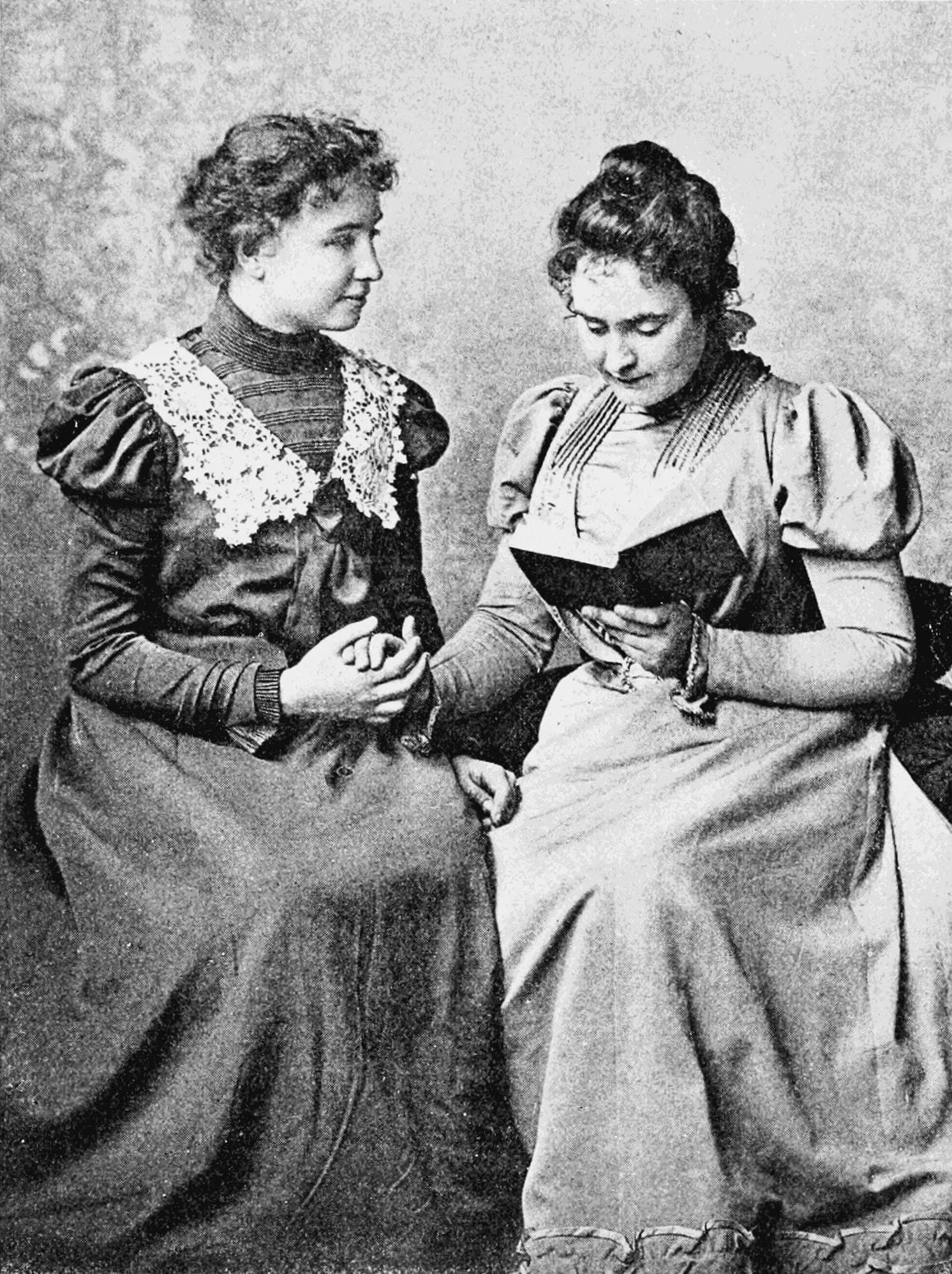
Sullivan arrived in Tuscumbia on 3 March 1887. Keller would later call it the most important day of her life. Sullivan began by spelling words into Helen's hand with the manual alphabet, starting with a doll the children at Perkins had made. Helen learned to form the letters quickly and in the correct order, but the letters meant nothing to her.
She was copying shapes without knowing that shapes could stand for things. Sullivan saw the problem and changed her approach. She took Helen out of the house, away from the family that gave in to her, and worked with her alone.
The breakthrough came less than a month later, at the water pump. Sullivan put Helen's hand under the water and spelled W-A-T-E-R into her other hand, again and again, until the connection formed. According to the American Foundation for the Blind's account, Helen learned thirty words that day.
Whether the number was thirty or fewer, the change was real: Helen now knew that everything had a name, and she wanted to know them all. She learned to read braille, to write, and to use a typewriter. In 1890, at ten, she asked to learn to speak, and Sullivan took her to Sarah Fuller at the Horace Mann School for the Deaf in Boston.
School, College, and a Book
Keller's education was long and demanding, and it was paid for by a network of supporters. She attended the Wright-Humason School for the Deaf in New York in 1894, and then the Cambridge School for Young Ladies, where she prepared for university entrance. She took her preliminary examinations for Radcliffe College between 29 June and 3 July 1897, in nine subjects, including German, French, Latin, English, and Greek and Roman history. The examination papers were brought from Harvard by a special messenger, and she wrote her answers on a typewriter.
She entered Radcliffe in 1900, with Sullivan beside her, spelling lectures into her hand. At Radcliffe, no one read her papers back to her after they were written, and she had no chance to correct errors unless she finished before the time was up. She graduated cum laude on 28 June 1904, the first deaf-blind person to earn a Bachelor of Arts degree.
She was twenty-four. While still a student she had written her autobiography, The Story of My Life, which was published in 1903, with letters and an account of her education by her editor, John Albert Macy.
The book made her famous. It also made her a public figure with opinions, and she used the platform. She supported women's suffrage, workers' rights, and pacifism, and she wrote and spoke about socialism.
From 1920 to 1924, she and Sullivan even toured in vaudeville, giving talks and answering questions from audiences, to earn money and to show the public what a deaf-blind person could do. The work was exhausting, and Sullivan's health was failing, but Keller kept going.
Forty-Four Years of Advocacy
In October 1924, Keller and Sullivan began working with the American Foundation for the Blind. Keller would work for the organisation for forty-four years. She travelled across the United States and, later, the world, visiting schools, hospitals, and government offices, arguing that blind people needed education, employment, and rehabilitation services, not charity alone.
She campaigned for talking books, for services for deaf-blind people, and for wounded veterans returning from war. She visited military hospitals during the Second World War, including a visit to wounded soldiers at Thayer Military Hospital in Nashville in June 1945.
Sullivan died on 20 October 1936. Keller wrote a biography of her teacher, Teacher, published in 1955, and she continued the work with a new companion, Polly Thomson. In 1946, Keller and Thomson made their first world tour for the American Foundation for the Overseas Blind, visiting London, Paris, Italy, Greece, and Scotland. She kept travelling into her seventies, and she kept writing: Midstream, an account of her later life, and Helen Keller's Journal, covering 1936 and 1937, were published after Sullivan's death.
Keller's advocacy changed the law as well as attitudes. She helped to secure funding for talking books and for rehabilitation services, and she pressed governments to treat blind and deaf-blind people as citizens with rights. When she was born in 1880, blindness was widely treated as a punishment or a fate that barred a person from a normal life. By the time she died, that assumption had been challenged in public, in print, and in law, and she had done much of the challenging herself.
The End of a Long Life
Helen Keller died in her sleep on 1 June 1968, at her home in Easton, Connecticut. She was eighty-seven. She had lived through two world wars, the Korean War, the winning of the vote for women, and the civil rights movement. She had seen the world change, and she had helped to change one part of it.
Her life is often told as a story about a miracle at a water pump, and the pump matters. But the miracle, if that is the word, was not a single afternoon. It was the years of work that followed: the examinations, the degree, the books, the lectures, and the forty-four years of advocacy.
Sullivan gave her the word for water. Keller spent the rest of her life giving words to people who had been treated as if they had none.