In May 1936, a twenty-three-year-old mathematician at Cambridge submitted a paper to the Proceedings of the London Mathematical Society. Its title was "On Computable Numbers, with an Application to the Entscheidungsproblem". The paper asked whether there was a mechanical procedure that could decide, for any mathematical statement, whether it was true or false.
Turing's answer was no. To prove it, he had to define what a mechanical procedure was, and no such definition existed. So he invented one: an abstract machine that read symbols from a tape, wrote symbols onto it, and moved left or right according to a set of rules.
The machine existed only on paper. It had no wires, no switches, and no physical form. Yet it contained the logical principles of every digital computer that would follow.
Turing called it a universal machine. The world would later call it the Turing machine.
A Solitary Schoolboy
Alan Mathison Turing was born on 23 June 1912 in London, in Maida Vale. His father, Julius Turing, was a civil servant in the Indian Civil Service, and his parents spent much of his childhood in India while Alan and his older brother remained in England. He attended Hazelhurst preparatory school from 1922 to 1926, and then Sherborne School in Dorset.
His schoolboy letters to his parents already showed an interest in mathematics and chemistry, and a disregard for the subjects that did not interest him. He was solitary, intensely focused, and little concerned with social convention.
He arrived at King's College, Cambridge, in October 1931 to read mathematics, and he found his element. He graduated with first-class honours in 1934 and was elected a Fellow of King's in March 1935, aged twenty-two, on the strength of a dissertation on the central limit theorem. The following year he wrote the paper on computable numbers that made his name.
In the same year he moved to Princeton University in the United States to study for a doctorate in mathematical logic under Alonzo Church, who had independently reached a similar conclusion about the decision problem by a different method. Turing completed his doctorate in 1938.
His method, rather than Church's, was the one that mattered for computing. Church had proved that no general decision procedure existed. Turing had proved the same thing by describing a machine that could, in principle, carry out any computation at all.
The universal machine could simulate any other machine, given the right instructions. That idea — a single machine that could do many different jobs by following different programs — is the idea at the heart of the modern computer.
Bletchley Park
Turing had been recruited to the Government Code and Cypher School in 1938, before the war began. On 4 September 1939, the day after Britain declared war on Germany, he reported to Bletchley Park in Buckinghamshire, the wartime station of the codebreakers. His work was the German Enigma cipher, the machine the German armed forces used to encipher their messages.
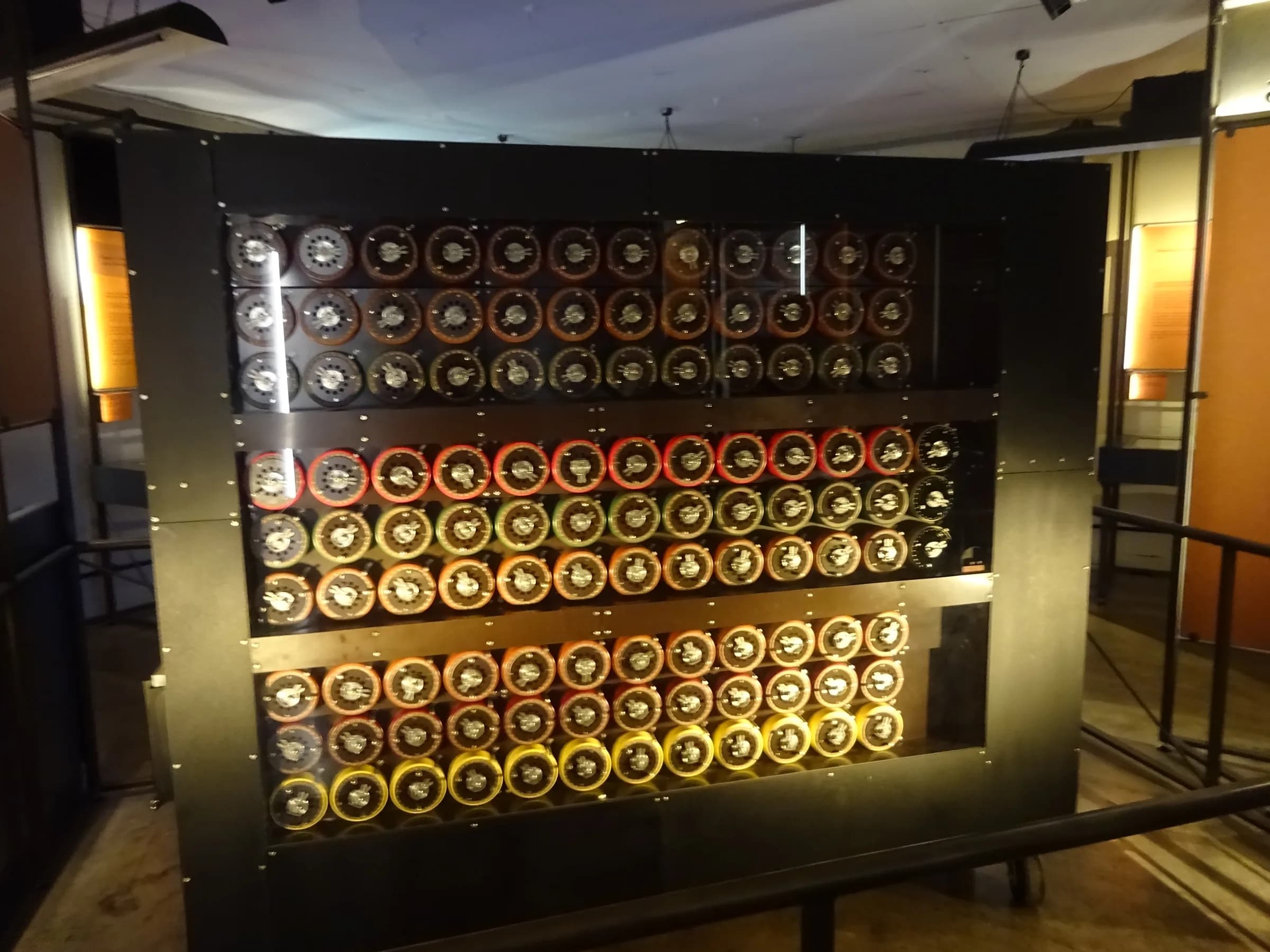
The Poles had broken early versions of Enigma before the war, and Turing built on their work. He designed the Bombe, an electromechanical machine that tested possible Enigma settings far faster than any person could, and he led Hut 8, the section responsible for German naval Enigma.
Naval Enigma was the hardest problem at Bletchley Park, and the most important. German U-boats were sinking the ships that carried food and supplies to Britain, and the messages that directed them were enciphered in naval Enigma. Breaking those messages let the Allies route convoys away from the U-boats.
Turing's techniques, including a method he called Banburismus, improved the attack on the cipher, and the intelligence produced — known as Ultra — was used throughout the Battle of the Atlantic. The work was covered by the Official Secrets Act, and none of it could be spoken of for decades.
Turing was awarded the OBE in 1946 for his wartime work. He was thirty-four, and almost no one outside the secret world knew what he had done. He had helped to break a code that had helped to win a war, and he could not tell anyone. The secrecy would last for most of the rest of the century, and it shaped how his life was remembered: for thirty years after his death, the public knew him, if at all, as a mathematician, not as a codebreaker.
The Computer, Built at Last
After the war, Turing joined the National Physical Laboratory, where he designed the Automatic Computing Engine, an early stored-program computer. In 1948 he moved to the University of Manchester, to Max Newman's Computing Machine Laboratory, where he helped to develop the early Manchester computers. He also turned to a question that had interested him since the 1930s: whether a machine could think.
In 1950 he published "Computing Machinery and Intelligence", the paper that introduced what became known as the Turing test. He proposed a simple game: if a person exchanging written messages with a machine could not tell whether they were talking to a machine or a human being, then the machine could be said to think. He did not claim that machines already thought.
He asked what it would mean if they could, and he set out the terms in which the question would be argued for the next seventy years. He also worked on mathematical biology, on the chemical basis of how patterns form in living things, a field that would later be called morphogenesis.
He was, by then, one of the most original thinkers in Britain. He was also a gay man in a country where homosexual acts between men were a criminal offence. In 1952, after acknowledging a sexual relationship with another man, he was prosecuted for gross indecency at Knutsford Quarter Sessions.
He pleaded guilty on 31 March 1952. He was given probation on condition that he undergo chemical castration, treatment with the hormone oestrogen, as an alternative to prison. He lost his security clearance, and with it his ability to work for GCHQ, the successor to the wartime codebreaking organisation.
Death and Reckoning
Turing died on 7 June 1954, at his house in Wilmslow, Cheshire. He was forty-one. A post-mortem examination found that he had died of cyanide poisoning, and the inquest recorded a verdict of suicide.
His family and his biographers have since questioned that verdict, noting that the evidence is also consistent with an accident, and the article records the inquest's finding without presenting it as settled beyond doubt. He died sixteen days before his forty-second birthday, two years after his conviction, and his wartime work was still secret.
The reckoning came slowly. In 2009, after an internet campaign, Prime Minister Gordon Brown issued a public apology on behalf of the British government for the way Turing had been treated. On 24 December 2013, Queen Elizabeth II granted him a posthumous royal pardon under the Royal Prerogative of Mercy, an exceptional step.
In 2017, a change in the law extended pardons to thousands of other men convicted under the old laws against homosexual acts. The measure became informally known as the Alan Turing law. In 2021, Turing's portrait appeared on the Bank of England's fifty-pound note, alongside a quotation about his work and a representation of the Bombe.
Turing's life is often told as a tragedy, and the ending was tragic. But the tragedy is not the whole story. The machine he imagined in 1936 became the model for every computer in use today. The code he helped to break saved lives in a war he could not talk about.
The question he asked in 1950 is still the question asked about every new generation of machines. He was wronged by his country, and his country eventually said so. The work, meanwhile, had already outlived them both.