The Morning the Canal Closed
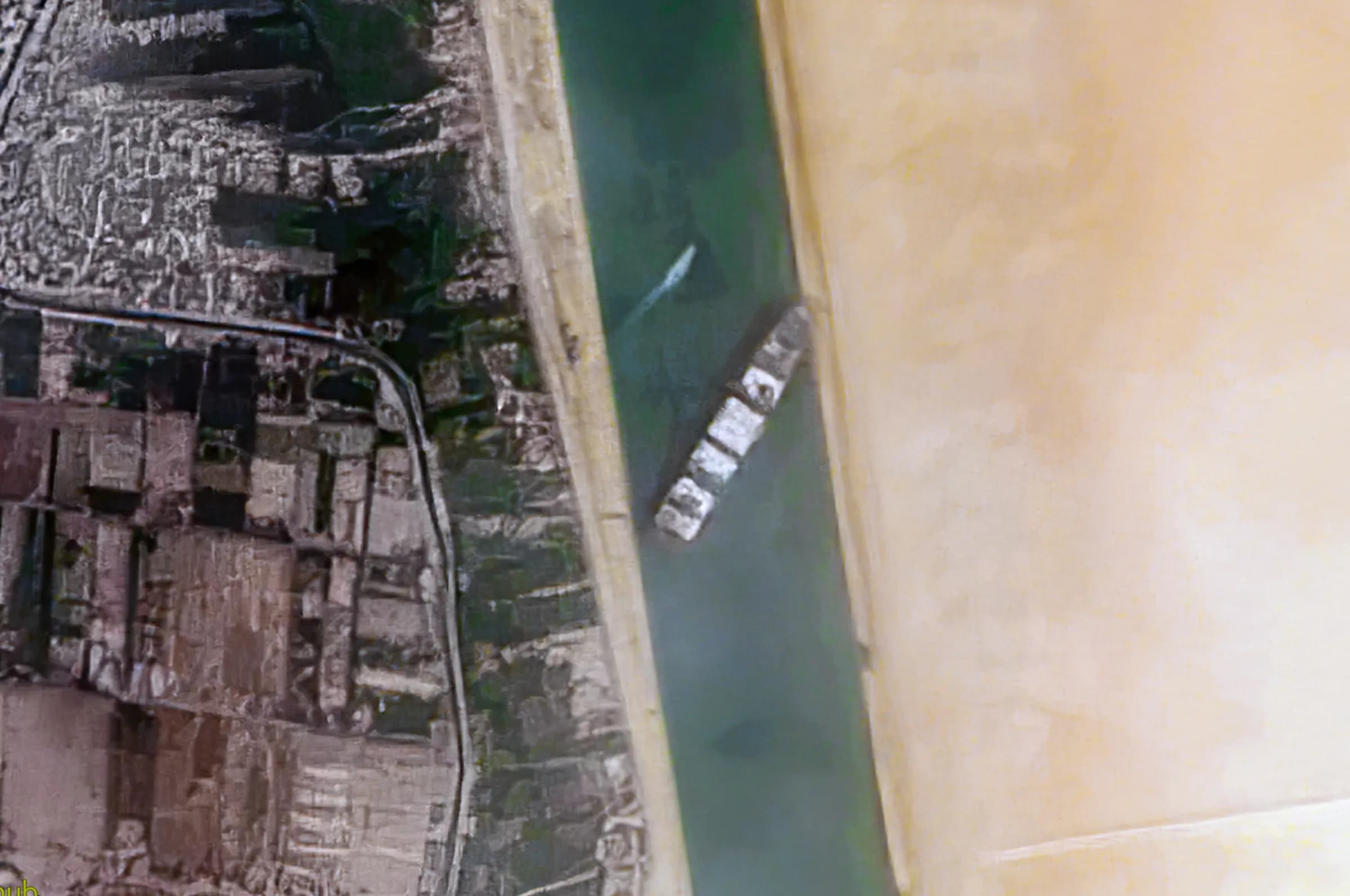
At 7:40 on the morning of 23 March 2021, the container ship Ever Given ran aground in the southern section of the Suez Canal in Egypt. The ship, 400 metres long and carrying cargo from Tanjung Pelepas in Malaysia to Rotterdam in the Netherlands, turned sideways in high winds and a sandstorm. Her bow dug into one bank of the canal and her stern swung towards the other, wedging the vessel diagonally across the waterway.
The canal is a single lane at that point, south of the section where two channels run side by side. No other ship could pass, in either direction. Within hours, vessels began stacking up at both ends of the canal, and the blockage of one of the world's busiest trade routes became the most watched shipping story in years.
The Ever Given was the fifth ship in a northbound convoy, and fifteen vessels were behind her when she grounded near kilometre-marker 151, about ten kilometres from the port of Suez. She was registered in Panama, owned by the Japanese firm Shoei Kisen Kaisha, operated by Taiwan's Evergreen Marine, and managed by the German company Bernhard Schulte Shipmanagement. Her crew were Indian nationals, and none were reported injured.
For six days the ship did not move. Dredgers worked around her bow, tugs pulled at her hull, and excavators dug at the bank from the shore. On 29 March, at 3:05 in the afternoon local time, fourteen tugs pulled her free, and that evening shipping resumed. The canal had been closed for six days and seven hours.
A Ship Built for a Narrower World
The immediate cause was weather, but the weather alone does not explain the grounding. The Ever Given was caught in a sandstorm with winds reported at up to 74 kilometres per hour, and the ship's enormous flat side acted like a sail. The official cause of the grounding remains inconclusive, and a later casualty investigation found no single navigational or mechanical failure that explained it. The ship lost steering at the worst possible place, in a narrow, single-lane stretch of canal.
The deeper cause was scale. The Ever Given is one of the largest container ships ever built, 400 metres long, nearly 60 metres wide, and able to carry 20,000 standard containers. Ships of that size were not imagined when the canal was dug in the nineteenth century, and the southern section where she grounded had never been widened to match them.
The canal itself had been stretched by demand. Opened in 1869, it carried about fifty ships a day by 2021, representing about 12 percent of total global trade. It is the shortest sea route between Europe and Asia, and for the largest ships the alternative — around the Cape of Good Hope at the southern tip of Africa — adds days to a voyage and thousands of dollars in fuel.
The People Trying to Free Her
The rescue was run by the Suez Canal Authority, the Egyptian state body that operates the canal, under its chairman Osama Rabie. The Authority suspended navigation through the canal on 25 March and brought in heavy dredgers, excavators, and tugs of its own. It also accepted help from a United States Navy team of dredging experts, and from the Dutch salvage company SMIT Salvage, a subsidiary of Royal Boskalis, which was hired to manage the marine salvage operation.
The salvage team was led on the ground by SMIT's experts and directed from the Netherlands by Boskalis chief executive Peter Berdowski. Berdowski warned early on that the operation could take days to weeks, and he was right. His teams dredged around the bow, adjusted the ship's ballast, and timed the final pull to the rising tide, using eleven harbour tugs and two powerful seagoing tugs, the Alp Guard and the Carlo Magno.
On board, the crew waited through six days of salvage work, unable to move their ship and at the centre of world attention. The ship's owner, Shoei Kisen Kaisha, apologised for the disruption, and the operator, Evergreen Marine, said responsibility for the incident lay with the shipowner. The crew themselves were not blamed in the public record, and the ship was towed to the Great Bitter Lake for inspection once she was free.
Why One Ship Could Stop World Trade
The Suez Canal matters because of geography. It is a man-made waterway about 120 miles long across the Isthmus of Suez, connecting the Mediterranean Sea with the Red Sea, and by extension the Atlantic Ocean with the Indian Ocean. For ships travelling between Europe and Asia it saves thousands of kilometres compared with the route around Africa. About 12 percent of world trade passed through it in 2021, including oil, liquefied natural gas, grain, and manufactured goods.
The canal's importance had grown with the ships that used it. Container shipping rewards scale: the bigger the ship, the lower the cost of moving each container. By 2021 the largest container ships were four hundred metres long, and the canal had been widened in places to take them, but the southern section, where the Ever Given grounded, remained a single lane south of the two-channel section. That was the weak point, and the grounding found it.
The blockage also showed how tightly the world's supply chains are wound. A delay of a few days in one canal rippled into port congestion, displaced containers, higher freight rates, and shortages of goods that had nothing to do with Egypt. The ship did not have to sink, or spill cargo, to cause damage. It only had to stop moving, in the wrong place, for long enough.
Six Days, Then the Bill
The cost was measured first in ships. By 28 March at least 369 vessels were waiting to pass through the canal, and by the time traffic resumed the number had reached 422, according to the Suez Canal Authority. Lloyd's List, the shipping journal, estimated that goods worth about 9.6 billion dollars a day were held up.
The ship herself was not free to leave. On 13 April the Egyptian government impounded the Ever Given while the Canal Authority sought compensation, initially demanding 916 million dollars. The figure was later reduced, and in July a formal settlement was reached, reported at about 540 million dollars, although the terms were confidential and the figure was never officially confirmed. The ship sailed again on 7 July and reached Rotterdam, her original destination, on 29 July, four months after she grounded.
Egypt responded by announcing that it would widen the narrower parts of the canal, so that a single grounded ship could not close it again. Shipping companies, meanwhile, re-examined their dependence on one route, and some began to weigh the longer voyage around Africa more seriously.
What the Blockage Exposed
The Ever Given did not create the vulnerability it exposed. The world had built a trading system that depended on a small number of narrow passages — the Suez and Panama canals, the Strait of Malacca, the Strait of Hormuz — and on ships that kept growing larger to cut costs. A system built for efficiency had very little slack in it, and the blockage showed what happens when slack runs out. One ship, one sandstorm, and one narrow stretch of water were enough to slow trade between continents.
The rescue also showed what the system could still do. A salvage operation of that scale had never been attempted under such public scrutiny, and it succeeded without injury and without damage to the canal itself. The dredgers, the tugs, and the timing of the tide all worked, and the ship came out intact. The operation was a reminder that the expertise to fix such failures exists, even if it is rarely called on in public.
Six days is a short time in history, but the image of the Ever Given wedged across the canal has lasted. It is now the standard illustration of how connected the world has become, and how fragile that connection is. The canal is wider now, and the ships are no smaller. The next blockage, if it comes, will find the same narrow water, the same large ships, and the same world waiting on the other side.