The Bang
Late on the evening of 13 April 1970, the three astronauts of Apollo 13 had just finished a television broadcast from their spacecraft, more than 200,000 miles from Earth. Mission Control in Houston asked the command module pilot, Jack Swigert, to stir the spacecraft's cryogenic oxygen tanks, a routine procedure. Seconds later the crew heard a dull bang, and the spacecraft shuddered.
Swigert radioed Houston: "Houston, we've had a problem here." The commander, Jim Lovell, added: "Houston, we've had a problem. We've had a main B bus undervolt."
Within eight seconds of the explosion, the pressure in one of the service module's two oxygen tanks had dropped to zero. Two of the spacecraft's three fuel cells were lost, and with them went most of the command module's power, oxygen, and water.
The explosion happened about 56 hours into the flight, on the third day of a mission that was meant to land on the Moon. Apollo 13 was NASA's third planned Moon landing, and Lovell and the lunar module pilot, Fred Haise, were to have walked in the Fra Mauro highlands. Within two hours, Mission Control told the crew the command module was mortally wounded, and they would have to move into the lunar module to survive.
What followed was a four-day rescue, carried out in a spacecraft that had not been designed for it, by three men and by the engineers on the ground in Houston. The crew came home alive on 17 April.
A Mission Already Changed
Apollo 13 had already been changed before it left the ground. The original command module pilot, Ken Mattingly, was replaced by Swigert days before launch, after a measles scare exposed the crew to the disease. Swigert was the backup pilot, and he had trained for the mission, but he had not expected to fly it. The change was a reminder, before the flight began, that the mission depended on people who could step in at short notice.
The launch itself gave the first warning. Apollo 13 lifted off from Kennedy Space Center in Florida on 11 April 1970, carried by a Saturn V rocket, and during the ascent one of the second stage's five engines shut down early. The remaining four engines burned longer, and the third stage burned nine seconds longer, to put the spacecraft into its proper orbit. The crew settled into a comfortable rhythm for the next two days, and 12 April passed without incident.
The cause of the explosion lay in the spacecraft's oxygen tank number two, and the chain of errors stretched back years. NASA's review board, led by Edgar Cortright and reporting in June 1970, found that damaged insulation on wiring inside the tank had ignited, and the resulting explosion blew a panel off the service module and damaged the second oxygen tank as well. The board traced the accident to an electrically initiated fire in the tank, a failure that no one on the flight had foreseen.
The explosion was not the kind of accident anyone had planned for. The command module, Odyssey, was the only part of the spacecraft that could survive re-entry into Earth's atmosphere, and it was now crippled. The lunar module, Aquarius, was designed to land two men on the Moon and bring them back to the command module, not to keep three men alive for four days.
Three Men and a Room in Houston
Lovell was the most experienced astronaut in the world at the time, having flown on Gemini 7, Gemini 12, and Apollo 8, the first flight around the Moon. He was the commander, and it was his judgement that shaped the crew's response: he looked out of the window, saw oxygen venting into space, and knew at once that the landing was lost. Haise, who would have become the sixth man to walk on the Moon, and Swigert, the last-minute replacement, worked with him through four days of cold, rationing, and improvisation.
In Houston, the flight directors ran the rescue in shifts. Gene Kranz, who was on duty when the explosion happened, laid out the new mission within an hour: abandon the Moon landing, loop around the Moon, and get the crew home as quickly as possible. The teams in Mission Control worked out, hour by hour, how to stretch the lunar module's power, water, and air far beyond what it had been built to provide.
The most famous improvisation was the carbon dioxide filter. The lunar module's lithium hydroxide canisters, which absorbed the gas the crew exhaled, were not designed to serve three men for so long, and the spare canisters from the command module were square while the lunar module's sockets were round. Engineers in Houston devised an adapter from materials known to be aboard, including plastic bags, cardboard, a sock, and tape, and talked the crew through building it. Carbon dioxide levels fell, and the crew could breathe again.
A Spacecraft Never Meant to Be a Lifeboat
The rescue worked because the spacecraft, for all its damage, had a second ship inside it. Apollo 13 was two spacecraft in one: the command and service module, Odyssey, which carried the crew to the Moon and back, and the lunar module, Aquarius, which was meant to land on the Moon. When Odyssey was crippled, Aquarius became a lifeboat, using its own oxygen tank and its descent engine to keep the crew alive and to steer them home.
Navigation was the hardest problem after the explosion. Debris from the blast made it impossible for the crew to navigate by the stars using the on-board sextant, and the spacecraft's own guidance functions were unavailable. The crew improvised by using the limb of the Earth — the horizon where Earth meets the atmosphere — as a reference point, and performed a controlled burn to shorten the time until splashdown. It was a manoeuvre that had never been practised, carried out with the Earth itself as the instrument.
The Long Way Home
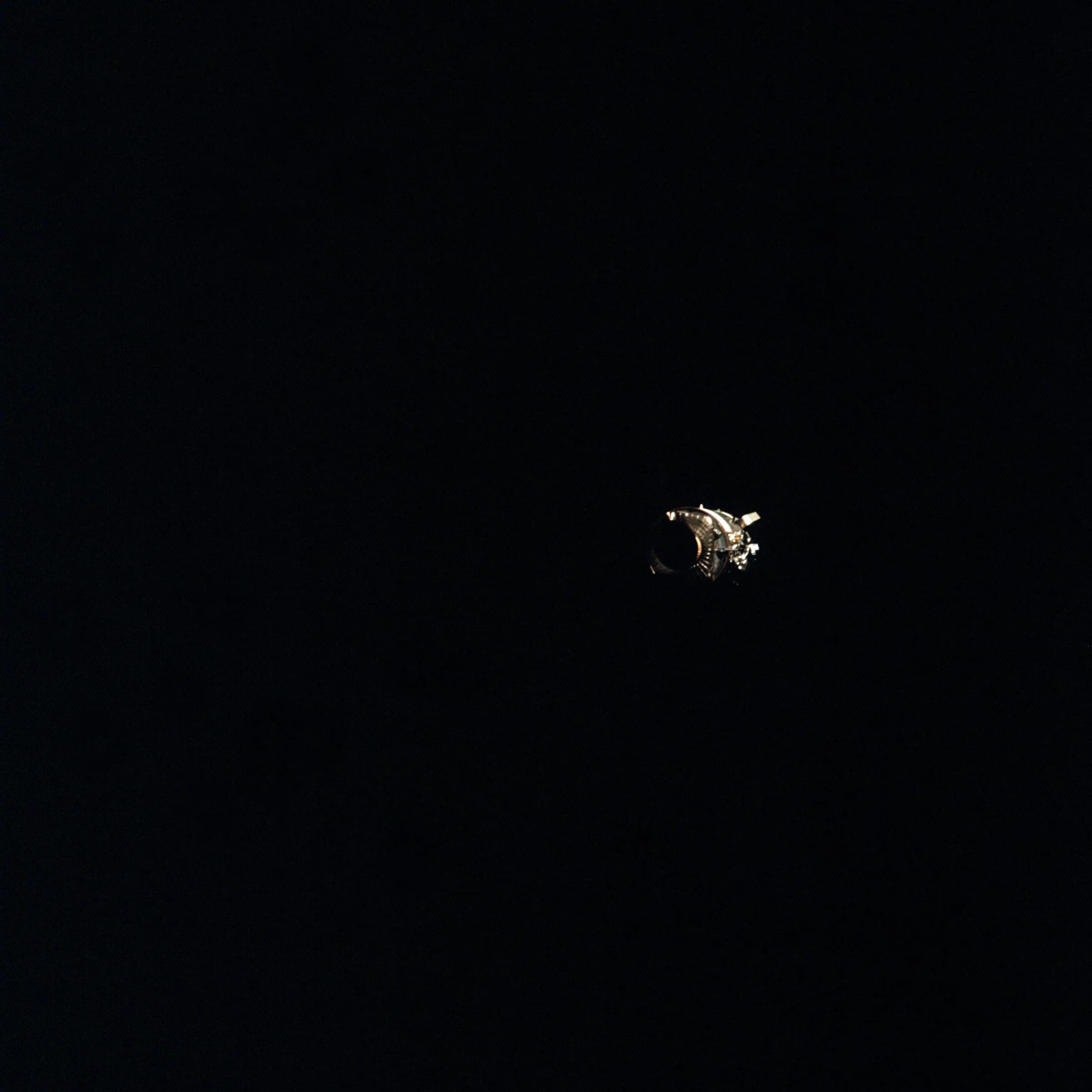
The journey home took the damaged spacecraft around the Moon and back, on a free-return trajectory that used the Moon's gravity to send it towards Earth. A burn of the lunar module's descent engine brought the splashdown forward to the mid-Pacific. The crew photographed the service module as it drifted away on 17 April and saw for the first time that an entire panel had been blown off one side.
On 17 April the astronauts moved back into Odyssey, powered it up, and released Aquarius, which had kept them alive for four days. The command module re-entered the atmosphere, and after a longer-than-usual radio blackout that left Mission Control anxious, its parachutes appeared on television screens. The capsule splashed down in the Pacific Ocean near Samoa at 18:07 UTC, and the crew were taken aboard the recovery ship USS Iwo Jima.
The Successful Failure
Apollo 13 is called a successful failure, and the phrase is exact. The mission failed in its purpose: no one landed on the Moon, and the landing that would have been NASA's third was lost. It succeeded in the only way that mattered once the tank exploded, by bringing three men home alive from a spacecraft that had lost its power, its oxygen, and its water two hundred thousand miles from Earth.
The mission is also remembered as Mission Control's finest hour, and the description is deserved. The rescue was not the work of a single decision or a single invention, but of hundreds of small ones: a filter made from plastic bags and tape, a burn aimed by the Earth's horizon, a power budget worked out hour by hour. Each of them was ordinary on its own. Together they were enough.
The crew never gave a thought to the number thirteen. Lovell later said he considered himself lucky to have survived it. Haise called it a great mission, and a miraculous recovery.