On 24 July 1911, a Yale lecturer named Hiram Bingham climbed a steep ridge in the Andes of Peru and found stone buildings standing among the trees. He had been searching for Vilcabamba, the last refuge of the Inca rulers who resisted Spanish rule. What he found instead was a place the Spanish had never seen, and one that local people had never entirely left.
Quechua farming families were already living among the ruins and growing crops on the old terraces. A boy named Pablito guided Bingham along the ridge. The story of a lost city found by one man is therefore only partly true, and the fuller version is more interesting than the legend.
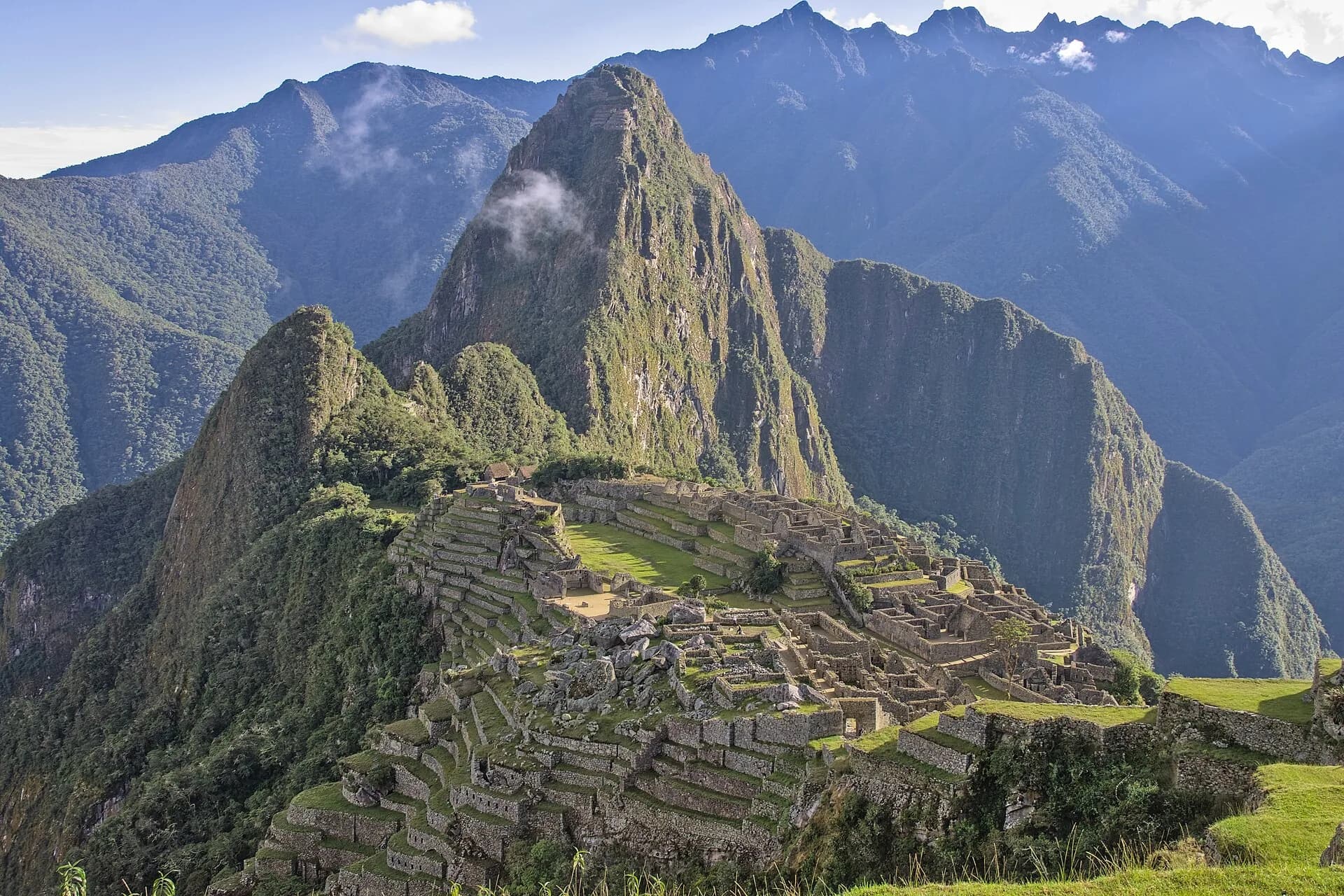
Machu Picchu stands on a narrow saddle between two peaks, Machu Picchu and Huayna Picchu, above the Urubamba River valley, about 80 kilometres northwest of Cusco. The citadel sits at more than 2,400 metres above sea level, where the high Andes meet the Amazon basin. The ridge is steep, the cloud forest is dense, and the setting is part of the reason the place survived.
UNESCO describes the property as a mixed World Heritage site, recognised for both cultural and natural value. The protected sanctuary covers 32,592 hectares of mountain slopes, peaks, and valleys around the citadel. Within that landscape are about 200 structures, set on stone terraces and linked by stairways.
An Estate for an Emperor
The estate was built in the fifteenth century, and most scholars attribute it to the emperor Pachacuti Inca Yupanqui, who reigned from about 1438 to 1471. Pachacuti expanded the Inca state from its heartland around Cusco into an empire that stretched across the Andes. Machu Picchu was one of his country estates, a place for the ruler and his court to stay away from the capital.
Radiocarbon dating has sharpened the older timeline. A study published in 2021, led by the Yale archaeologist Richard Burger, dated human remains excavated at the site in the early twentieth century. It found that people were living there from about 1420 until around 1530, at least two decades earlier than the written record had suggested.
The buildings were not a town in the ordinary sense. The site is divided into an agricultural sector of terraces and an urban sector of temples, houses, and plazas. Its aligned temples show that religious use mattered as much as residence, and its terraces show careful planning for farming on a steep slope.
Construction used stone fitted so closely that little mortar was needed. Walls, doorways, and windows were shaped to the ridge rather than imposed on it. The result is a place that looks as if it grew from the mountain, which is part of why photographs of it are so often mistaken for the whole story.
The People Who Lived There
Machu Picchu was staffed by people drawn from across the empire. Servants, retainers, and workers kept the estate running, farmed the terraces, and maintained the buildings. The population was small compared with a city, and the estate depended on the wider Inca system of labour and supply.
When Bingham excavated in 1912, several dozen skeletons were found at the site. Because most were first identified as female, he suggested that Machu Picchu had been a sanctuary for the Virgins of the Sun, an elite group of Inca women. Later analysis found a more balanced ratio of men and women, and that explanation is no longer widely accepted.
The Inca left no written records of their own, so much of what is known comes from archaeology and from Spanish-era histories written after the conquest. That gap matters, because it leaves room for confident-sounding claims that the evidence cannot support. The estate interpretation rests on the buildings themselves, on the dating, and on the pattern of other royal estates.
Local knowledge also matters to the record. Bingham was led to the site by Melchor Arteaga, a local Quechua-speaking farmer, after hearing of ruins high on the mountain. The rediscovery was therefore a meeting between an outside expedition and people who already knew the ridge. The outside world learned of the site in 1911, but the site had not been empty.
Abandoned, Then Found Again
Occupation of Machu Picchu seems to have ended around the time of the Spanish conquest in the sixteenth century. The Spanish never saw the estate and left no account of it. With the empire collapsing, the reason to maintain a royal retreat disappeared, and the forest covered much of what had been built.
The site remained undisturbed for more than three hundred years, though not untouched. Farming families worked the terraces, and the stonework survived because the place was hard to reach and had little to attract looters. Vegetation grew over walls and stairways, and the buildings became part of the hillside.
Bingham returned in 1912 and again in 1914 and 1915, with support from Yale University and the National Geographic Society. His teams cleared, mapped, and excavated the site, and shipped thousands of objects to Yale, including pottery, metal figures, jewellery, and human remains. That removal later became a long dispute between Yale and Peru.
The collection was returned in stages, with the last batch reaching Peru in November 2012. The objects are now shown at the Machu Picchu Museum in the Casa Concha in Cusco, run by the city's national university. The dispute is part of the site's modern history, and it changed how museums and universities handle material taken from other countries.
What the Place Represents Today
In 1983, UNESCO inscribed the Historic Sanctuary of Machu Picchu on the World Heritage List. It is one of the few major pre-Columbian ruins found nearly intact, and it is now the most visited tourist attraction in Peru. The inscription recognised the citadel and the landscape around it together, not the ruins alone.
That popularity has become a management problem. Peru's Ministry of Culture now limits daily entry, with 4,500 visitors on ordinary days and 5,600 during the high season from 1 June to 15 October and on 30 and 31 December, under Ministerial Resolution No. 000207-2024-MC. Visitors follow timed circuits, and tickets must be booked in advance.
The limits are a response to a real tension. The site earns income for Peru and for the town below it, now known as Machu Picchu Pueblo, and it gives work to guides, railway staff, and hotel workers. At the same time, foot traffic, erosion, and pressure on the town strain the sanctuary that UNESCO recognised.
Machu Picchu endures as evidence of what the Inca could build, and of how quickly an empire's centre can fall silent. It was a royal estate for about eighty years, a farmed hillside for centuries, and a world-famous monument for little more than a hundred. The photographs show the ridge at dawn, but the story is in the shorter span: a place built for one emperor, used briefly, and then left to the people who stayed.