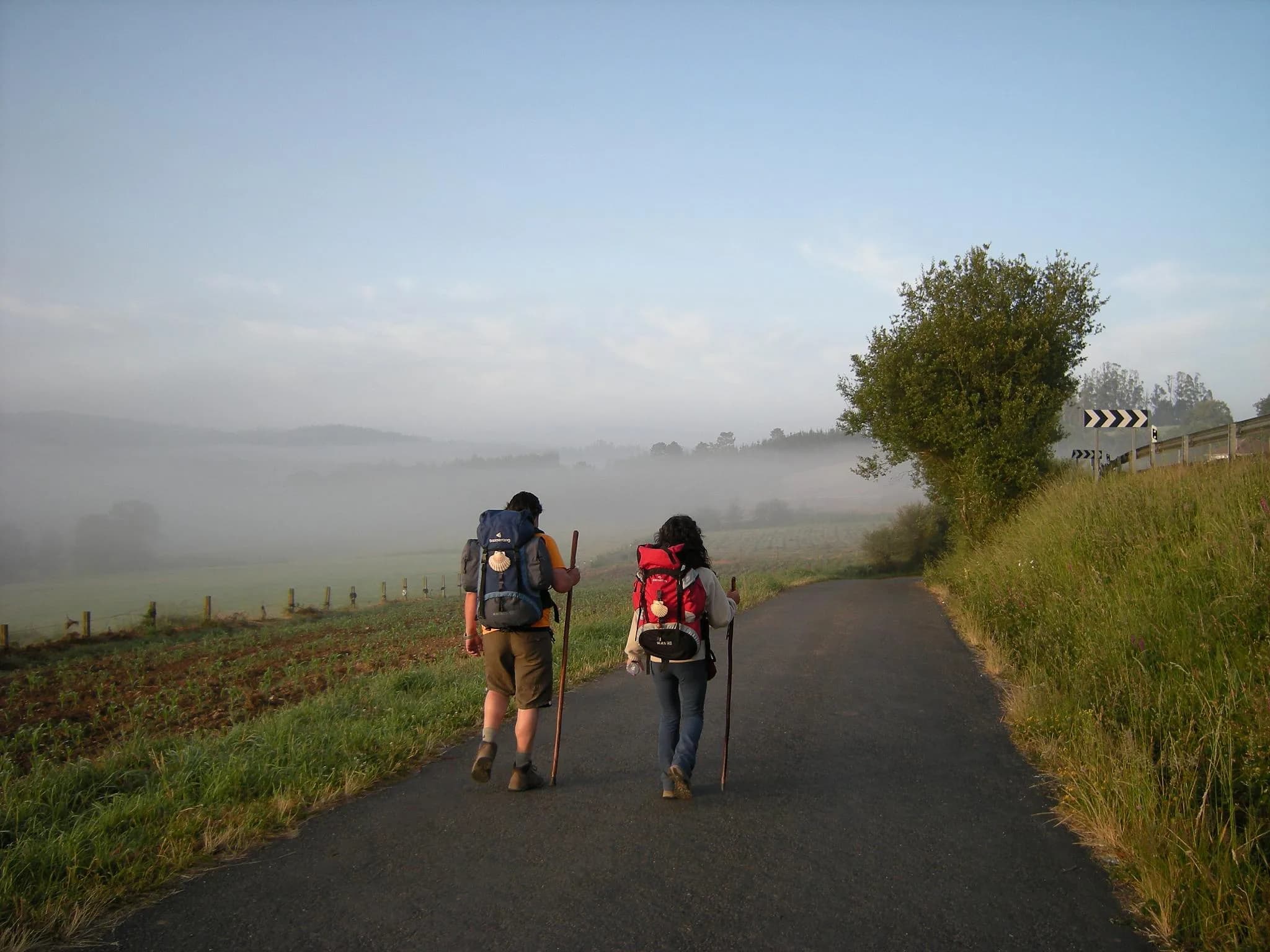
In the Praza do Obradoiro in Santiago de Compostela, pilgrims arrive on foot with dust on their boots and a scallop shell tied to their packs. Some have walked for a month. Some have walked for five days from Sarria, the last point from which a walker can still complete the hundred kilometres needed to claim the Compostela. They gather in front of the cathedral, and the journey that brought them there is the same journey people have made for more than a thousand years.
The Camino de Santiago, or the Way of Saint James, is a network of pilgrims' ways leading to the shrine of the apostle James in the cathedral of Santiago de Compostela in Galicia, in northwestern Spain. Tradition holds that the remains of the apostle are buried there. The road is the monument, and the cathedral is the destination, and that distinction is what makes the Camino unusual among World Heritage sites.
The French Way, the most popular route, runs from Saint-Jean-Pied-de-Port on the French side of the Pyrenees to Santiago, a distance of about 780 kilometres through Pamplona, Logroño, Burgos, and León. Other routes cross northern Spain from the coast and the interior, and routes in France lead to the Spanish border. UNESCO's inscription covers nearly 1,500 kilometres of northern routes and the 738-kilometre French Way, together with the churches, bridges, and hospices raised along them to serve people walking.
The scallop shell, often found on the shores of Galicia, has long been the symbol of the Camino. Pilgrims carry it on their packs, and it marks the way on signposts and stones. The shell is a practical emblem as much as a religious one: it tells a walker, and everyone the walker meets, where that person is going.
A Tomb in the Woods
The pilgrimage begins with a tomb. According to tradition, a hermit named Paio found the grave of Saint James the Apostle in 814, in the forests of Libredón. Teodomiro, bishop of nearby Iria, went to look, identified the Roman-era tomb he found there as that of James the Greater, and carried the news to King Alfonso II of Asturias. A chapel went up on the spot, and people began to walk.
The earliest records of visits to the shrine date from the ninth century, in the time of the Kingdom of Asturias and Galicia. The pilgrimage became a major route of medieval Christianity from the tenth century onwards. It was one of the most important Christian pilgrimages of the later Middle Ages, and a pilgrimage on which a plenary indulgence could be earned. The other great pilgrimages of the time led to Rome and to Jerusalem.
The main pilgrimage route follows an earlier Roman trade route, which continues to the Atlantic coast of Galicia, ending at Cape Finisterre. The road was therefore not new when the pilgrims came to it. It was an old way across northern Spain, given a new purpose by a tomb and a story.
Alfonso II himself is said to have walked to Santiago in about 850, on what became known as the Primitive Way from Oviedo. That route is traditionally the oldest, and it is still walked today. The king's journey set a pattern: a ruler walked, and others followed.
The Road Takes Shape
The Camino Francés took shape in the eleventh century. Pilgrims had earlier used the old Roman causeway from Astorga to Bordeaux, and at the Ibañeta Pass a Roman way station later housed the first pilgrim hospital, at Roncesvalles. Kings redirected roads, the Church organised hospitality, and the route became a system rather than a track.
In 1075, work began on the Romanesque cathedral that stands today, under Alfonso VI and Bishop Diego Peláez. The building was planned on the model of the pilgrimage church of Saint-Sernin at Toulouse, and it was built in Galician granite. Between 1168 and 1188, Maestro Mateo completed the Pórtico de la Gloria, a doorway with more than two hundred figures. The lintel carries the date 1188, and almost nothing is known of Mateo beyond the contract and the stone.
In the same century, a French monk named Aymeric Picaud wrote what is often called the first guide to the Way. The Codex Calixtinus, dated by the Xunta to 1135, describes the French Way in its fifth book. The book sets out the routes and their stages, names the rivers safe to drink from and the ones that will kill a horse, lists the hospices and the shrines worth stopping at, and describes the peoples a traveller will meet along the way.
The Codex was compiled in the twelfth century, most likely in the late 1130s or early 1140s, and credited pseudonymously to Pope Calixtus II. Its fifth book changed things. Modern route guides still follow its stages, and the road it described is the road pilgrims still walk. The cathedral traces the custom of Holy Years, in which the Holy Door is opened, to Pope Callixtus II in 1122, made permanent by Alexander III in 1179.
The People Who Keep the Road
The Camino was never only a religious road. It was also a route for trade, for the exchange of ideas, and for people moving across Europe for reasons that had little to do with the shrine. UNESCO inscribed the routes because of their historical significance for Christianity as a major pilgrimage route and their testimony to the exchange of ideas and cultures across them. The road carried people, and the people carried ideas with them.
Hospices, bridges, churches, and hostels were built along the way to serve walkers. Towns grew up around the road, and the road gave them their livelihood. The infrastructure of the Camino was built by kings, bishops, monasteries, and local communities, and it was maintained by the same people who profited from it.
The route lost importance over the centuries, and it was revived from the late nineteenth century. In 1957, Walter Starkie published The Road to Santiago, setting the route's history beside his own diaries of four pilgrimages made between 1924 and 1954. His book brought the Camino to a new generation of readers, and the revival that followed has continued ever since.
In 1987, the Camino was declared the first Cultural Route of the Council of Europe. The French Way and the northern routes in Spain were inscribed on the UNESCO World Heritage List in 1993, and the routes in France followed in 1998. In 2015, the listing was extended to four further northern routes. The road that had been walked for a thousand years was now recognised as heritage in its own right.
What the Place Represents Today
Today, the Camino is busier than at any time in its history. According to the Pilgrim's Office in Santiago de Compostela, 499,239 completion certificates were issued to pilgrims in 2024. That was the third record year in a row, after 446,082 in 2023 and 438,307 in 2022. More than 200,000 of the 2024 pilgrims were Spanish, and more than 38,000 were American.
The figures count only pilgrims who reach Santiago and request a Compostela. They do not capture those who walk a stretch without finishing, or who finish without claiming the certificate. The real number of walkers is therefore higher than the official total, and the road is fuller than the statistics suggest.
Not all of today's pilgrims walk for religious reasons. Many walk for the exercise, for the company, for a break from work, or for a reason they find hard to name. The road accommodates them all, as it accommodated traders, soldiers, and the curious in the Middle Ages. The cathedral still stands over the tomb, and the shell still marks the way, but the reasons for walking have widened.
The next Holy Year will be in 2027, when the feast of Saint James falls on a Sunday and the Holy Door is opened. The road will be busier still, and the towns along it will prepare as they have prepared for centuries. The Camino endures because it is not a building that can be closed, but a way that people keep using. A thousand years after a hermit found a tomb in the woods, the road to it is still walked, and the walkers still arrive on foot.