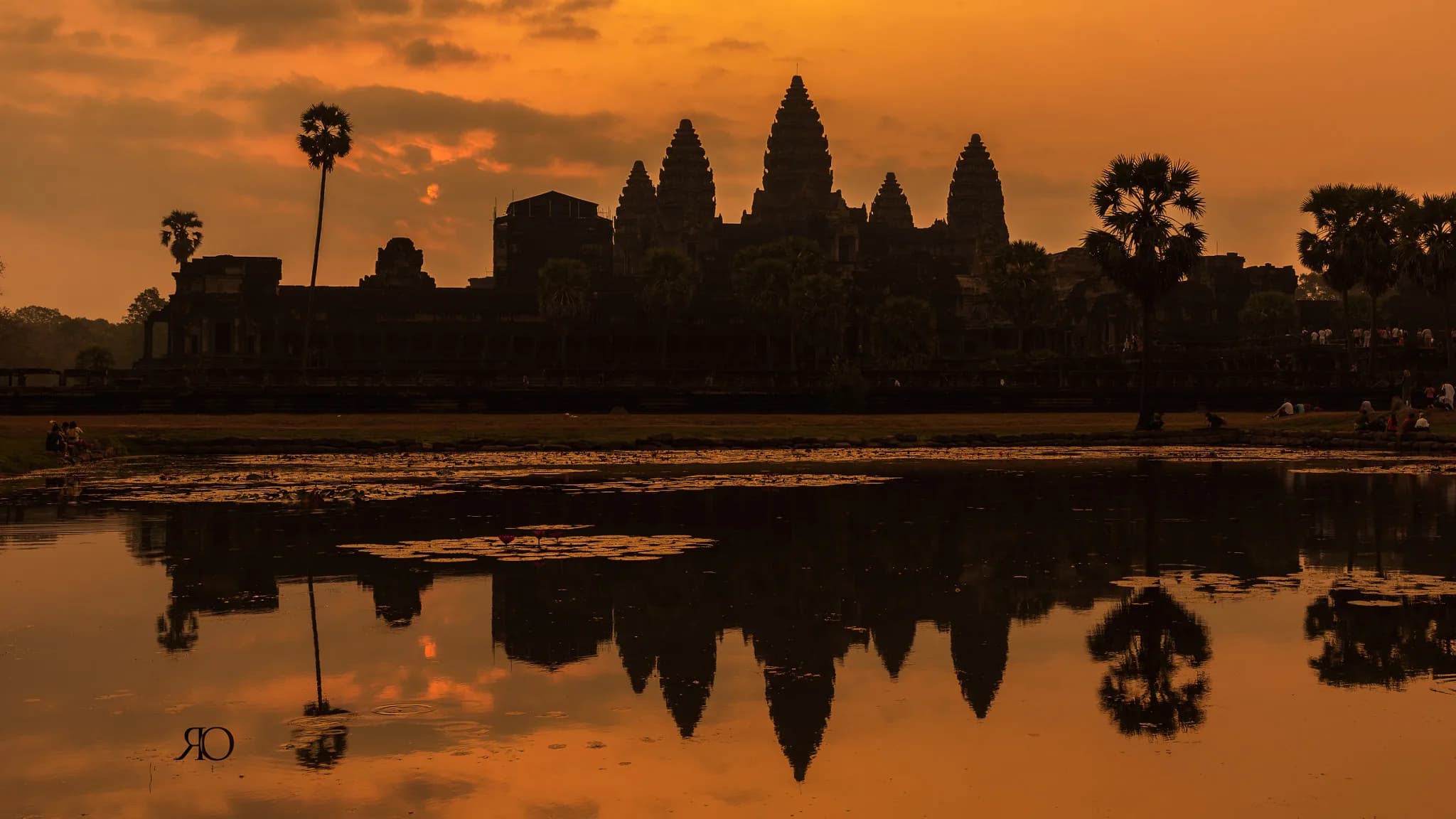
At dawn, the five towers of Angkor Wat stand reflected in the pool in front of the temple, and the silhouette is one of the most recognised in the world. The image is on the flag of Cambodia, on banknotes, and on the cover of almost every guidebook to Southeast Asia. What the image does not show is the scale of what lies behind it.
Angkor Wat is a single temple in a city that once covered about 400 square kilometres. The city of Angkor was the capital of the Khmer Empire, which ruled much of mainland Southeast Asia from about the ninth to the fifteenth centuries. The temple was built to be the centre of that world, and it outlasted the empire that built it.
Angkor lies near the modern town of Siem Reap in northwestern Cambodia, between the Kulen Hills and the great lake of Tonle Sap. The name comes from a Sanskrit word meaning holy city, and Wat is the Khmer word for temple. The site extends over forest and rice fields, with scores of temples, reservoirs, canals, and roads spread across the plain.
UNESCO describes Angkor as one of the most important archaeological sites in Southeast Asia. Its temples, including Angkor Wat, the Bayon, Preah Khan, and Ta Prohm, are closely linked to their landscape and filled with symbolic meaning. The park is still inhabited, and villages whose ancestors date back to the Angkor period are scattered throughout it.
A Temple for a King
Angkor Wat was built in the first half of the twelfth century, during the reign of King Suryavarman II, who ruled from 1113 to about 1150. Construction is believed to have spanned about three decades. The temple was dedicated to the Hindu god Vishnu, and it was most likely built as the king's own tomb temple, a place where his remains would be deposited.
The temple covers about 400 acres, or 160 hectares, and its central tower rises 65 metres high. It is the world's largest religious structure. The five central towers symbolise the peaks of Mount Meru, the dwelling place of the gods in Hindu mythology. The temple is therefore a model of the universe in stone, with the mountain at its centre and the moat around it standing for the cosmic ocean.
Suryavarman II is remembered as one of the greatest monarchs of the Khmer Empire, and also as a usurper who took the throne by force. He built a strong central government, sent military expeditions against neighbouring kingdoms, and used Angkor Wat to legitimise his rule. The temple was a statement of power as much as a place of worship, and its size was part of the message.
The building was entered from the west, a direction traditionally associated with the land of the dead and with Vishnu. Visitors crossed a causeway over the moat, passed through galleries covered in carved reliefs, and moved toward the central towers. The reliefs tell stories from Hindu epics, and they run for hundreds of metres along the walls.
The City Around the Temple
Angkor Wat was not built alone. The Khmer period began in 802, when Jayavarman II declared himself king and laid the foundations of the empire. From the end of the ninth century until early in the thirteenth century, successive kings built temples, reservoirs, and cities across the plain. Angkor was the royal centre from which they ruled.
The city was far larger than the stone temples that survive. Palaces, public buildings, and houses were built of wood and have long since decayed and disappeared. What remains in stone is the religious and administrative skeleton of a metropolis that may have been home to hundreds of thousands of people. The great reservoirs, known as barays, stored water for farming and for the city, and they were as important to Angkor as the temples.
The Khmer kings ruled a domain that reached from Vietnam to the Bay of Bengal. Trade, rice farming, and control of water made the empire wealthy, and the wealth paid for the temples. Angkor was therefore not only a religious centre but the centre of a political and economic system that depended on managing water across a flat, monsoon-fed plain.
That dependence was also a weakness. When the water system failed or the political centre shifted, the city could not sustain itself in the same way. The temples remained, but the population that had built and maintained them moved away. The stone outlasted the system that had produced it.
Sack, Renewal, and a Change of Faith
In 1177, the Cham people of modern-day Vietnam sacked Angkor, coming up the Mekong and across the great lake. The attack came about twenty-seven years after the death of Suryavarman II, and it shook the empire. A Khmer prince drove the Cham out and took the throne in 1181 as Jayavarman VII.
Jayavarman VII built a new capital nearby, Angkor Thom, and a new state temple, the Bayon, with its towers carved with faces. He also changed the religious direction of the empire. Under his rule, Angkor Wat moved gradually from Hindu to Theravada Buddhist use, a change that continued into the late thirteenth century and continues to the present day.
In the early fifteenth century, Angkor was abandoned as a capital. The reasons are still debated, and they probably include a combination of political change, pressure from neighbouring powers, and strain on the water system. The city faded, but Angkor Wat did not. Theravada Buddhist monks maintained the temple, and it remained an important pilgrimage site.
That continued use is the reason Angkor Wat survived better than the temples around it. Its moat provided some protection from encroachment by the jungle, and the monks kept the building in use and in repair. European visitors continued to reach it, and it was never completely abandoned, even when the city around it had gone.
The Temple in the Modern World
In the nineteenth century, the French naturalist Henri Mouhot visited Angkor Wat and wrote about it for a European audience. His account is often described as a rediscovery, but that word is misleading. The temple was known to Cambodians, to monks, and to earlier European visitors, and Mouhot's writing brought it to wider attention in Europe rather than finding it unknown.
In the twentieth century, restoration programmes were undertaken, first by the French School of the Far East and later by other national teams. Work was suspended during the political unrest that engulfed Cambodia in the 1970s, and when it resumed in the mid-1980s, the required repairs were extensive. Some sections had to be dismantled and rebuilt.
In 1992, UNESCO inscribed Angkor on the World Heritage List and immediately added it to the List of World Heritage in Danger. Restoration efforts increased in the years that followed, and Angkor was removed from the Danger List in 2004. Since 1993, the work has been coordinated through an international committee in which India, Germany, and Japan have joined UNESCO.
Today, Angkor Wat is one of the most important pilgrimage shrines in Southeast Asia and a popular tourist attraction. It has appeared on Cambodia's national flag since the first version in 1863. The temple draws millions of visitors, and the pressure of that attention is now part of its management, as it is at other famous sites.
Angkor Wat endures because it was built as a mountain in stone, because monks kept it alive when the city faded, and because it became a symbol of Cambodia itself. The towers at dawn are the image the world knows, but the story is longer: an empire that ruled for centuries, a temple that changed its faith, and a building that stayed in use when everything around it fell silent.