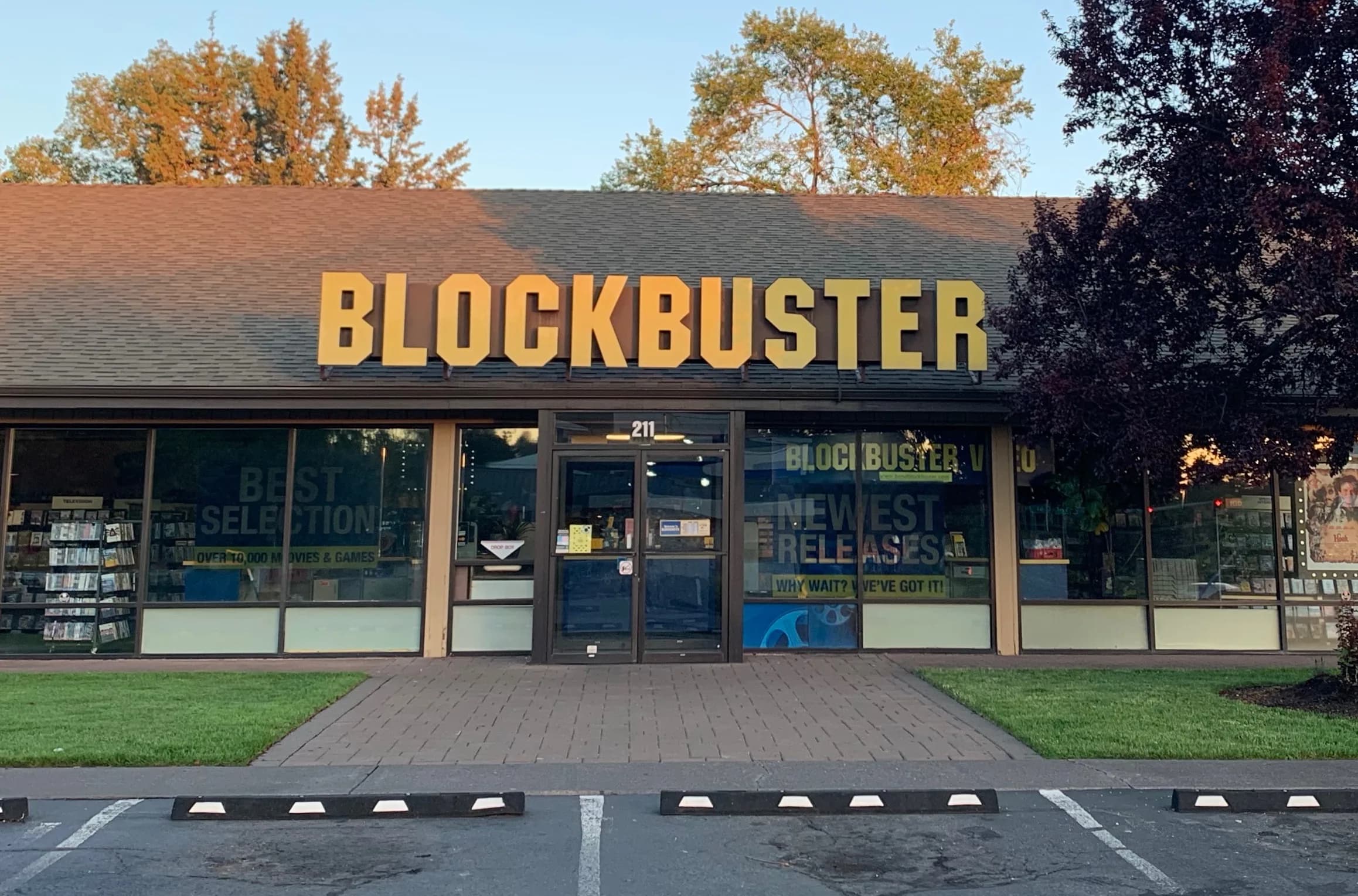
At the end of 2004, Blockbuster was the largest video rental chain the world had ever seen. It operated 9,094 stores in the United States, its territories and 24 other countries, employed about 84,300 people, and took in revenue of 6.05 billion dollars in a single year. On a Friday night in almost any American town, the blue and yellow sign was where the evening began.
Less than six years later, on 23 September 2010, the company filed for bankruptcy protection in New York. It listed about 1.02 billion dollars in assets against about 1.46 billion dollars in debts, and it had about 3,300 stores left in the United States. The chain that had defined home entertainment for a generation was finished.
The usual telling of this story is simple: Blockbuster ignored the internet and died. The record is more interesting than that. Blockbuster did build an online service, and its combined offer briefly pushed Netflix into its first ever subscriber decline.
What killed the company was a combination of debt, a business model that depended on fining its customers, and a boardroom fight that removed the chief executive who had built the counterattack. The internet was the pressure. The company's own decisions did the rest.
Origins and Early Development
David Cook opened the first Blockbuster Video in Dallas, Texas, on 19 October 1985. Cook had built a company that wrote software for the Texas oil and gas industry, and his wife Sandy, who loved films, suggested the video business after studying how rental shops worked. The first store stocked 8,000 VHS tapes and 2,000 Beta tapes, an unusually large selection for a single shop, and it was decorated in the blue and yellow that would become the chain's signature.
The idea was not simply to rent tapes. It was to make renting feel reliable, with a large catalogue, clean stores and a consistent experience from one town to the next. Small independent rental shops dominated the market, and most of them carried limited stock and closed early.
Cook's store offered choice and convenience, and customers responded. Within two years he began franchising, and the chain spread across Texas and beyond.
In February 1987, Wayne Huizenga, who had built Waste Management from a single garbage truck, bought control of the company with an investment of about 18 million dollars from himself and two partners. Huizenga understood scale in a way Cook did not.
He bought rival chains, pushed franchising hard and moved the headquarters to Fort Lauderdale, Florida. Cook left the company in April 1987, less than two years after opening the first store.
The Rise to Power
Viacom bought Blockbuster in 1994 for 8.4 billion dollars, largely to help finance its bid for the Paramount film studio in a contest with the QVC network. The price reflected how valuable the chain had become: a nationwide network of stores, a huge customer base and a steady flow of rental income. Viacom's ownership gave Blockbuster access to capital, and the chain kept growing through the rest of the decade.
The economics of the business were better than they looked. Rental fees were only part of the story. Late fees, which Blockbuster called extended viewing fees, brought in nearly 800 million dollars in 2000 alone, about 16 percent of the company's total revenue that year.
Customers who kept a film a day too long paid a penalty, and those penalties were almost pure profit. The company had, without quite planning it, built a business that earned a large share of its money from its customers' mistakes.
That dependence shaped every decision that followed. A subscription model with no late fees, like the one Netflix offered, would have removed a sixth of Blockbuster's revenue overnight. Customers disliked late fees, and the company knew it, but the money was too large to give up voluntarily.
By the end of 2004, the chain had reached its peak: 9,094 stores, about 84,300 employees and revenue of 6.05 billion dollars. It had about 65 million registered customers and roughly 40 percent of the American video rental market. The company looked unassailable, and that appearance was part of the problem.
The Decisions That Changed Everything
The most famous decision in Blockbuster's history happened in September 2000, when Netflix founders Reed Hastings and Marc Randolph travelled to Dallas and offered to sell their company to Blockbuster for 50 million dollars. Netflix had about 300,000 subscribers and was losing money.
The two sides still tell the meeting differently. Randolph's account has chief executive John Antioco struggling not to laugh, while Antioco insists there were never any serious talks. What is not disputed is that no deal was done.
The decision made a certain sense at the time. Netflix was small, unprofitable and built on mailing DVDs, a model that looked slow and marginal next to 9,000 stores. The 50 million dollars that seemed too much in 2000 would later look like the cheapest purchase in business history.
Blockbuster's own filings show how slowly it moved. Its annual reports for 1999 through 2002 never mention Netflix at all. The first filing to name Netflix was filed in March 2004, and Blockbuster Online did not launch until August 2004, six years after Netflix had started.
The company also made a decision in 2004 that damaged its finances for years. When Viacom spun Blockbuster off as an independent company, Blockbuster paid a special distribution of about 905.6 million dollars to Viacom shareholders. The payment loaded the newly independent company with debt at exactly the moment it needed money to fight Netflix.
The Crisis
Blockbuster's counterattack, when it finally came, was better than the popular story allows. In 2005 the company ended late fees at its company-owned stores in the United States, a move its own filing said would cost 400 to 450 million dollars in revenue in that year alone. In November 2006 it launched Total Access, which combined online rental with the right to exchange DVDs in a store, something Netflix could not copy.
For a time it worked. Total Access added about 500,000 subscribers in the last quarter of 2006, reaching about 2.2 million subscribers, and in the second quarter of 2007 Netflix recorded its first ever decline in subscribers, losing about 55,000.
Blockbuster had found a way to use its stores as an advantage rather than a burden. The company had not missed the internet. It had arrived late, but it had arrived with something real.
Then the boardroom intervened. Antioco, the chief executive who had built the online counterattack, was forced out in 2007 after a dispute over his pay, and his successor, Jim Keyes, cut the advertising that had made Total Access grow. The product that had been working was starved of support within a year of its launch, and the subscriber gains reversed.
Meanwhile the financial position deteriorated. Revenue fell from 6.05 billion dollars in 2004 to 4.06 billion dollars in 2009, and the company lost money in eight of the nine years from 2002 to 2010, with total net losses of about 5.66 billion dollars.
Its annual report for 2008 warned of substantial doubt about its ability to continue as a going concern. The recession of 2008 made everything worse, and the debt taken on in the Viacom spin-off became harder to service.
The Fall and Its Consequences
The bankruptcy filing on 23 September 2010 ended the argument about whether Blockbuster could recover. The petition listed about 1.02 billion dollars in assets and about 1.46 billion dollars in debts, with about 5,600 stores still operating worldwide. Its market value at the filing was about 12 million dollars.
Dish Network bought substantially all of Blockbuster's assets at auction in April 2011 for about 320 million dollars, a price that reflected how little remained of a company Viacom had bought for 8.4 billion dollars seventeen years earlier. In November 2013 it announced that the last 300 or so company-owned stores would close by early January 2014, along with the DVD-by-mail service.
Franchise stores lasted longer than company stores, because their owners had their own reasons to keep going. By January 2018 there were nine franchise stores left in the United States, six of them in Alaska, where slow internet made streaming difficult.
Eight of those nine closed by August 2018, and a store in Perth, Australia, closed at the end of March 2019. That left one Blockbuster in the world, a franchise in Bend, Oregon.
The human cost was spread across thousands of towns, where store jobs disappeared and a familiar piece of Friday night vanished. The company's own filings show the scale of the destruction: a business that had earned 6 billion dollars a year was sold for 320 million dollars, and the brand survived only as a single shop in Oregon.
What Remains
The more useful remainder is the lesson, and it is more precise than the slogan that Blockbuster ignored the internet. The company understood the threat, built a response, and briefly made it work. It failed because its profits depended on late fees it could not afford to keep and could not afford to lose, because it took on nearly a billion dollars of debt to pay its former owner, and because its board removed the chief executive who had built the recovery.
That distinction is why the story is still told. Companies rarely die from a single missed meeting, even a famous one. They die when several weaknesses combine, and when the people in charge solve the wrong problem at the wrong time. Blockbuster solved the late-fee problem five years too late, solved the online problem six years too late, and solved the leadership problem by removing the person who was solving the others.