
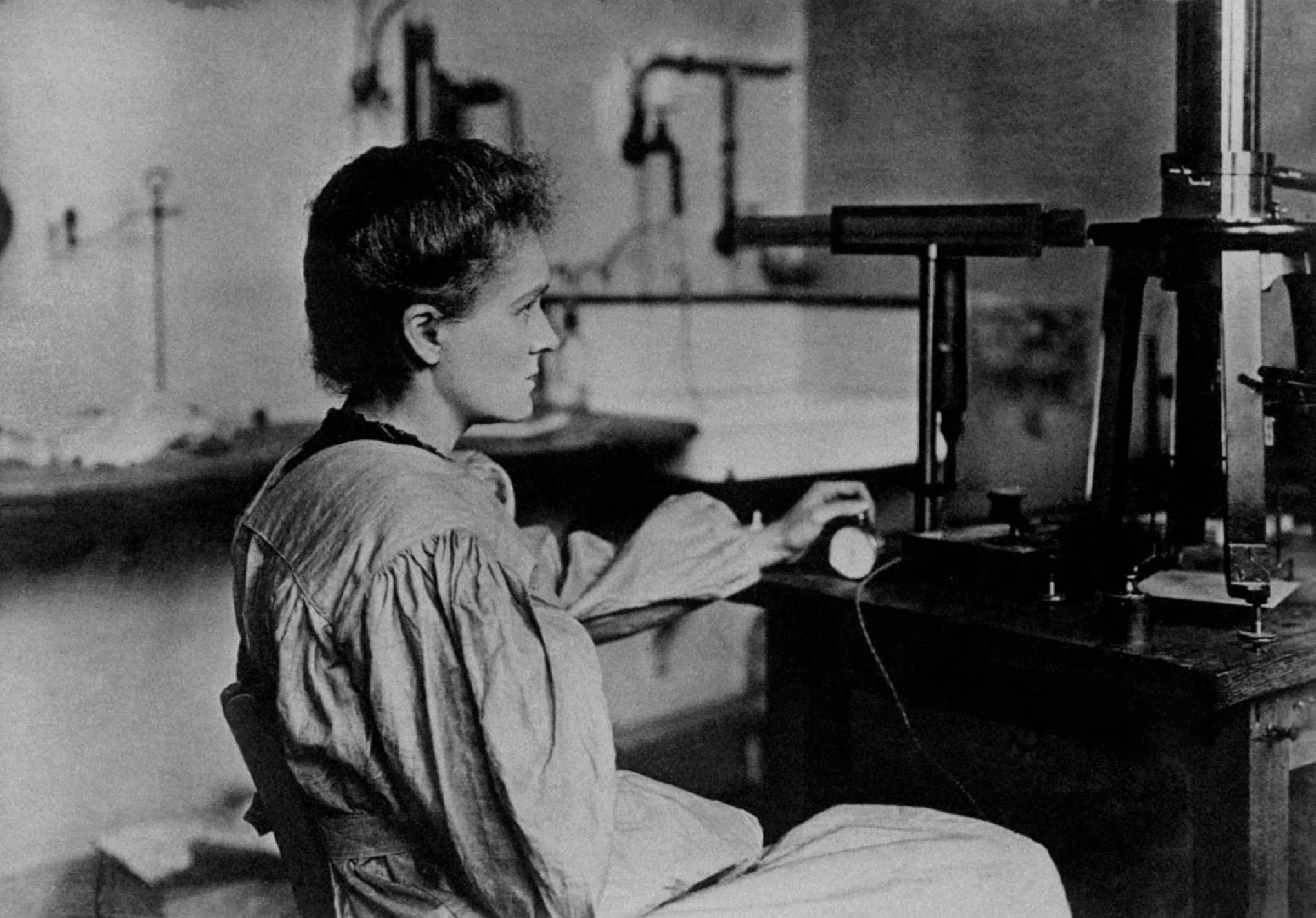
On 25 June 1903, Marie Curie stood before the examiners of the Sorbonne in Paris and defended a doctoral thesis on radioactive substances. She became the first woman in France to receive a doctoral degree. The thesis described work she had done in a leaking shed, with her husband Pierre, on a substance that glowed in the dark and that no one yet understood.
Within six months, that work would bring her a Nobel Prize. Within eight years, it would bring her a second.
She had arrived at the Sorbonne twelve years earlier with almost no money, a Polish name, and a determination that had already carried her through six years of work as a governess. She was twenty-four, and she had waited a long time to study.
A Childhood in Occupied Warsaw
Maria Skłodowska was born on 7 November 1867 in Warsaw, then part of the Russian Empire. Her parents were both teachers, and both believed in education. Her father taught physics and mathematics; her mother ran a girls' school.
The family lived under a Tsarist regime that was trying to stamp out Polish culture, and her parents' employment was precarious. Her father moved from job to job, and the family moved into smaller and smaller apartments.
When Maria was eleven, her mother died of tuberculosis. Her oldest sister had died of typhus not long before. The losses left their mark on the family, but they did not change her parents' conviction that their children should be educated.
Maria was a strong student, and she finished school at the top of her class. There was, however, no university in Warsaw open to a woman.
As a teenager, she made a pact with her older sister Bronisława, known as Bronya. Maria would work as a governess and tutor to support Bronya through medical school in Paris, and Bronya would then pay for Maria's studies. From the age of seventeen, Maria worked for six years in Polish households, teaching other people's children while studying in her spare time. She also attended secret classes of the clandestine Flying University, which taught Polish students in defiance of the Russian ban on Polish-language higher education.
The Move to Paris
In 1891, Bronya kept her part of the bargain, and Maria left for Paris. She enrolled at the Sorbonne, where she lived in a small attic room and often went short of food and heating. In 1893 she earned a degree in physics, graduating first in her class.
A year later she earned a second degree, in mathematics. She had intended to return to Poland, but there was no academic post for a woman there, and Paris held the work she wanted to do.
In 1894 she met Pierre Curie, a physicist working on crystals and magnetism. They married in 1895, in a civil ceremony, and Marie wore a dark blue dress that she continued to wear in the laboratory for years afterwards. Pierre was already an established scientist. What followed was a partnership in which the two of them worked side by side, in difficult conditions, on a problem that neither could have solved alone.
In 1896, Henri Becquerel discovered that uranium gave off mysterious rays. Marie Curie chose the phenomenon for her doctoral research. She found that the rays came from inside the atom itself, and she coined the word radioactivity to describe them.
She also found that a mineral called pitchblende was far more radioactive than its uranium content could explain. Something else inside the ore had to be producing the rays.
Two New Elements
Working in a draughty shed at the School of Physics and Chemistry in Paris, Marie and Pierre Curie processed tons of pitchblende residue. The work was slow, physical, and dirty. In July 1898 they announced a new element, which Marie named polonium, after her birth country.
In December 1898 they announced a second, radium, which was far more radioactive still. The Curies had found the elements by following the radiation itself, measuring it at each step of the chemical separation until only the unknown substance remained.
The discovery changed physics. It showed that atoms were not unchanging, and that energy could come from inside them. It also opened a new field of medicine, because radium's rays could destroy diseased tissue.
In 1903, Marie and Pierre Curie shared the Nobel Prize in Physics with Becquerel, for their research on the radiation phenomena Becquerel had discovered. French academics had originally proposed only Pierre and Becquerel; Pierre insisted that his wife share the honour. Marie Curie became the first woman to receive a Nobel Prize.
Pierre Curie was killed in a street accident in Paris in April 1906. Marie Curie took his place as professor of general physics at the Sorbonne, the first woman to hold the position. She continued the work alone, and in 1910 she isolated pure radium metal, a feat that required processing large quantities of ore to obtain a tiny amount of the element.
In 1911 she received a second Nobel Prize, this time in chemistry, for the discovery of radium and polonium and the isolation of radium. She remains the only person to have won Nobel Prizes in two different sciences.
The War and the Little Curies
When the First World War broke out in 1914, Curie had just become director of the new Radium Institute in Paris. She put her research aside. She knew that X-rays could help surgeons find bullets and broken bones in wounded soldiers, but the machines were large and fixed in hospitals, far from the front. She decided to make them mobile.
With money raised from wealthy friends and the Union of Women of France, she equipped cars with X-ray machines, darkrooms, and dynamos to generate power. French soldiers called the vehicles "petites Curies", little Curies. She learned to drive, and to repair the cars herself, and she went to the front with her seventeen-year-old daughter Irène as her assistant.
By the end of the war she had built a fleet of twenty mobile units, trained at least 150 women to operate them, and helped establish some two hundred radiological units in battlefield hospitals. Curie herself put the number of wounded soldiers X-rayed at about 900,000. She later wrote: "The use of the X-rays during the war saved the lives of many wounded men; it also saved many from long suffering and lasting infirmity."
The war years cost her health. She worked for long periods close to X-ray equipment, with little protection, and she carried the exposure with her for the rest of her life. She did not complain about it in public, and she continued to work at the Radium Institute after the war, directing research and training a generation of scientists. Her daughter Irène would go on to win a Nobel Prize in chemistry herself, with her husband Frédéric Joliot, in 1935.
The Cost and the Legacy
In 1921, Curie travelled to the United States, where President Warren Harding presented her with a gram of radium on behalf of the women of America, in recognition of her service to science. Radium was so rare and so expensive that a single gram represented years of work, and Curie, who had never patented her discoveries, could not have afforded it herself. She had given the knowledge away, and the world had used it.
Marie Curie died on 4 July 1934, at a sanatorium in Sallanches in the French Alps, aged sixty-six. The cause was aplastic anaemia, a failure of the bone marrow that her doctors linked to her long exposure to radiation. She had spent nearly forty years working with substances whose dangers were only gradually understood, and she had paid for that knowledge with her health.
Her legacy is not a single discovery but a field. Radioactivity became the foundation of nuclear physics, and of radiation therapy for cancer, which is still used today. The Radium Institute she directed became the Curie Institute, a centre for cancer research in Paris.
In 1995, her remains and Pierre's were moved to the Panthéon in Paris, the resting place of France's honoured dead. She was the first woman to be honoured there on her own merits.
She had begun as a girl in occupied Warsaw who was not allowed to attend university, and she had ended as the most decorated scientist of her time. The work was done in a shed, in a war, and in a laboratory she built herself. The two Nobel Prizes were the recognition. The science was the point.